

Aston Martin stands out as one of the most British among all British car firms, but the company assembled the 2009 Rapide in Graz, Austria, at a special facility, with Magna Steyr serving as the contract manufacturer. In a brochure aimed at future Rapide customers, Aston even referenced that special assembly facility, but they did so in just a paragraph on page 51 of the 60-page book. Elsewhere, the British company downplayed the Rapide, describing it as a 'high technology, low volume' model.
The factory in Graz could assemble up to 2000 Rapides per year, but that capacity wasn't realized as the demand waned. Instead, the company transitioned production back to Gaydon in the UK from the autumn of 2012, right before the launch of the Rapide S in early 2013. This shift means that a Gaydon-made Rapide has become the scarcest of this four-door model, which can reach 296 km/h (184 mph).
Audi V8L
Only 271 Audi V8L cars were manufactured, and the team at Steyr-Daimler-Puch made all of them in Austria in 1990. The Austrian firm stretched this car for those fortunate buyers who wanted to enjoy the extra room available in the rear, which resulted from increasing the wheelbase by 316mm. This luxurious limo seats two in the back and comes equipped with a host of high-end amenities, including plush leather seating, a fridge, and a mobile phone for convenience. The same powerful 247bhp 3.6-litre V8 engine used in the standard saloon was available under the V8L's bonnet, and it was later upgraded to a more robust 276bhp 4.2-litre unit in 1991. All models of the V8L proudly featured four-wheel drive and an automatic transmission for a smooth driving experience.
Austro-Daimler Prinz Heinrich
The firm originally sold imported German Daimler automobiles in Austria before it shifted its focus to the serious business of manufacturing its own vehicles, such as the massive 5.7-litre four-cylinder Prinz Heinrich model of 1911. By that time, Ferdinand Porsche was actively carrying out the automotive technical development for the firm, while also engaging in the design of aero engines. After the war, Austro-Daimler continued to build large luxury cars and maintained royal support, but the firm faced significant threats, and the narrowly engined, ordinary models were simply not enough to prevent its closure in 1931.
BMW Z4
BMW has manufactured Magna-built BMWs at its factory in Graz, Austria, in the past. The German giant first assembled the original X3 model there in 2003, before turning to Magna for the construction of the G30-generation 5 Series there starting in 2017. When the Z4 was launched in 2018, BMW again turned to Austria to produce one of its cars. Since then, this third generation Z4 has been built just as the previous BMW models have been – outside of the BMW plants in Munich or Dingolfing. The first generation Z4 was assembled in Spartanburg (USA), while the second generation was produced in Regensburg (Germany). The production of the Z4 model will be discontinued in March 2026.
Custoca
By the mid-1960s, the kit car scene was already well under way in the UK and US, so Gerhard Hller, recognizing the momentum, decided that there was no reason for Austria to be left behind. Living in Leoben, Hller took the initiative to develop his glassfibre body design in the form of the Hllar Strato, which was based on the VW Beetle floorpan, with the intention of selling completed cars to eager customers. However, the fibreglass body turned out to be quite poorly manufactured, prompting the company to finally decide to sell the kit instead. Nevertheless, the company produced 135 Stratos before it launched the Custoca beach buggy, which designers based on the iconic Ford GT40 and named the Hurricane; by 1971, this model had sold 100 units equipped with a range of powerful V8 engines. These models became best-sellers, contributing to the impressive total of 350 units sold of the Buggy Fun.
Denzel
Wolfgang Denzel began building his own wooden-bodied cars using a VW KdF Wagen floorpan, which had existed since the end of the Second World War, but he established that his own Denzel sports car represented a more complete operation. Like the early 356 Porsche, it boasted a low profile, and everything about it was sleek and smooth. The Dedge sported a VW Beetle floorpan, but, similar to the VW-engined Porsche, it eventually transitioned to a bespoke design crafted for performance. Denzel built a series of his own fully tuned VW flat-four engines, which produced as much as 86bhp from a 1.5-litre engine. However, the roadster achieved overall victory at the 1954 Alpine Rally in a nimble 1.3-litre car, and approximately 300 Denzel sports cars were manufactured before the firm folded in 1960.
FAQ's
1. What are some of the most iconic cars manufactured in Austria?
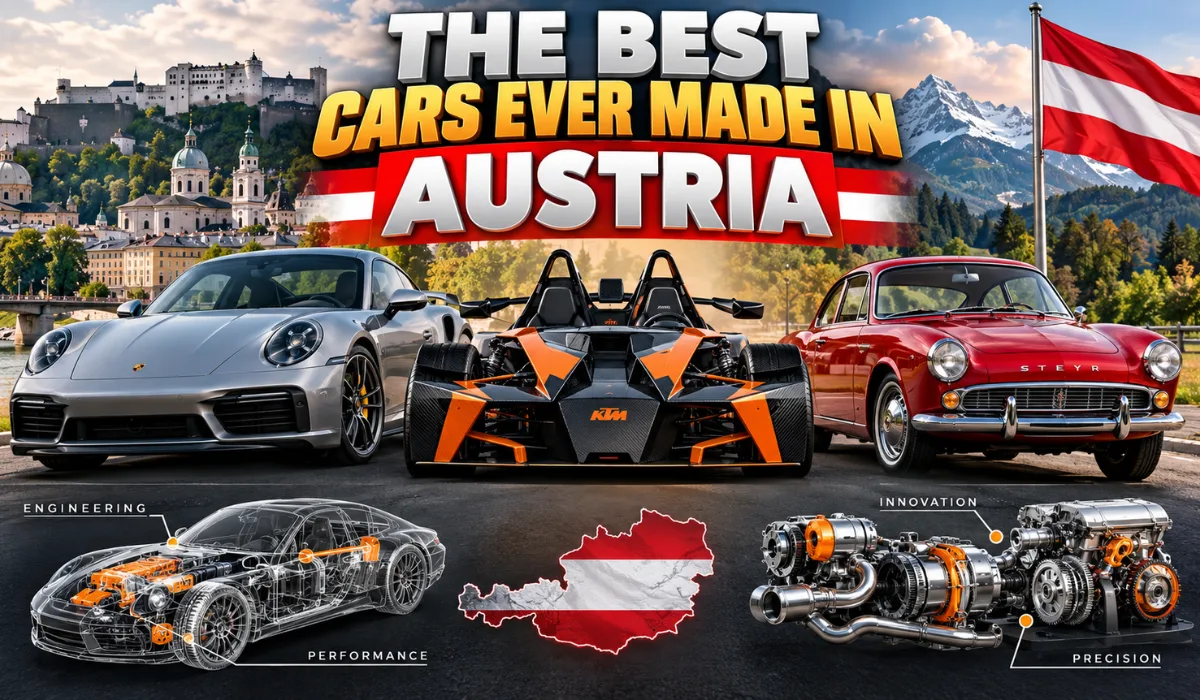
Key historical and modern vehicles include early Porsche 356 models built in Gmünd, the rugged Steyr-Puch Haflinger and Pinzgauer off-roaders, and performance track cars like the KTM X-Bow.
2. Did Porsche have production roots in Austria?
Yes. Following World War II, Porsche relocated design and production to Gmünd, Austria, where the first aluminum-bodied 356 Coupes and Cabriolets were hand-built before returning to Stuttgart.
3. What famous global cars are built by Austrian contract manufacturers?
Contract manufacturing giant Magna Steyr in Graz has built numerous renowned international vehicles, including the Mercedes-Benz G-Class, BMW Z4, Jaguar I-Pace, and Toyota GR Supra.
4. What makes the Steyr-Puch Haflinger and Pinzgauer special?
Developed by Steyr-Daimler-Puch, these lightweight, ultra-capable utility vehicles became legendary for their exceptional four-wheel-drive performance, air-cooled engines, and unmatched off-road endurance.
5. Are there modern high-performance supercar brands native to Austria?
Yes. Brands like KTM with the carbon-fiber X-Bow and Tushek with lightweight hypercars like the TS 900 Apex represent modern Austrian automotive engineering focused on extreme track performance.