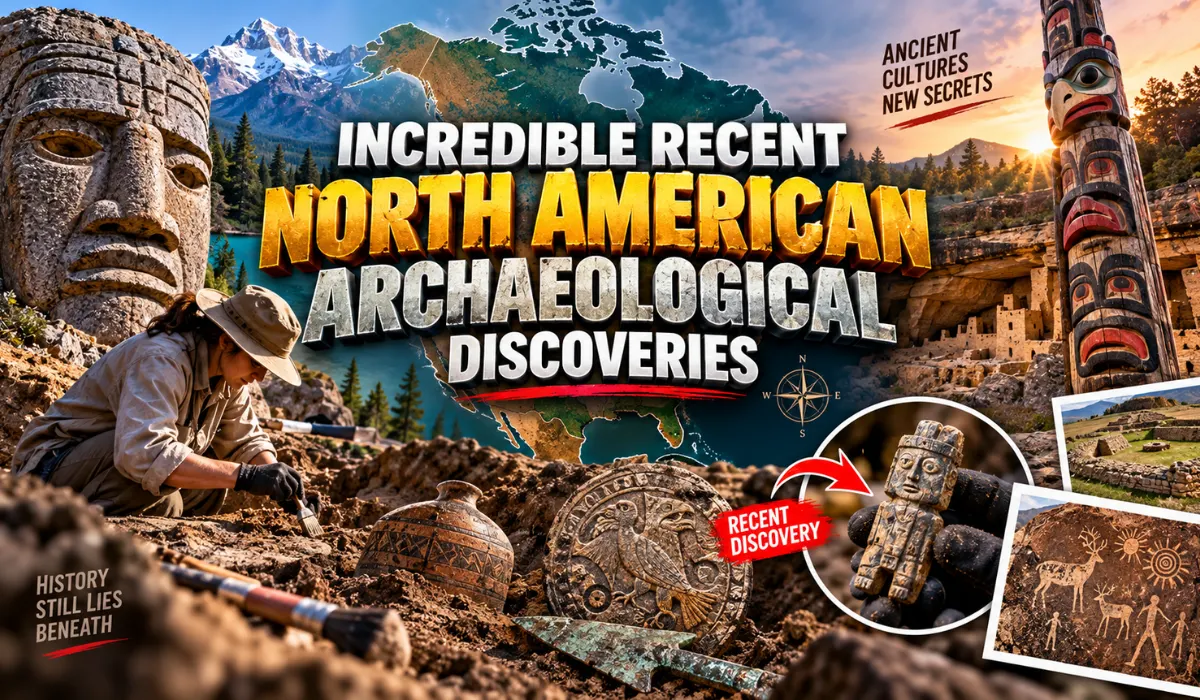
Nothing beats the suspense that archaeology brings, especially when you know you are about to turn up another spadeful of earth that will reveal the unexpected. For a couple of years, archaeologists have been enjoying quite the spree in terms of amazing finds right across North America. Some experts discovered these treasures while attempting to put new research towards old sites; other times, thorough excavations over months or years uncovered hidden gems, while a small few were stumbled upon purely by sheer chance.
Fossilized footprints, White Sands National Park, New Mexico, USA
Researchers have known about ancient tracks at White Sands since the turn of the 20th century; however, last year scientists determined using seeds found in the tracks that the tracks are 21,000 years old (which makes them the oldest human tracks known). Some experts believe the testing methods are not valid; however, no experts disagree that very ancient humans, mainly youngsters and children, made them. Further dating tests in 2025 also dated the tracks to 21,000 B.C.
Mayan neighborhood, Tikal, Peten, Guatemala
Examining laser scans of Tikal (a vast Maya city), archaeologists investigating the area of natural, rolling hills within and nearby a settlement noticed something: the shape of an uncharted section of the city. When they meticulously mapped the neighborhood, they discovered that the buildings themselves were miniature replications of the citadel at the old city of Teotihuacan, an area more than 600 miles to the west. The information that archaeologists discovered appears in a 2021 publication and testifies to substantial interaction.
St Mary’s Fort, St Mary’s City, Maryland, USA
Colonial Maryland began in 1634 when a party of English settlers established a fort. However, historians lost the exact location to history, as the fort remained in use for less than 7 years. Researchers discovered that we had been searching for it in the wrong place all along. Instead of being located next to the river as previously thought, a geophysical survey guided the archaeologists towards a plateau situated 1000ft from the water's edge. In 2021, archaeology teams discovered buildings of wooden construction and some coins, definitively proving that they had now successfully found the fort.
Bonebed, Dinosaur Park, Maryland, USA
For well over one hundred years, researchers have uncovered fossils from this part of Maryland – it's Dinosaur Park. In Spring 2013, scientists discovered the newest 'bonebed'—a fossiliferous layer containing multiple species. A three-foot-long tibia was identified as being from an Acrocanthosaurus—the third biggest meat-eater that there was. JP Hodnett, program coordinator, stated that "this is the sort of thing that paleo's dreams are made of."
La Union, Gulf of Mexico
In 2020, maritime archaeologists established off Mexico's north coast that a sunken paddle steamer was, in fact, a slave ship; every month for decades, the infamous 'La Union' carried dozens of Mayan slaves to work Cuba's brutal sugarcane plantations. She sank after her boilers exploded in 1861, but nobody can say how many slaves perished on that final voyage because they were listed as cargo, not passengers.
Dyar Mound, Lake Oconee, Georgia, USA
Dyar mound sits at the bottom of a reservoir that the 1970s created for the purpose of supplying Georgia with water. Even before the reservoir filled, excavators discovered that someone abandoned it in 1540 after the settlement of Spaniards whose diseases swept through the area and decimated the population. Researchers went through samples of charcoal in 2020 to reevaluate previous findings: they say that the mound’s inhabitants performed rites on it as long as 150 after the arrival of the Spaniards so the local Mississippian culture did not disappear quite as rapidly as they thought it did.
Chinatown pigs, Los Angeles, California, USA
Archaeologists retested the pig bones exhumed from the remnants of the city's first Chinatown in 2002. Scientists applied new tests to the plaque on the teeth which revealed the pigs consumed rice husks and leaves but no corn suggesting the pigs were being kept within the community and not being run out on the rural farm. Historians now use evidence in this case to trace an undiscovered practice - the business of pig farmers operating in their own yards, typically Chinese migrants facing prejudice - and its contribution to the booming Los Angeles at the dawn of the 20th century.
Jaguar burial, Templo Mayor, Mexico City, Mexico
Aztecs revered the jaguar and also included it in representations of the god Tezcatlipoca. In 2002, archaeologists discovered one cat (a jaguar) buried in Temple Mayor, Mexico City, and they found its skeleton interred with a spear in its claw, surrounded by 164 starfish. The weight of the soil helped preserve the starfish, and it was clear to the archaeologists that they had likely selected the chocolate chip variety for its brown spotting and the similar appearance of the orange color to the jaguar's fur.
Dugout canoe, Lake Mendota, Wisconsin, USA
During the process, an incident unfolded in the scuba diving field when a scuba diving instructor discovered a carving on a log, along with a similar object that the same diver had found the year before, making him the first one to do so; immediately, maritime archaeologists identified the object as a dugout canoe, which turned out to be the oldest one in the Great Lakes, discovered in the same year.
The boat was carved out of an oak tree and it had been dredged from the sand in the lake, after which it underwent conservation aimed at preserving the waterlogged wood. Through carbon-14 data, radiocarbon dating indicates that the canoe belongs to the period around 1000 BC, which means it predates the previously discovered log by over 1,000 years.
FAQ's
What are some of the most profound recent shifts in North American archaeology?
Recent breakthroughs have heavily focused on pushing back the timeline of human arrival in the Americas. Groundbreaking excavations at sites like White Sands National Park in New Mexico have uncovered fossilized human footprints reliably dated to around 23,000 years ago during the Last Glacial Maximum, fundamentally challenging the long-held Clovis-first model which argued humans only arrived about 13,000 years ago.
How is advanced technology changing discoveries across North America?
Light Detection and Ranging (LiDAR) technology has revolutionized archaeology by allowing researchers to digitally "strip away" dense forest canopy and modern overgrowth. In places like the southeastern United States and Mesoamerica, aerial laser scanning has revealed vast, hidden networks of ancient settlements, earthwork mounds, and agricultural infrastructure that were previously invisible from the ground.
What have recent underwater and coastal excavations revealed?
Submerged landscape archaeology along the continental shelves—particularly off the Pacific Northwest and the Gulf of Mexico—has yielded remarkably preserved stone tools and camp debris. Because ancient sea levels were much lower during the last ice age, many early human migration routes and coastal settlements are now underwater, providing pristine artifacts sealed in sediment that offer a rare look into maritime hunter-gatherer lifestyles.
How are ancient Indigenous structures being reinterpreted with modern science?
Monumental earthworks and mound complexes, such as those at Cahokia in Illinois, are being analyzed with high-resolution geophysical survey methods, soil core sampling, and archaeoastronomy. These modern techniques show that these ancient urban centers were far more populous, highly engineered, and socially complex than previously understood, featuring sophisticated sanitation, massive plazas, and precise alignment with celestial bodies.
Why are recent discoveries in North America so heavily debated by researchers?
Discoveries that challenge established timelines—such as deeply buried lithic tools or disputed bone modifications dating back 20,000 to 30,000 years—naturally face intense scientific scrutiny. Archaeologists require flawless stratigraphic contexts and multiple independent dating methods (like radiocarbon and optically stimulated luminescence) before rewriting history books, which leads to rigorous, ongoing academic debate over every new early site.