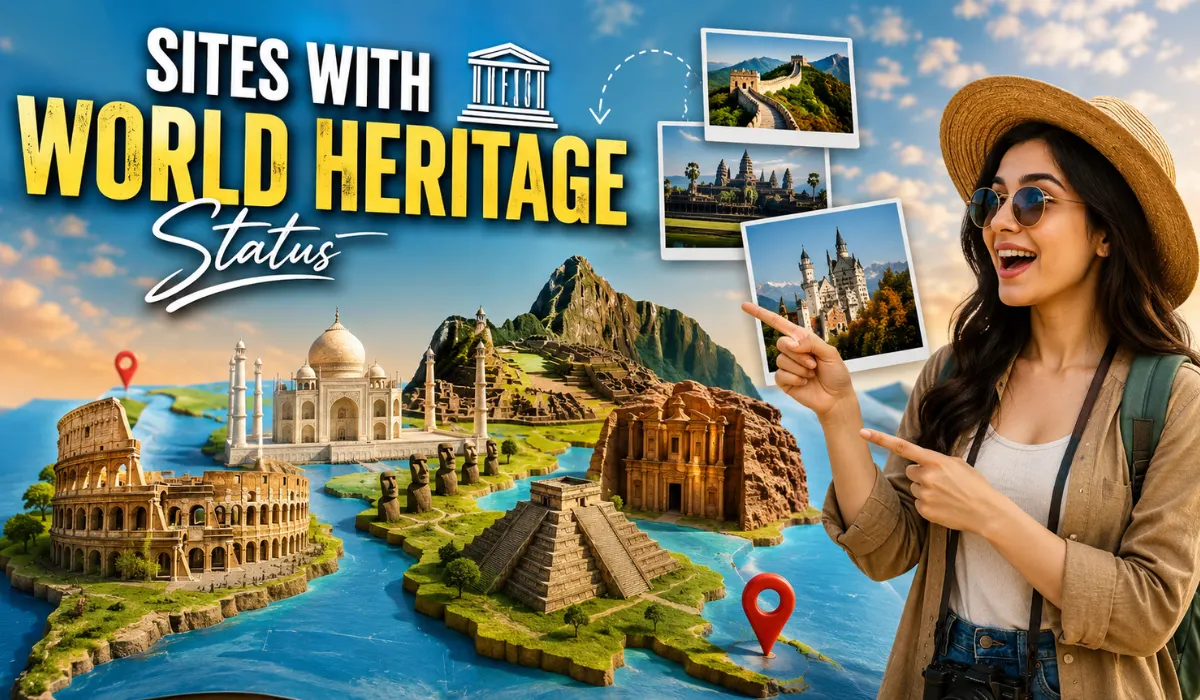
Most years since 1978, UNESCO has been adding to the long list of natural and cultural treasures at its disposal that form part of the World Heritage List. In order to protect the marvels and sites, authorities grant the name World Heritage so they might be protected from the effects of climate change and the effects of man and at the same time to spread the understanding of the sites' unique significance to all people, to share. Here's a look at the world's most remarkable sites added to the World Heritage Site since we decided to look back and our favorites that made the cut in 2024.
Beijing Central Axis, China
Carving north-to-south through the ancient heart of China’s capital, the builders of the Beijing Central Axis designed it to stretch for barely five miles (7.8km) between the Drum and Bell Towers at one end and Yongding Gate (pictured) at the other. Beginning in the Yuan Dynasty (AD1271-1368), the construction of the road connects many of the most awe-inspiring imperial structures of Old Beijing, including former palace grounds, gardens, and significant sites of sacrifice and ceremony. Designers purported that the Central Axis demonstrates an ideal urban design, as laid out in Kaogongji, otherwise referred to as the Book of Diverse Crafts, and between its significance, it became one of only six sites added to the UNESCO World Heritage list in 2024.
The Flow Country, Scotland, UK
Located in the Scottish Highlands, the Flow Country also joined UNESCO’s catalogue in 2024. It represents the first time a peatland landscape has been inscribed to the World Heritage List and is the world’s most intact and extensive blanket bog system. Speckled with dark pools and a host of unique natural features not found anywhere else on the planet, the peatland bogs of the Flow Country have been actively accumulating for the past 9,000 years. Peatlands are some of Earth’s most important ecosystems as they store carbon.
Ivindo National Park, Gabon
Lying across, the 300,000-hectare Ivindo National Park, with a lattice of blackwater rivers running through it, is one of Gabon's most stunning and rich areas. Home to critically endangered animals such as forest elephant and the extremely threatened slender snouted crocodile, it has to be up there. 'The Chutes de Kongou', the series of spectacular waterfalls which drop over 164 feet (50 m), are its biggest draw, and nowhere else can you get so close to such tremendous power without a tremendous distance on all sides; the world does seem much larger.
Hegmataneh, Iran
Hegmataneh – Iran the newest among the newly added World Heritage Sites is Hagmatana of Iran as an “outstanding and unique” testimony to the Median civilization; the Iranic Peoples, known as the Medians, made the city the capital of their empire and resided there for almost three millennia from the 7th to 6th centuries BC as their administrative seat that became an important summer capital of Achaemenid, Seleucid, Parthian, and Sasanian rulers. It is the site of the ancient city called Ecbatana which is located outside of the current city of Hamadan.
Deer Stone Monuments and Related Bronze Age Sites, Mongolia
Decorated stags, etched onto stones in the Khangai Ridge area of central Mongolia, chronicle a history of nomadic peoples during the late Bronze Age, across Eurasia. Between 1200 BC and 600 BC, when they assumed to have placed on site, such monuments designated ceremonial/funerary by virtue of the existence of associated burial mounds (khirgisuurs), with their abundant evidence of mass human sacrifice (i.e. Sacrificial altars). Such stag stela's (monuments) are the most substantial remains to survive from this culture.
Hopewell Ceremonial Earthworks, Ohio, USA
Dating from 2,000 to 1,600 years ago and constructed along the Ohio River, the Hopewell Ceremonial Earthworks stand as Ohio's only UNESCO World Heritage Site. The Hopewell ceremonial earthworks consist of a group of eight square, octagonal, and circular enclosed earthen mounds that Native Americans built as a sacred space and social assembly hall with impressive geometric precision. This monument, which experts accurately positioned to align with the solar and lunar calendars, served important roles for spiritualism and festivities.
Cold Winter Deserts of Turan, various
Ten things to know about Central Asian Desert Only one of the two new sites added this year to the World Heritage List at this year’s Committee Session, the fourteen detached parts in remote steppes areas of Kazakhstan, Turkmenistan and Uzbekistan in Central Asia compose the property as a severe desert. This remote land in the temperate regions is between Caspian Sea and Turanian High Mountains, experience extremely frigid cold in winter and scorching summers! Nevertheless, it provides shelter to a host of hardy animal and plant species that adapted well to the extreme environmental conditions within its numerous desert ecosystems.
FAQ's
1. What is a World Heritage Site?
A World Heritage Site is a landmark or area with legally protected status by the United Nations Educational, Scientific and Cultural Organization (UNESCO) because it has cultural, historical, science-based, or other forms of significance.
2. Who decides which places get World Heritage status?
The World Heritage Committee, which consists of representatives from 21 state parties elected by the General Assembly, evaluates nominations and decides which sites are inscribed on the World Heritage List.
3. How many types of World Heritage sites exist?
There are three distinct categories: cultural sites such as ancient ruins and monuments, natural sites featuring unique ecological and geological formations, and mixed sites that display significant elements of both culture and nature.
4. Can a World Heritage site lose its status?
Yes, the World Heritage Committee can remove a site from the list if its defining characteristics and outstanding universal value are severely degraded or destroyed due to lack of management, war, or natural disasters.
5. What are the primary benefits of receiving this status?
Inscribed sites gain access to the World Heritage Fund for emergency conservation assistance, heightened international recognition, increased tourism potential, and a legal obligation for governments to protect them for future generations.