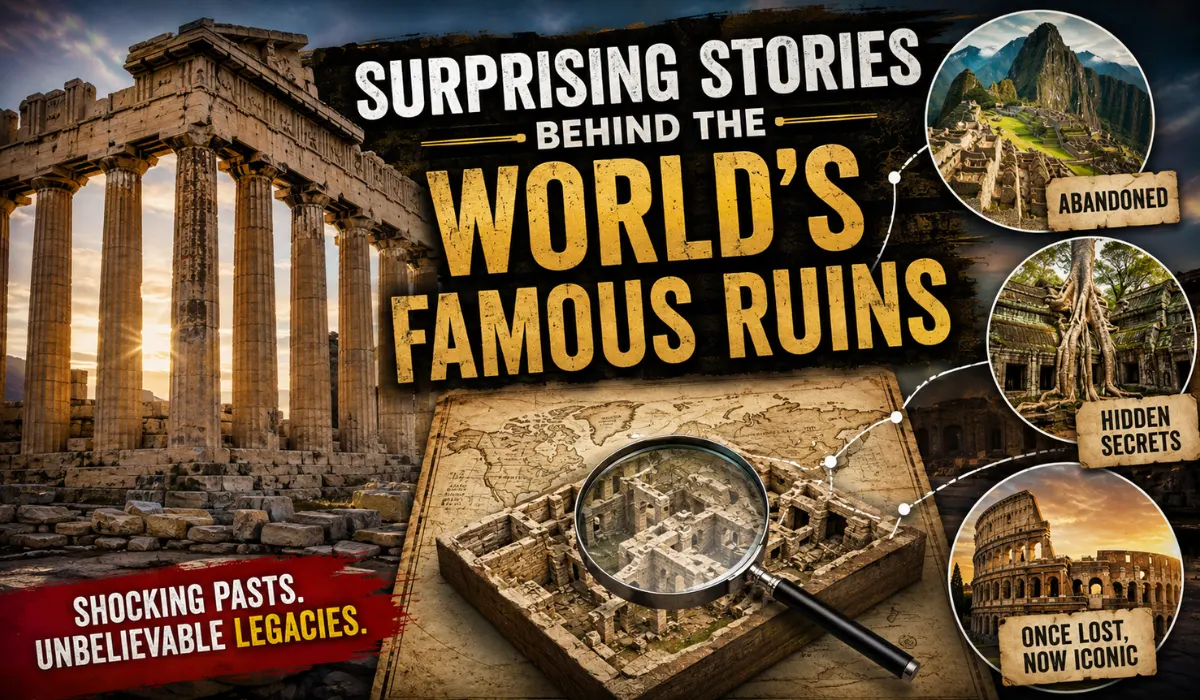
World heritage sites and buildings, some of which date back to centuries, if not thousands of years, represent some of the top tourist attractions in the world. Visitors experience the history of these magnificent sites during their peaks when they served as a temple or government structure or army fortress. However, if they are still around today, how did it fare overtime?
Colosseum, Italy
Also, the Flavian Amphitheater, the Colosseum is probably the most famous of all surviving monuments of ancient Rome, a multistory arena capable of seating 50,000 spectators or more during its most populous period. In 80 AD when the builders finished the building, Roman Emperor Titus held games in the arena for 100 days straight. This bloodbath became standard practice for the next four centuries of gladiatorial combat, animal hunts, battle reenactments, and even mock naval battles that would necessitate flooding the entire Colosseum.
Colosseum, Italy
After the Western Roman Empire collapses, the Colosseum falls out of favor in great decline. The arena eventually becomes housing, workshops, and even a cemetery before two noble Roman families attempt to fortify it unsuccessfully. The Colosseum falls into disrepair where an earthquake sends an entire chunk of the outer wall crumbling down. It essentially becomes a giant quarry where builders siphon off stones for building purposes. Much of the marble goes towards one particular monument in the city, a local one. It ends up in St Peter’s Basilica.
Luxor Temple, Egypt
Luxor lies in Egypt and is described as ‘the world’s greatest open-air museum’ due to two major archaeological sites – Karnak and Luxor Temple. One of the latter two temples, built in about 1400 bc and expanded and modified throughout the centuries by pharaohs such as Amenhotep III, Tutankhamen, and Ramesses II, became one huge sacred site by the Nile. Even non-Egyptian ruler Alexander the Great also contributed to it. Located at one of Egypt’s most prominent cult centre, Luxor, or the Southern Sanctuary as it was sometimes known, held the most vital position among them in the entire ancient world.
Luxor Temple, Egypt
For some time, worshippers occupied parts of the Luxor complex for the worship of non-Egyptian deities, and today, we can find the remains of what were Christian churches. Perhaps one of the most curious aspects of the Luxor temple is the 12th or 13th century Mosque of Abu Haggag, which now stands at one side of the complex. It is likely that when builders constructed the mosque, a large part of the temple complex lay below ground, forming the foundations on which the Mosque was built, from which archaeologists subsequently excavated the ancient structure.
Palace of Versailles, France
No ruler embodies more the concept of absolute monarchy than the French King Louis XIV; his reign lasted 72 years from 1643 to 1715, and nowhere was his absolute power and extravagance felt more than at the Palace of Versailles. Originally a hunting lodge belonging to his father situated on the outskirts of Paris, he transformed it into an enormous royal palace that spread out towards the horizon. The finest gem in the crown of Versailles was the Hall of Mirrors: a magnificent hall seventy meters long and containing large windows on one side, hundreds of mirrors on the other to make every space glitter.
Palace of Versailles, France
Despite not falling to the French Revolution, and even acting as a temporary house for Napoleon, it would experience new military uses in the 19th and 20th centuries. During the Franco-Prussian war of 1870-1, the German army occupied the palace, and in the Hall of Mirrors, the German Empire was declared, with the German Kaiser at its head. The peace treaty that concluded World War One, after long periods of negotiations in Paris, was also eventually signed in the Hall of Mirrors.
Masada, Israel
But Masada is about much more than just a stronghold perched on a cliff edge in the expansive Judaean Desert. Historians widely consider it a symbol of Jewish defiance and liberty; the Jewish rebels made their final stand against the might of Rome here in AD 73, following an epic and bloody siege. Many say that the defenders ultimately chose suicide over surrendering – although some historians remain skeptical of this account – and you can still see the siege ramp that the Romans constructed after their victory, which has been preserved throughout the years.
Masada, Israel
Despite being most famous for monuments created by Herod the Great, King of Judea between 37-4 BC, builders constructed a Byzantine church from the 5th-6th century on the cliffs. It was the last site to be inhabited and in the 20th century, Masada (or Mossada, as it can also be written) became a national pilgrim site for the Jews; today people must undertake a demanding mountain climb to see the site, or they can opt to ascend using the simple but more effective cable car system, at the summit one can see Herod's palaces, Roman bathhouses, and the church from times past.
FAQ's
Why was Machu Picchu actually built?
Long believed to be a lost military stronghold or a sacred religious retreat, modern archaeological research and historical analysis suggest it was built as a grand royal estate for the Inca Emperor Pachacuti around 1450 CE. It functioned as a private resort where the ruler and his nobility could entertain guests, conduct rituals, and manage agricultural experiments away from the capital of Cusco.
Did anyone actually live in the Colosseum after the Roman Empire fell?
While its days as a venue for gladiatorial games ended in the early medieval period, the Colosseum was far from abandoned. Over the centuries, its massive structure was repurposed into housing, workshops, a Christian shrine, a limestone quarry, and even a fortified castle for powerful Roman noble families during the 12th and 13th centuries.
How did the ruins of Pompeii manage to stay so remarkably preserved?
The sudden eruption of Mount Vesuvius in 79 CE buried the city not in molten lava, but in a thick, suffocating blanket of fine volcanic ash and pumice. This airtight seal protected buildings, everyday objects, and organic matter from the elements and scavengers for nearly 1,700 years, effectively freezing a single afternoon in ancient Roman history until excavations began in the 18th century.
Were the Moai statues of Easter Island always headless or isolated?
When the Rapa Nui people carved and erected the iconic monolithic statues, they were not bare stone; their eyes were inlaid with coral and red stone, and many featured giant red stone cylinders called pukao on their heads, which represented topknots or hair. Furthermore, nearly all of the statues were originally placed on stone platforms (ahu) facing inland to watch over and protect the island's ancestral villages, rather than staring blankly out toward the ocean.
Why was Angkor Wat abandoned by the Khmer Empire?
The vast temple complex was never completely forgotten or lost to the jungle, as local Buddhist monks continuously maintained parts of it over the centuries. However, the surrounding metropolis of Angkor was gradually deserted in the 15th century due to a combination of severe, prolonged droughts followed by devastating monsoonal floods that crippled the city's complex hydraulic infrastructure, alongside shifting regional trade routes and political instability.