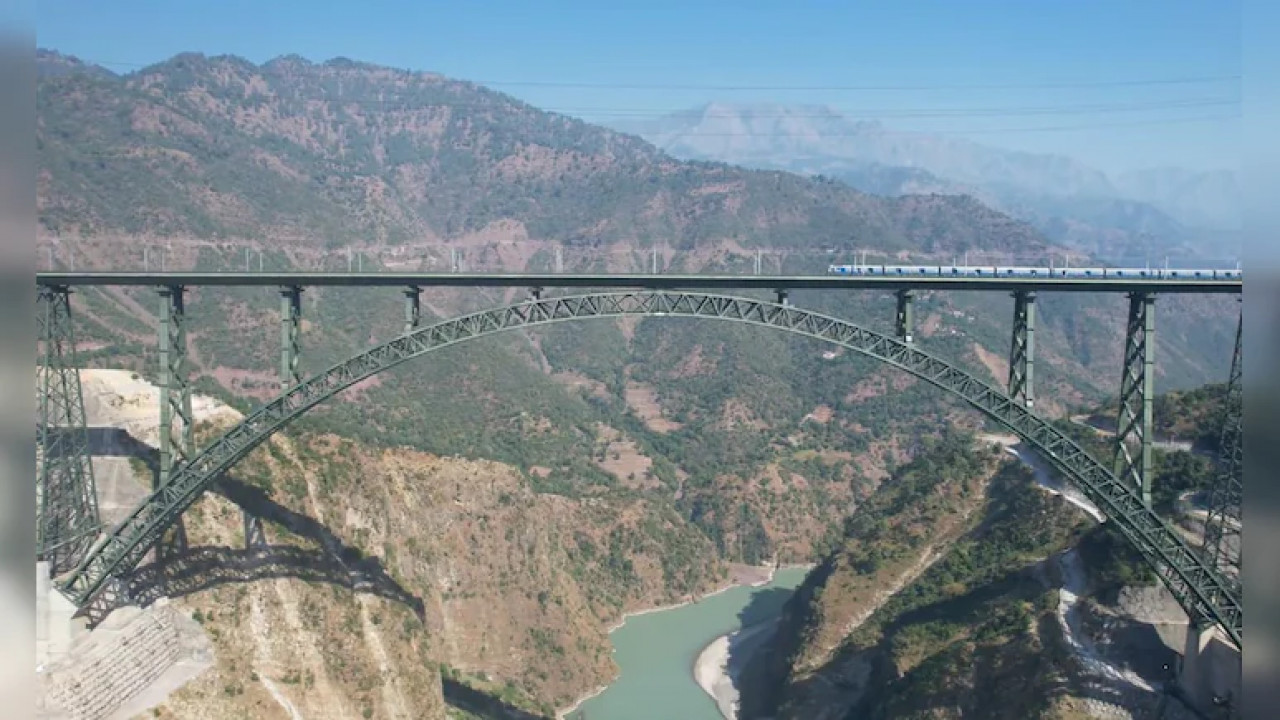
National News: Prime Minister Narendra Modi will dedicate to the nation the world's tallest railway bridge, the Chenab Rail Bridge, built on the Chenab River in Jammu and Kashmir on June 6. This bridge will not only connect the Kashmir Valley with the rest of India but will also revolutionize the trade, tourism, and industrial development of the region. This amazing marvel of engineering is built at a height of 359 meters, which is 35 meters higher than the Eiffel Tower in Paris.
An example of engineering: technology and strength
This bridge, an important part of the 272 km-long Udhampur-Srinagar-Baramulla railway line, has been built at a cost of Rs 1486 crore. Its design is such that it can withstand winds of 266 kilometers per hour and is also capable of withstanding the strongest level of earthquake up to 8. This bridge has 28,000 metric tons of steel and more than six lakh bolts, which can be gauged from its strength and durability. The length of the bridge is 1315 meters, and it has 17 spans.
PM 6 - . . 359 , . … pic.twitter.com/XkKrRuSe0Z
— NDTV India (@ndtvindia) June 4, 2025Revolution in connectivity: reduction in travel time
The construction of the Chenab Bridge will reduce the distance and travel time from Katra to Srinagar by about three hours. This will greatly facilitate the residents and travelers of the valley in commuting. The first trial run on the bridge was successfully conducted in June 2024, and the trial of the Vande Bharat train was also completed in January 2025. These steps are big steps towards better connectivity in Jammu and Kashmir.
Development of extensive rail network in Jammu and Kashmir
Under this project, 17 stations have been built on a total rail route of 272 km. It includes 36 tunnels, with a total length of more than 119 km. The longest tunnel among these is the 12.77 km long T-50 tunnel. This rail network has also been 100% electrified, making it modern and sustainable from the environmental point of view. This step will prove to be helpful in achieving Prime Minister Modi's 'zero carbon emission' target.
Trade, tourism and security will get a new direction
The expansion of rail connectivity will greatly benefit religious and cultural tourism in Kashmir. Major sites like Kheer Bhawani Temple, Martand Sun Temple, and Amarnath Yatra will now be easily accessible. Apart from this, four cargo terminals between Banihal and Baramulla will help in transporting local products like apples, dry fruits, handicrafts, and pashmina shawls to the markets. From a military point of view also, this rail link will ensure fast supply to the border areas, thereby strengthening national security.