But not all eccentric means of transit used wheels. A practice renowned in France involved shepherds and farmers of the Landes, an area in the southwest part of the country, crossing the soft, wet land on long pairs of wooden stilts. These elevated, slender supports also served to give them a higher view above their grazing sheep and enabled them to traverse the ground fairly quickly. As the roads improved and the area was drained in the nineteenth century, the reasoning behind this type of motion began to disappear.
Sedan Chairs Turned People into Passengers
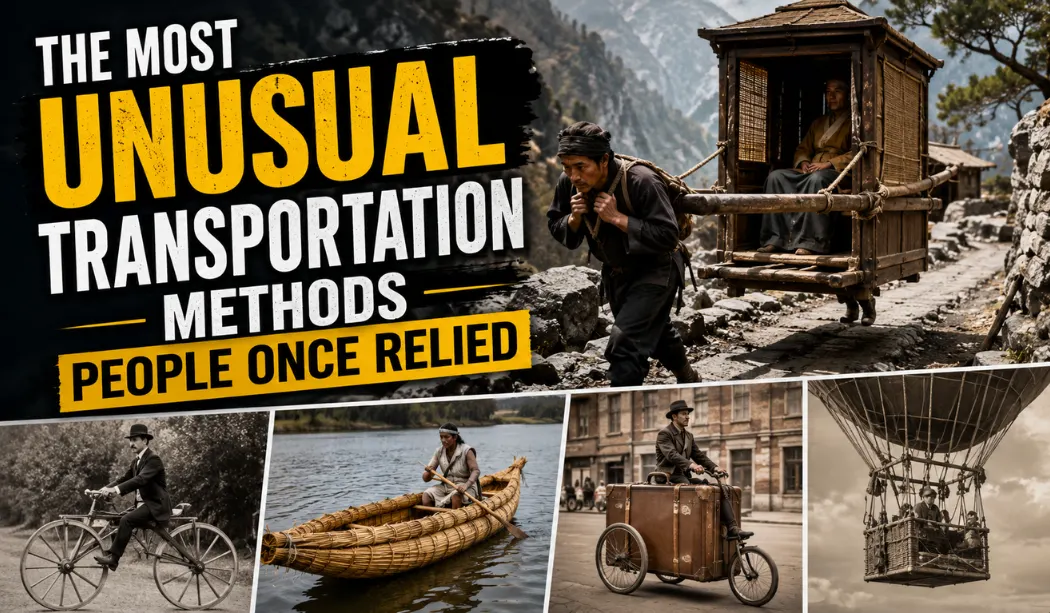
Before the advent of the taxi, rich visitors in many Asian and European cities would hire sedan chairs. A sedan was an enclosed chair that two or more porters picked up on the end of poles and carried a passenger through a town of people. The technique was most suitable for towns with few streets wide enough for coaches to navigate and the practice survived in many regions until the latter half of the 19th century.
Coracles Floated Across Rivers with Ease
More akin to a basket than a boat, the coracle nonetheless ferried people throughout Britain and parts of Asia for centuries. Artisans, working with light, wooden frameworks, stretched hides-or later, canvases-over this sturdy shell to develop an astonishingly lightweight boat that fishermen wore on their back into the water.
Dog Sleds Kept Entire Communities Connected
Before snowmobiles, Indigenous peoples used dog sleds as the primary means of transportation in the Arctic. Sled dogs, trained to pull sleds over snow and ice, proved instrumental for Indigenous peoples who transported their entire households, hunting gear, and goods. Even in Alaska's earliest years, people hired dog teams to carry their mail from place to place. Dog sledding then mostly gave way to aircraft but still retains a strong cultural practice among Indigenous peoples.
Reindeer Pulled Travelers Across the Far North
Norlands Smi people used reindeer for transport long ago. Reindeer as sled transport was the family means of communication. The reindeer perfectly suited as transport for those who came in snow country because the family's other animal, the horse, couldn't get around. If something had to be brought during their seasonal movements to a different location, the reindeer could bear anything. It didn’t get better for the transport animal during harsh conditions than the Sami dog, not even though other of the herd went on the journeys when something important was to be communicated or delivered.
Camels Became Ships of the Desert
Camels made travel through some of the world's fiercest deserts possible. Their long endurance on no water provided travelers with a way to move goods across great portions of the Sahara Desert and into the deserts of Arabia. For centuries, camel caravans served to join some of the major trade routes together. Some cities' prosperity even depended upon how well they supported the passage of those great creatures where even wheeled vehicles could not follow.
Llamas Became the Andes' Pack Specialists
Horses did not exist in the empire of the Incas before the arrival of the Europeans. However, llamas provide an important form of transport for carrying goods. The llamas are robust and could carry provisions along difficult trails that large beasts could not navigate. They cannot transport men; however, they transport foods, woven clothes, and precious materials. This fact makes the trade possible through the Andes.
Yak Caravans Crossed High Mountain Passes
The life of the Himalayas required transportation that could navigate the low altitude and difficult countrysides. Between communities that often lie many miles apart, the yak's sturdy shoulders carried everything from grain to wool to salt. With their thick fur coats and sturdy build, these animals could survive a climate that very few others could endure, providing the most necessary transport that aided the entire region.
Toboggans Slid Across Frozen Landscapes
Very basic toboggans of wood found use wherever northern North America experienced snow. Indigenous peoples loaded furs onto them and carried other goods across snow without the wheels of wagons getting buried in deep snow. Fur traders put their sleds to work carrying their long treks in the winter snow, as sleds could be pulled very easily with few materials for traveling in the woods.
Ice Boats Raced Across Frozen Lakes
Sometimes, winter provided opportunities for transport rather than hardship. The people utilized ice boats propelled by sails that employed runners of metal. These ships could swiftly cut across the surface of any frozen lake, efficiently carrying mail, people, and cargo; when conditions allowed, these ships operated faster than horse-powered transports.
FAQ's
1. What was the "Lartigue Monorail," and how did it work?
Built in the late 19th century (most famously in Ireland), the Lartigue Monorail was an elevated single-rail track where trains straddled the rail like a saddle on a horse. To keep the train balanced, passengers and freight had to be evenly weighed and distributed on both sides before departure.
2. How did people travel down snowy mountains in Madeira before cars?
They used Tobogganing Wicker Sleds (Carreiros). Starting in the 1850s on the island of Madeira, residents used two-seated wicker baskets mounted on wooden runners to slide down steep, slick roads. Two drivers running alongside guided the sleds using rubber-soled boots as brakes.
3. What was "Pedestrianism," and why was it treated like a sport?
In the 18th and 19th centuries, before reliable long-distance transit, Pedestrianism was extreme competitive walking. Endured as both a daily reliance and a major spectator sport, "pedestrians" would walk hundreds of miles over consecutive days, drawing thousands of betting fans to arenas and roadsides.
4. Were dogs ever used as draft animals for commuter transit?
Yes. Throughout the 19th century in parts of Europe (especially Belgium, France, and the Netherlands), Dog Carts were a primary mode of transit for milk deliveries, small farm goods, and personal transportation. They were widely relied upon by poorer merchants until animal welfare laws phased them out in the early 20th century.
5. What was the "Atmospheric Railway"?
Engineered by Isambard Kingdom Brunel in the 1840s, this short-lived British train system used pneumatic pressure rather than onboard steam engines. Pumping stations along the track created a vacuum inside a central pipe, sucking a piston attached to the train to pull it along the rails.