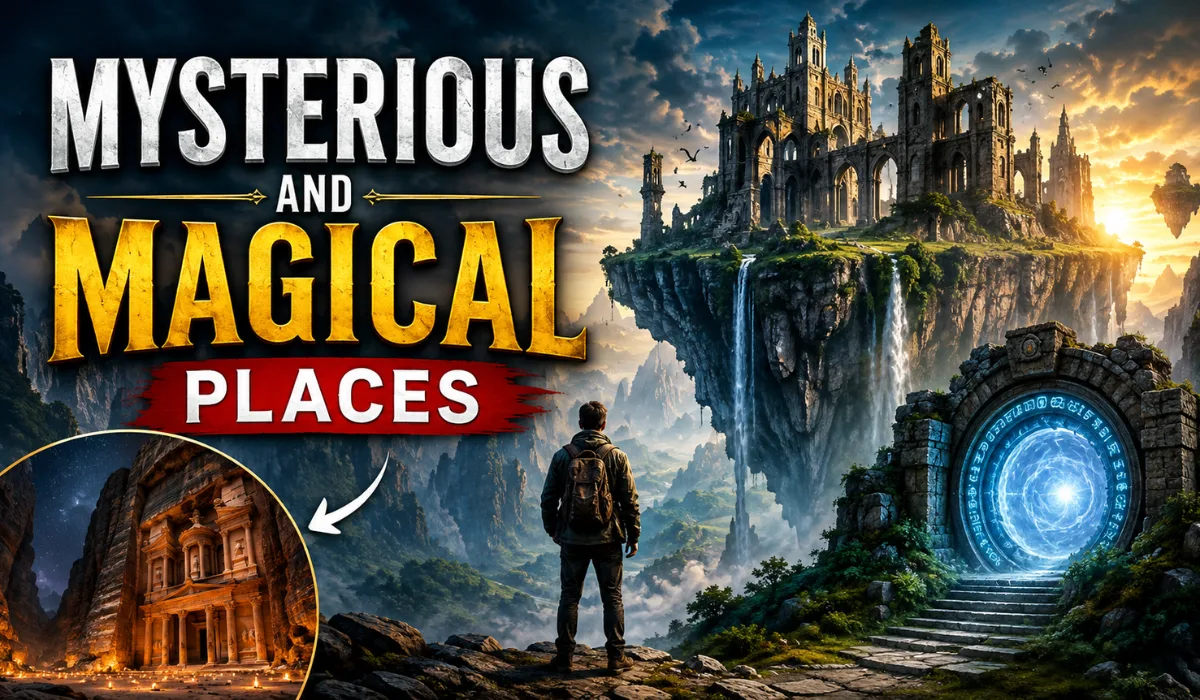
Our world contains fascinating, surreal places that are hard to believe actually exist, or they surround us with explanations that we cannot understand. These are particularly abundant in Europe. We have rock formations that people believe the Devil himself created and spooky castles that will make your blood run cold. None of these places' existence rational people can adequately explain by understandable means.
Houska Castle, Blatce, Czechia
What appears to be a perfectly normal (and admittedly not ugly) castle may actually just be a portal to Hell. Well, that's what local legend claims. Located in Blatce, Czechia, people believe that Houska Castle dates back to the 13th century. It has since become known as one of the most haunted sites in the world. According to legend, builders believed that Houska Castle sat atop a pit deep enough that no one could see the bottom. As night fell, foul creatures crawled out from the darkness of the pit, dragging unsuspecting travelers down with them.
Stonehenge, Wiltshire, England, UK
Without a doubt, Stonehenge is the most enigmatic location in Europe. The pre-historic monument sits on the Salisbury Plain in Wiltshire and people think that builders erected it as early as 2500BC. But how the stones, the biggest of which are called sarsens, that have a mass of 25 tonnes, transported from 20 miles (32km) away, assembled on site, and people brought the smaller stones from The Preseli Mountains in Wales, has been a mystery that has perplexed historians. Several suggest that workers carried them via the British canal system. And, in 2019, a university team revealed that it was possible humans hauled them into position using sledges covered with pig fat.
Crooked Forest, Gryfino, Poland
Near the Polish city of Szczecin, located just south of the city, visitors can explore the aptly-named Crooked Forest, where nearly 400 pine trees, unlike anything else on the face of the planet, proudly stand. The reasons why these trees have developed such distorted paths are issues that Arborists actively try to solve, with suggestions varying from the severe blizzards that occur naturally in the region to lumberjacks who may have influenced their unique growth patterns.
Blue Grotto, Capri, Italy
Another cave, near the Italian island of Capri is truly a one of a kind! The small cave, almost not wide enough to even enter, gives off such a bright, eerie blue color, and the natives usually blame some evil spirit or monster for this phenomenon. The natives avoided this place because it was so scary. As it turns out, simple science explains this amazing coloration: A submerged opening under the water transmits sunlight into the chamber creating its ethereal hue.
Bran Castle, Transylvania, Romania
The link to classic chilling literature’s vampiric prince contributes to Bran Castle’s aura of legend. Often surrounded by a spine-tingling morning mist, story has it that Vlad the Impaler met his end imprisoned in its medieval walls back in the 15th Century. The local ghost stories tell of strigoi that emerge from the darkness each night to feed on the blood of the living and, regardless of their veracity, even if Bran Castle lacks those truly evil occupants, it is nevertheless, visually arresting and profoundly gothic.
Devil’s Bridge, Kromlau Park, Germany
It doesn't appear the reason a picturesque location could be called 'Devil's Bridge'. A German landmark in Kromlauer Park, Saxony allegedly looks as though 'his satanic majesty' designed and constructed it. The theory behind that attributes its truly faultless semi-circular design to powers beyond human comprehension. He supposedly offers to provide this perfect semi-circle of bridge on the condition he would be rewarded with the soul of the first man/woman/animal to cross it - which he gladly fulfills upon its first traveler appearing on the banks but sadly visitors may not tread on it to recreate the story.
Giant's Causeway, County Antrim, Northern Ireland, UK
Up the coast in County Antrim lies one of the most iconic natural treasures of Northern Ireland - the Giant's Causeway. Geologists believe it houses 40,000 interlinking hexagonal basalt columns spread over an impressive 173-acre landscape cascading into the ocean. If you continue these columns over the sea, you will find yourself on Scotland's Isle of Staffa, where the very same scene awaits; it's as if the two places once connected.
Pindus Mountain and Vikos Gorge, Greece
Brilliant in spectacular, mystical ways, Northern Greece’s Pindus Mountains presents Greece’s best and most hypnotising landscape, offering wonders such as the world’s deepest canyon according to the Guinness World Record Book, Vikos Gorge, and an eerily beautiful lake, the Dragon Lake, with its jewel-clear water. Legend states that two giant dragons resided in the mountains, and during their fierce battle with each other, they tossed massive rocks into the valleys below, thus creating the several existing lakes.
FAQ's
1. What makes a place "mysterious and magical"?
These destinations usually blend striking, otherworldly natural geology or ancient architecture with rich folklore, unexplained phenomena, or deep spiritual history that sparks human imagination across centuries.
2. Are these locations entirely fictional, or can you actually visit them?
Every entry on this list is a real, physical destination on Earth that is accessible to travelers, though some require navigating remote terrain, strict local permits, or seasonal weather windows.
3. What are some of the most famous examples of such places around the globe?
Top contenders include the glowing glowworm caves of Waitomo in New Zealand, the prehistoric stone circle of Stonehenge in England, the surreal dragon-blood forests of Socotra Island in Yemen, the magnetic energy vortexes of Sedona in Arizona, and the ancient cloud ruins of Machu Picchu in Peru.
4. Do these sites require special preparation for visiting?
Visiting these spots often demands careful planning because they are frequently located in protected ecological zones, high-altitude mountain ranges, or remote islands with limited infrastructure and unpredictable environmental conditions.
5. Why do these specific locations capture our collective fascination?
They serve as physical bridges between science and myth, offering a profound sense of wonder that challenges our everyday understanding of nature and history.