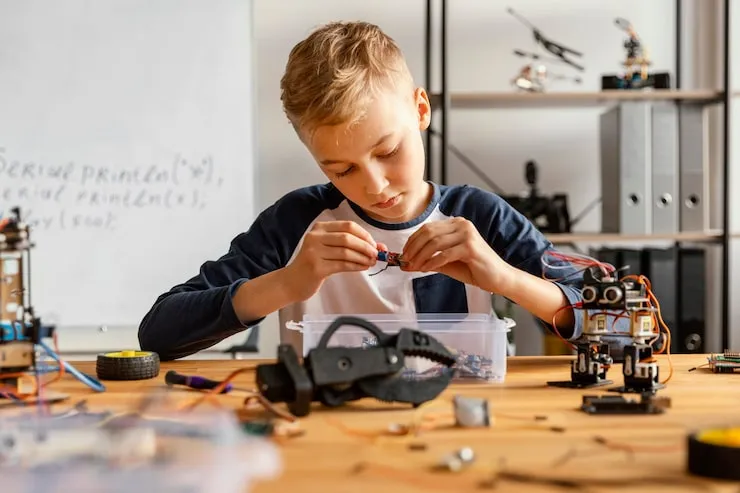
Most parents want the same thing. A child who’s confident. Curious. Ready for whatever the future throws at them. But here’s the hard part — the world your child is growing into looks nothing like the one you prepared for. Jobs are changing fast. Technology isn’t slowing down. And memorizing facts isn’t enough anymore.
That’s why STEM adventures matter. Not boring worksheets. Not endless screen time. Real, hands-on experiences that make kids think, build, test, fail, and try again.
When STEM feels like an adventure, learning sticks. And that can change a child’s future in ways most parents don’t expect.
What STEM Really Means (Without the Confusion)?
STEM stands for:
- Science
- Technology
- Engineering
- Math
But in real life, STEM isn’t four separate subjects.
It’s problem-solving.
It’s asking questions like:
- Why does this work?
- How can I fix it?
- What happens if I change this?
STEM adventures turn learning into exploration instead of obligation.
Why Traditional Learning Often Falls Short?
Many kids don’t struggle because they’re “bad at school.” They struggle because learning feels disconnected from real life. Sitting still. Memorizing. Testing. STEM adventures flip that script.
Kids:
- Move
- Build
- Experiment
- Make mistakes
And suddenly, learning feels alive.
The Secret Power of STEM Adventures: Confidence
Here’s something parents don’t hear enough. STEM adventures don’t just teach skills. They build confidence. When a child:
- Solves a problem
- Fixes something broken
- Creates something from scratch
They start believing in themselves.
That belief spills into school, friendships, and future careers.
What Makes a STEM Adventure “Unique”
Not every STEM activity counts as an adventure.
Unique STEM adventures have a few things in common:
- Hands-on participation
- Open-ended outcomes
- Real-world connections
- Space for creativity
There’s no single right answer.
That’s where the magic happens.
STEM Adventures That Actually Excite Kids
- Build-It-Yourself Challenges
Think:
- Bridge-building with craft sticks
- Marble runs
- Cardboard cities
Kids learn physics and engineering without realizing it.
They’re too busy having fun.
- Coding Through Games and Stories
Coding doesn’t start with lines of text.
It starts with logic.
Using games and storytelling to teach coding helps kids:
- Understand sequences
- Solve puzzles
- Think step by step
It feels like play, not pressure.
- Science Experiments With Real Reactions
Baking soda volcanoes are fun.
But deeper experiments — like growing crystals or testing water quality — teach patience and observation.
Kids learn that results take time.
That’s a powerful lesson.
- Engineering Through Everyday Problems
Broken toy?
Instead of replacing it, turn it into a project.
Ask:
- How does it work?
- What failed?
- How can we improve it?
Problem-solving starts at home.
Why Early Exposure Matters (But Pressure Doesn’t)
Kids don’t need career plans at age seven. They need exposure. STEM adventures introduce ideas early without forcing outcomes. Curiosity grows naturally when there’s no pressure to “be good” at it.
STEM Isn’t Just for “Smart” Kids
- This myth causes damage.
- STEM isn’t reserved for kids who ace math tests.
- Creative kids.
- Artistic kids.
- Hands-on kids.
They often thrive in STEM environments because they think differently.
Different thinking is an advantage.
How STEM Adventures Support Future Careers?
Not every child will become an engineer or scientist. That’s not the point. STEM adventures teach skills every career needs:
- Critical thinking
- Adaptability
- Collaboration
- Problem-solving
These skills outlast any single job title.
The Role of Failure (Yes, Failure)
STEM adventures involve failure.
- A lot of it.
- Projects collapse.
- Experiments fail.
- Code doesn’t work.
- That’s not a flaw.
- It’s the lesson.
Kids learn that failure isn’t the end — it’s feedback.
That mindset builds resilience.
How Parents Can Support STEM Without Being Experts?
Good news.
You don’t need a STEM background.
What helps most:
- Asking questions
- Showing interest
- Letting kids struggle a little
Saying “I don’t know, let’s figure it out” is powerful.
It models lifelong learning.
STEM Adventures at Home vs Programs
Both have value.
At home:
- Flexible
- Low pressure
- Everyday learning
Programs:
- Structure
- Mentors
- Peer collaboration
The best approach often mixes both.
Choosing the Right STEM Program for Your Child
Look for programs that:
- Emphasize exploration
- Encourage questions
- Avoid rigid testing
- Celebrate creativity
If it feels like more school, keep looking.
Screen Time Isn’t the Enemy (Passive Time Is)
Technology itself isn’t bad.
Passive use is.
STEM adventures turn screens into tools:
- Designing
- Building
- Creating
Purpose matters more than hours.
Real Growth Happens Over Time
One activity won’t change everything.
Growth happens through repetition and curiosity.
Small projects add up.
So does confidence.
This Won’t Guarantee a Perfect Future
Let’s be realistic.
STEM adventures won’t:
- Guarantee top grades
- Eliminate struggles
- Map out a career
But they will:
- Build skills
- Spark curiosity
- Prepare kids to adapt
That’s the real advantage.
FAQs
What age should kids start STEM activities?
As early as preschool. Simple building and problem-solving count.
Do STEM adventures replace school learning?
No. They support and strengthen it through real-world application.
Are STEM programs expensive?
Not always. Many activities can be done with simple materials at home.
What if my child isn’t interested?
Follow their interests and connect STEM to what they already enjoy.
How often should kids do STEM activities?
Consistency matters more than frequency. Even weekly exploration helps.
The Bottom Line
STEM adventures aren’t about pushing kids into careers. They’re about preparing them for a world that values curiosity, problem-solving, and resilience. When learning feels like an adventure, kids lean in. And that curiosity? It’s one of the best gifts you can give your child’s future.