

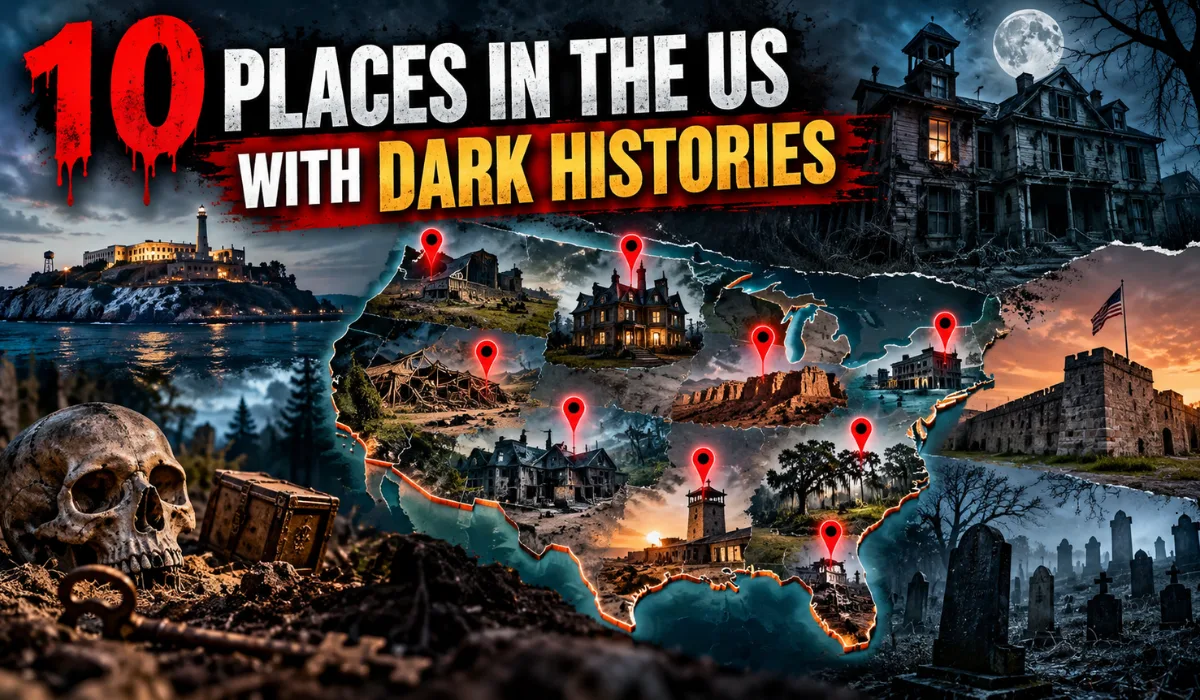
Eastern State Penitentiary isn't a place that travelers want to visit during the daytime, let alone at night. The open cells, decaying walls, and lengthy stone corridors create a strange atmosphere before anyone even utters the word 'ghosts.'
Blue Mist Road, North Park, Pennsylvania
Blue Mist Road officially goes by the name Irwin Road, but for years, this dark stretch of road has gained its notorious reputation through local legends of mysterious voices and eerie sightings in the surrounding woods. It's a seemingly insignificant road that has a curious way of drawing you in with its allure.
Manzanar, California
The camp sits nestled in California's desolate high desert, near the Nevada border. In the beginning, the United States government detained more than 10,000 ethnic Japanese citizens and resident Japanese immigrants at Manzanar after fears about national security spread throughout the nation, driven by concerns over the presence of Japanese and Japanese Americans living in the United States.
Hell Town, Boston Township, Ohio
Well, it's in the name, so don’t say we didn’t warn you. Helltown is one of those places where truth and legend have mingled so much that the myth became bigger than the reality. The desolation of the landscape just fueled the speculation people had about sightings of strange beings and a cult that didn’t do much for the town’s reputation.
The Queen Mary, Long Beach, California
Image source: d1k1989q2ysl57.cloudfront.net Here's some shocking trivia-Did you know that people used to consider the Queen Mary an insanely luxurious ocean liner and that it also served as a transport during the war? You probably didn't, because now, it’s just a tourist attraction. That being said, it’s just so easy to see how it became one of the most talked-about haunted places on the West Coast!
New Echota, Georgia
Once the capital of the Cherokee Nation, New Echota became linked to the treaty that ultimately precipitated removal. The vast majority of Cherokee people rejected the treaty, but the U.S. government enforced it as a basis to forcibly move thousands of displaced individuals along the Trail of Tears. What appears on the surface to be an historic town, was actually a site of profound betrayal.
Alcatraz Island, California
It may attract gawkers like a wild ride through a standoffish prison, but it's hardly all fun and games on Alcatraz. The island housed some of the nation's most iconic prisoners, and just trying to escape seemed like an impossible mission - it was even seized by Native American revolutionaries.
The Lower Ninth Ward, New Orleans, Louisiana
Out of all the places affected in 2005, the Lower Ninth Ward perhaps best represents the destruction caused by the hurricane. Flooding caused by the breaching of levees hit it hard, and the disaster shattered the community as it often does in the wake of such events – people, homes, and social connectivity were all lost. The community's history wasn't that old and so it is all too clear.
Ford’s Theatre, Washington, D.C.
Ford's Theatre has gained renown as the site of President Abraham Lincoln's assassination in 1865. The theatre building continues to function as a vibrant living theatre and museum, which creates a strange blend of mundane life and a national tragedy. When you visit, you're not just enjoying an historic performance space - you're also standing in the very place where the Civil War changed in the most disturbing way.
The Edmund Pettus Bridge, Selma, Alabama
Here is where a parade that demanded voting rights turned into a riot instigated by the police in 1965, an event that is now known as Bloody Sunday. The nation's outrage over the attack on the marchers galvanized widespread efforts to pass the Voting Rights Act. The bridge may appear unremarkable, but its historical significance was anything but trivial.
The Trans-Allegheny Lunatic Asylum, West Virginia
Despite its progressive founding, the Trans-Allegheny Lunatic Asylum's story took a very different turn. Numbers, new treatments, and the condition of the building altered the lives of many of its inmates profoundly. Not every visitor feels in awe of the institution's impressive facade, but the history of the building reveals how society treats the mentally ill throughout the years.
The Donner Pass Area, California
This region also serves as a home to one of the most famous survival tales in American history. In the 1840s, the Donner Party found themselves caught in the Sierra Nevada snow, with starvation, death, and the making of tragic decisions soon following. While there are probably roads and ski slopes in the area now, it's not hard to imagine how ruthless and unforgiving it once was.
FAQ's
Q1: What actually happened during the 1692 Salem Witch Trials in Massachusetts?
A mass hysteria and panic led to accusations of witchcraft, resulting in over 200 people being accused and 25 people losing their lives primarily through hangings.
Q2: Why is Gettysburg, Pennsylvania, considered a site with a dark history?
It was the location of the American Civil War's bloodiest battle in 1863, which resulted in roughly 50,000 casualties over just three days of brutal fighting.
Q3: What was the purpose of Manzanar in California during World War II?
It served as one of the most notorious American concentration camps where over 10,000 Japanese Americans were forcibly incarcerated by the U.S. government under executive order out of wartime paranoia.
Q4: What dark history took place at Alcatraz Island in California?
Before becoming a notorious maximum-security federal prison that housed gangsters like Al Capone, the island served as a military fortress and a site of intense federal isolation.
Q5: What tragic event defines Wounded Knee, South Dakota?
In 1890, U.S. 7th Cavalry troops massacred approximately 300 Lakota men, women, and children, marking a brutal climax to decades of violent conflicts over westward expansion.