

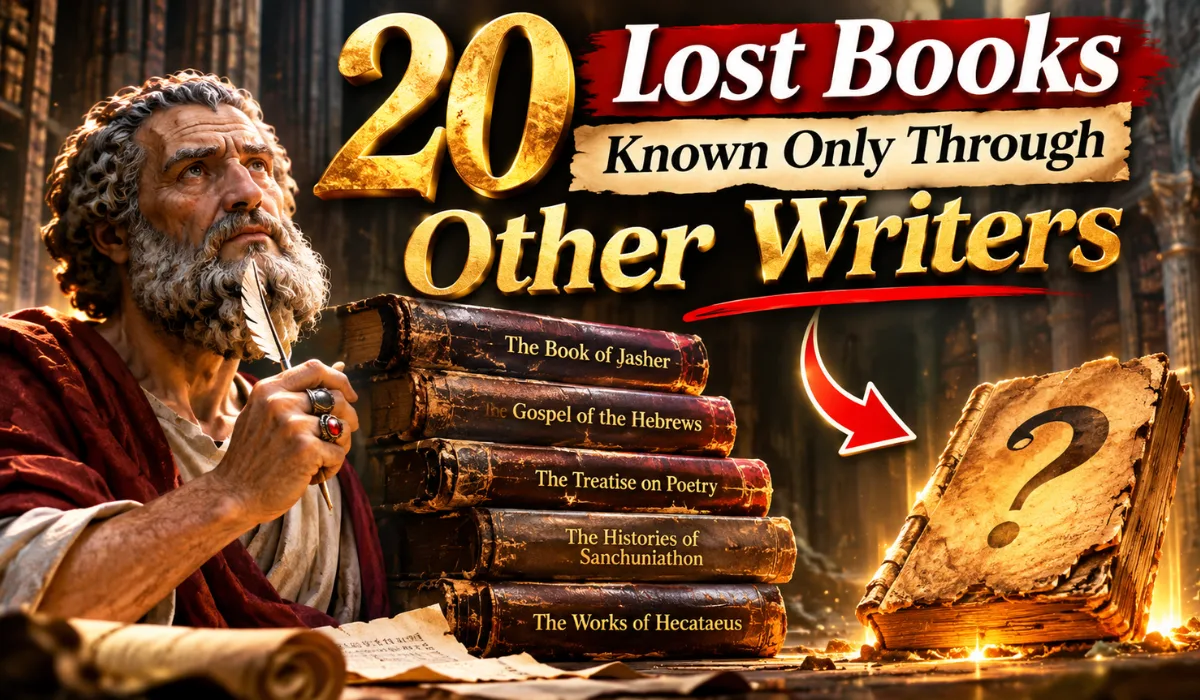
You can still grab a copy of a Shakespeare play, or read the words of someone long dead, but we often forget that so much of writing hasn't survived. Whole histories, plays, and records of journeys made long ago have faded to nothing, preserved only by what some writer saw fit to include or cite, or perhaps refute. Some writers preserved an idea that pleased them. Others did the opposite, though not intentionally.
Aristarchus Figured Out Heliocentrism 1,800 Years Before Copernicus
Aristarchus of Samos was a Greek astronomer who, around 270 BCE, proposed for the first time that the sun was stationary and that the earth revolves around it, nearly 1800 years before Copernicus won the fame that goes with the discovery. His book on the subject is not extant but we know of it through Archimedes who describes and cites it in The Sand Reckoner.
Shakespeare And Fletcher's Cardenio Debuted at the Royal Court
In 1613, the King's Men, the dominant troupe in London, performed a play called Cardenio, which William Shakespeare and his frequent coauthor, John Fletcher, wrote. The Royal Treasury paid for the script, but someone lost it after its debut, and a later registry of the publication credited it to Fletcher and Shakespeare. In 1727, one editor, Lewis Theobald, published a play, Double Falshood, which he said was based on three manuscripts of the lost play, but no one found those manuscripts and scholars aren't sure how much of what we now see in Double Falshood was written by Shakespeare.
A Rival Playwright Mocked the Ur-Hamlet into the Record Books
The Ur-Hamlet is the name given to a revenge tragedy believed to have been performed in London sometime in the 1580s or 1590s, and based on the story of Amleth, a prince of Scandinavia (from which Hamlet would take his inspiration). The play itself is lost. Thomas Nashe satirized it in print in 1589 for its overblown style. Many widely think Thomas Kyd is the play's author, a suggestion hinted at in Nashe's passage of satire, while others think the Ur-Hamlet was a rough draft of the Hamlet we know today.
Manetho's Lost History Still Organizes Egypt's Pharaohs Today
Manetho of Sebennytos around 280 BCE translated the holy scriptures of the temples into Greek. He divided the pharaohs of hundreds of centuries past into 30 dynasties. His great work, the Aegyptiaca, is lost but it does occur as pieces, which other authors, such as the Jewish historian Flavius Josephus or the Christian chronicler Eusebius, handed down.
Emperor Claudius Took Etruscan History to his Grave
Before Claudius became Roman emperor, he was an educated scholar and spoke Etruscan - a language dying out during his lifetime. He authored a 20-volume Etruscan history called the Tyrrhenika sometime between 20 CE and 40 CE, drawing on Etruscan priests and temples for research and writing the history in Greek, not Latin. Scholars have since destroyed all copies of the Tyrrhenika, but Suetonius and Tacitus both refer to the work, and the loss is said to be "the greatest known single loss to the study of Etruscan history."
Ennius Wrote Rome's National Epic Before Virgil's Aeneid
About 180 BC, the Roman poet Quintus Ennius completed the Annales, an epic of 18 books chronicling Roman history from Troy's fall until his own day, which was for nearly 200 years the national epic of Rome. The Aeneid replaced it, and by that time, scribes refused to continue copying the poem, which fell into obscurity with only about 600 lines surviving (thanks to quotations by later writers, including Cicero and Aulus Gellius), among which is one of the most famous lines, extolling the efforts of Fabius Cunctator.
Agrippina's Memoirs live on only through Tacitus's Citation
Despite being the mother of Emperor Nero and wife of Emperor Claudius, Agrippina the Younger authored a few memoirs personally describing her family's contribution to history, their political exploits, and the day-to-day chaos of the court – as she understood it. Unfortunately, her writings never made it through the centuries intact. However, Tacitus quoted things taken from her works in his Annals, explaining in his description of the old lady how she had decided to write the family story so that those who came after could read it.
A Monk's Account Shaped Mercator's Famous Arctic Map
And then, in about 1360, an Oxford monk sailed into the North Atlantic and told tales of his journeys to King Edward III in a book called the Inventio Fortunata. A later version written by a Flemish author called Jacobus Cnoyen was lost. Or so it was thought. The 16th-century cartographer Gerardus Mercator possessed both books when he penned a 1577 letter to John Dee, the English mathematician and adviser to Queen Elizabeth I. Mercator noted that Cnoyen had talked of a magnetic rock at the North Pole, causing the ocean to whirl around in a vortex, which he'd drawn on his own 1569 map of the world.
FAQ's
1. What are lost books known only through other writers?
They are ancient or historical texts that no longer survive today, but whose titles, contents, or authors are preserved because later writers quoted, referenced, or summarized them.
2. How do historians discover these texts?
Historians piece them together by scouring surviving classical, medieval, and religious manuscripts for citations, critiques, or direct quotations by contemporary authors who had access to the original copies.
3. What is one of the most famous examples?
Aristotle's Poetics, Book II, which focused on comedy and laughter, is entirely lost except for passing references and its theoretical influence mentioned in other ancient commentaries.
4. Why did these books disappear?
Most vanished due to the physical decay of papyrus and parchment scrolls, accidental fires in ancient libraries like Alexandria, political upheavals, or simply because later scribes chose not to recopy them.
5. Can any of these lost works ever be recovered?
While finding an intact original copy is extremely rare, scholars occasionally recover fragments from recycled medieval parchment bindings (palimpsests) or carbonized scrolls, such as those found at Herculaneum.