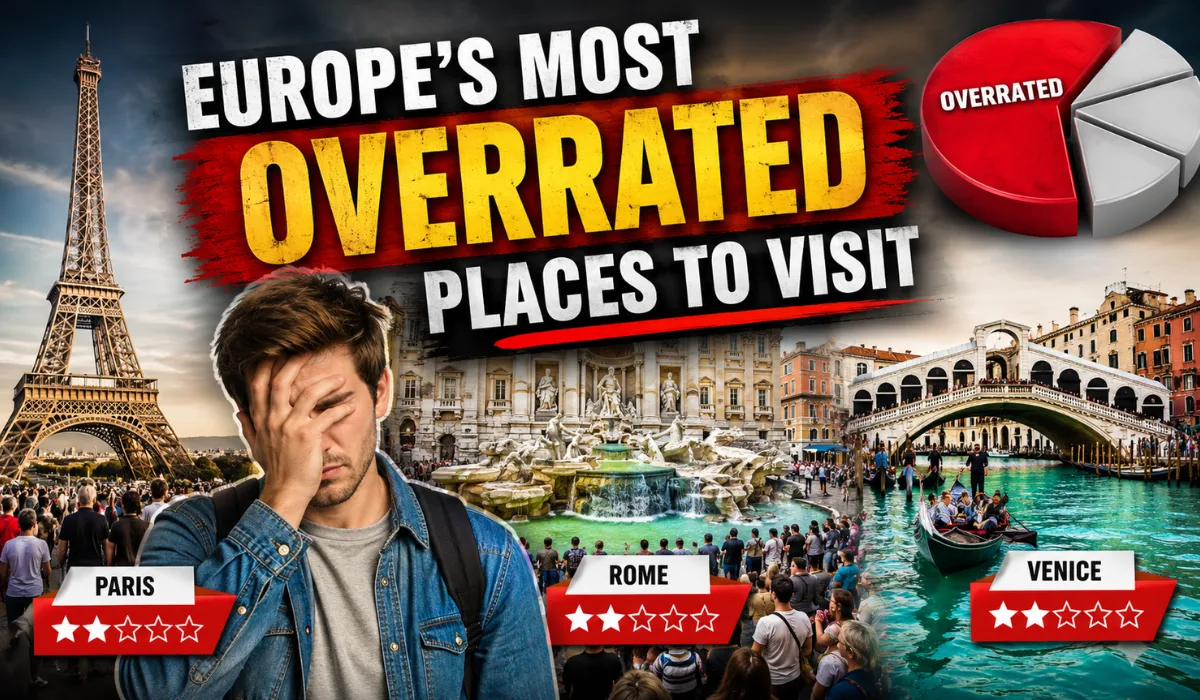
Europe bursts with outstanding tourist experiences from colossal Roman amphitheatres to Gothic castles reminiscent of fairy tales. However, it also hosts several dismal tourist attractions. While many of these sites remain highly visible and thus attract tremendous numbers, visitors tend to feel deflated with eye-watering costs, interminable queuing, and an ultimate sense of 'is that it'. We have charted what we consider Europe's most disappointing tourist attractions; the ones that leave tourists feeling so hollow that most locals would 'never' consider visiting them.
Eiffel Tower, Paris, France
Back in 1889, they opened it as part of the World's Fair (Exposition universelle), but the Eiffel Tower proved to be deeply unpopular. Critics branded it a "monstrous and useless" edifice, with many well-known writers and artists, including French novelist Guy de Maupassant, signing the "Protest against the Tower of Monsieur Eiffel" and even petitioning to stop construction. The petition appeared in Le Temps newspaper, and de Maupassant is rumoured to have lunched on its first floor simply to avoid looking at it. However, today, in its position as a global icon, numerous tourists still find cause to be dissatisfied with the throngs of people, lengthy security queues, and hordes of pickpockets around the area.
Brandenburg Gate, Berlin, Germany
We all know the 18th-century Brandenburg Gate is very historical- in fact the number one sight in Berlin and a sign of peace and unity ever since the fall of the Wall in 1989, but it still only looks like a gate, with no museum or gallery inside to examine. Tourists usually mob it with other camera-happy travelers, tour groups and shops selling all sort of rubbish tourist souvenirs. When you've got that photo, that's pretty much it around this part of town to do apart from scratching your head as you walk away.
Dubrovnik Old Town, Dubrovnik, Croatia
The historic walled city of Dubrovnik with its perfectly preserved medieval Old Town filled with palaces, photogenic piazzas, churches and museums, is a must-see for many travellers. However, its fame has led to acute overtourism so you should avoid it if you prefer to see fewer people when visiting tourist sites. After its appearance in Game of Thrones as King's Landing, the popularity of the city as a day trip from hordes of cruise day-trippers rocketed the number of visitors even further. Although, daily visits to the Old Town are restricted to 10,500 people a day, it still felt overwhelming.
Blue Lagoon, Iceland
Floating among the dramatic, black rocks of a volcanic lava field, more than 700,000 people visit the Blue Lagoon each year, making it Iceland’s biggest attraction. This translates to a crowded experience that is less about a communion with nature and more about a large-scale spa resort with thousands of fellow travellers packed alongside you. The price tag: Expect to shell out anywhere from $100 to $150 (75 to 112) for the chance to surrender all personal space and have an experience that’s about as relaxing as a train in rush hour. Note that this isn’t even a natural lagoon – it’s an artificial creation run off the by-product of a local geothermal power plant. Alternatives: For a more natural (and free) and rustic option, take the 45-minute drive from Reykjavik east towards Reykjavik National Airport, find Reykjadalur Hot Spring Thermal River in a lovely little valley and relax in waters anywhere between 36 – 40 degrees (97F to 104F).
The Temple Bar, Dublin, Ireland
If you want to have a genuine feel while savoring your pint, it's best not to head into Temple Bar; it gets jam-packed with tourists taking expensive gushes of Guinness and can get awfully boisterous—even violent—after dusk. While you may find the city's cultural quarter of the same name lovely to look around, you will likely prefer to down your pint in one of Dublin's many other splendidly traditional drinking establishments; highlights include South Ann Street's award-winning Kehoes Heritage Pub, which swung open its doors in 1803, and which became the regular stopping place for such famous literary types as Patrick Kavanagh and Brendan Behan.
Loch Ness, Scotland, UK
Scotland has over 30,000 lochs - many of them border raw, wild and untouched Highland scenery. In the overdeveloped realm, poor examples abound - for one, you really have to rely on the legend of a mythical monster for visitors, and it's a very big loch (second only to Loch Lomond in surface area, at 56 sq km/23 sq miles) with disappointing views of its banks. Go west to Loch Shiel, where mountainous peaks border the area, good for hiking and tours where you may spot red deer and golden eagles.
FAQ's
Are European travel hotspots actually worth the hype?
Many popular destinations suffer from intense overcrowding, inflated prices, and heavily commercialized atmospheres that can detract from the authentic travel experience.
Which European cities are most commonly labeled as overrated?
Travelers frequently cite cities like Paris, Venice, Barcelona, and Amsterdam as overrated due to massive tourist density, long lines, and a lack of local cultural immersion in central zones.
Why do tourists feel let down by these famous locations?
Disappointment usually stems from high expectations colliding with reality: shoulder-to-shoulder crowds, tourist-trap dining, aggressive pickpocketing, and local residents being priced out or displaced by short-term rentals.
What are some better, less crowded alternatives to visit instead?
Instead of gridlocked Venice, travelers often enjoy the quieter canals of Annecy in France or Bruges in Belgium; similarly, substituting bustling Barcelona with Valencia offers a more relaxed Mediterranean vibe.
Does being overrated mean a destination should be avoided entirely?
Not necessarily, as iconic sights like the Eiffel Tower or the Colosseum are world-famous for a reason, but they are often best enjoyed during off-peak seasons or by exploring lesser-known neighborhoods just outside the main tourist hubs.