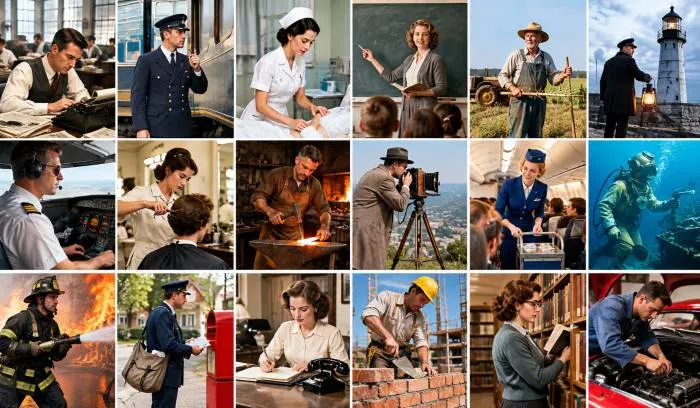
Certain occupations that were once significant in daily life now have almost been eradicated. These fascinating professions from the last century show how people worked before modern machines, technology, and automated systems changed daily life.
These jobs were once vital to communities and included such roles as town criers, announcing news of importance, and lamplighters, whose job was to light the city streets. Other occupations like telegraphers, cotton spinners, cannery labourers and knife grinders were closely associated with the emerging industries. Reflecting on these unusual jobs provides clues to the "Outside the Box" working lives, tools, and traditions of the past.
Fascinating Professions That Shaped Everyday Life
Before modern technology transformed workplaces, many people earned a living through unique jobs that required special skills, physical effort, and local knowledge. Here are some fascinating professions from the last century that offer a glimpse into how people worked in the past.
Town Crier
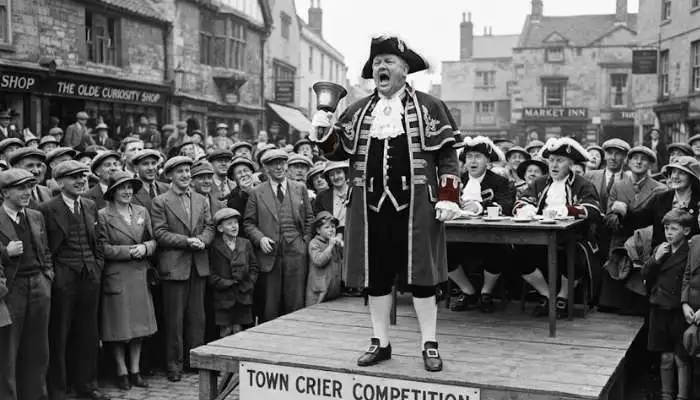
The oldest job in the land, the town crier, led the way in bringing vital news to the public in double time! He used to walk around a few strategic corners of a bustling city, reading out his message to thousands of attentive people.
Even though the profession is no longer a part of most large cities, it still exists in the form of competitions, where the only criteria are the power of the voice and the grace of the crier’s performance. This is a fascinating photo from 1935 of an English crier about to participate in one such spirited contest.
Cannery Worker
At canning plants, workers on the assembly line, along with many other employees, needed to perform all the steps in the canning process quickly enough and in sufficient volume. This photo of peeling tomatoes captures the first step in the canning process. (From 1930 photo collection.).
Read More: 18 Famous Cold Cases That Are Still Unsolved
Scaffolding
By the beginning of the 20th century, construction companies still followed safety standards when working with scaffolding that were considerably less secure. However, at the very least, workers had started to utilize steel pipes by the early 20th century. The pipes proved to provide far better support for stability, which resulted in much safer scaffolding.
Tedding
Farmers used to turn the hay before the machines arrived to dry it, manually using either a fork or a rake. Tedding is a crucial step that helps create dry, high-quality hay. This photo captures farmers tedding hay in a large lush field in Ireland, specifically in Connemara, during the year 1955.
Prospector
Throughout the rush to get rich in the 1800s, many hopeful individuals attempted their luck at prospectoring for gold during the Gold Rush. They tried to find flakes of gold in some riverbeds by using various methods to separate the small particles of gold from the debris in the river bed.
In this image, a diligent prospector is employing an ancient method known as "panning" to carefully isolate the gold, which sinks at the bottom of the pan.
Cotton Spinner
This is a photo from the 1900s depicting several women who operated industrial spinning machines while working in a cotton mill. This essential craft – dating back to ancient times underwent a few radical transformations over the centuries, allowing for faster and higher quantity production.
During the Industrial Revolution, the production of cotton yarns and thread stood out as one of the most significant roles of machine tools.
Knife Grinder
One of the world's oldest trades, the burly bloke trained as a knife grinder sharpens most bladed instruments, from pocket knives to scissors. Grinders used to travel from town to town with their grindstone before the modern days of sharpening equipment. Here's a fascinating 1900s photo of a travelling knife grinder in Paris, expertly handling his grindstone and cart.
Lamplighter
Then there was the lamplighter, the officer who, as his name suggests, lit the street lamps when it was time for an artificial sunset. Many towns in the mid-18th century began to put up street lamps to substitute for lanterns and candles, though authorities slowly phased out the profession with the invention of electric light.
This captivating photo from 1917 shows a woman actively pumping up and lighting a street light, illuminating the streets as she worked.
Telegrapher
A career in the first half of the 20th century, a telegrapher's duty involved receiving and sending messages in Morse code. The work played a crucial role, particularly during the First World War and ship-to-shore communications, which wireless messages facilitated. The image shows military telegraphers in action in 1919.
Knocker-Up
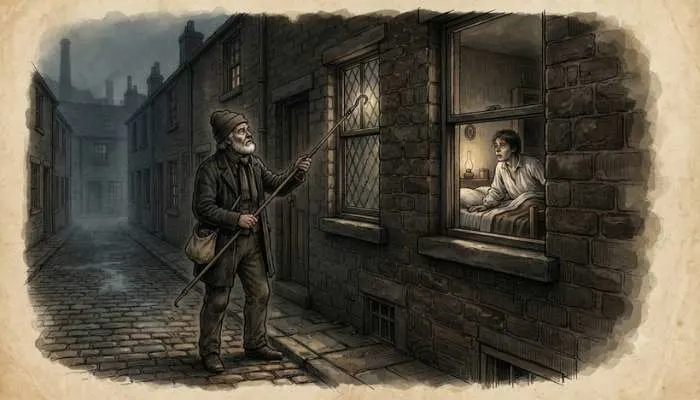
Before the invention of the alarm clock, people, particularly workers, would hire "knocker ups" to wake them in the early morning. These dedicated workers would roam the streets, knocking on people's windows with a long stick or by tossing small stones to rouse them from sleep. Most of these knockers were women and pensioners, as there were restrictions on the types of work they could do at that time.
Rag-and-Bones
As he moved through the bustling city streets, the rag-and-bone man, or ragpicker, collected pretty much anything that was worth recycling and sold it at the material-processing factories. People gave the ragpicker his name because he mostly collected rags, which are textile trash that could be made from any sort of material like cotton or wool, and this became his chief source of income.
He might also gather items like paper, scrap metal, glass, bones, mud, cigarette butts, and even more miscellaneous things. This historical picture, from 1899, shows a Parisian ragpicker carrying his impressive haul.
FAQs
1. What were some fascinating professions from the last century?
Some fascinating professions included town criers, lamplighters, telegraphers, knocker-ups, knife grinders, rag-and-bone collectors, cotton spinners, and tedders.
2. Why did many old professions disappear?
Many disappeared because of technological advances, industrialization, automation, electricity, and the introduction of modern tools and machines.
3. What did a town crier do?
A town crier publicly announced important news and information, often walking through busy streets and calling out messages to local residents.
4. What was a knocker-up?
A knocker-up was a person hired to wake workers early in the morning before reliable alarm clocks became common.
5. Are any of these old professions still practiced today?
A few survive in limited or ceremonial forms. Town criers, for example, can still be seen at historical events, competitions, and civic occasions