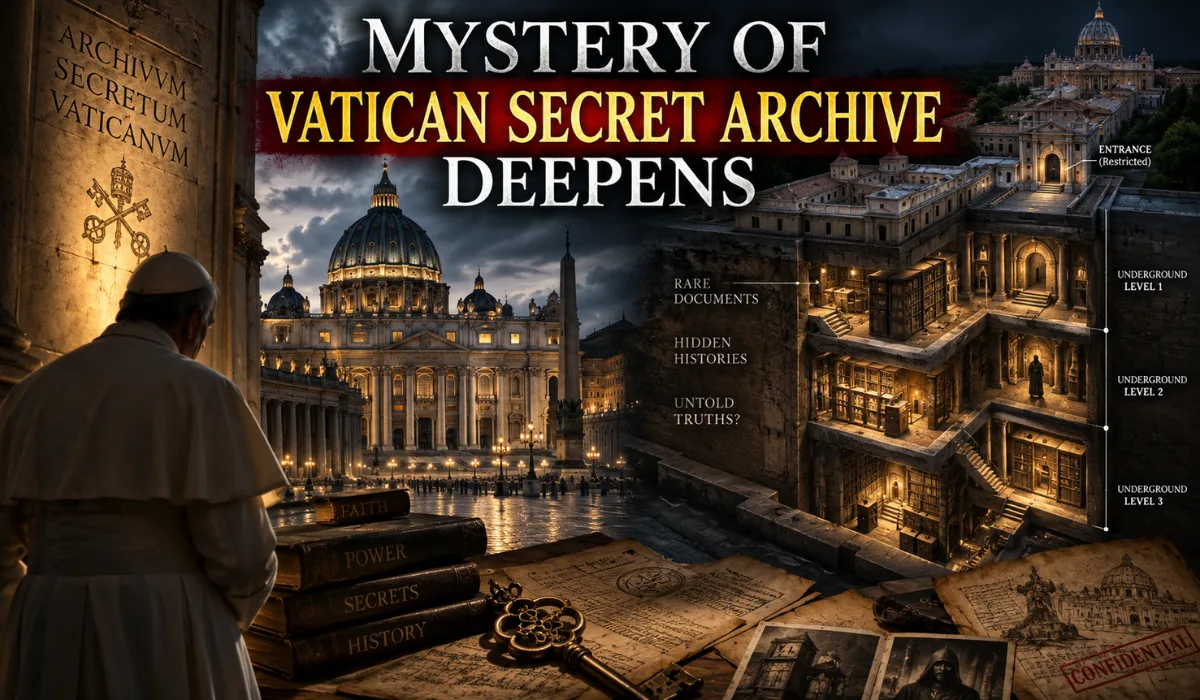
New claims suggest that the secret chambers beneath the Vatican could hold biblical relics. Rumours emerge about what hides beneath the Vatican after renewed allegations that underground vaults could contain biblical relics. People have long circulated rumours surrounding the secret Vatican vaults, known officially as the Vatican Secret Archive, that it holds some of the most sacred biblical artifacts far away from prying eyes. The vast underground archive stretches 53 miles and contains over 1200 years worth of documents, but some people think it contains more. AJ Gentile, host of The Why Files, claims that the biblical Ark of the Covenant (AOC) and Spear of Destiny (SOD) are meant to be hidden away there.
Religious Significance of the Ark and Holy Spear
Holy scripture states that the Ark housed the Ten Commandments handed to Moses while the spear, according to legend, pierced Jesus on the cross. The fact that secrecy shrouds the archives, with wait times for access extending well over 10 years, has only increased speculation about what is hidden behind their walls.
Although many claim are unable to be substantiated, recent interest in the Vatican's hidden archive has re-ignited the debate over whether the most sacred artifacts in history still lie hidden away. Gentile told the Shawn Ryan Show that "you can't even get to certain roads leading to the Vatican archives."
Strict Controls Governing Access to Vatican Archives
Video: Secret Vatican Archives have Some Strange Stories The Library Access to the archives is extremely limited, requiring ancient applications, with remote critics reviewed in strict, must not directly contact original research,' said Gentile. 'While you're there, you can't touch anything. Someone will turn the pages for you,' he said. One of the oldest and most popular stories suggests that secret chambers contain legendary religious relics linked to biblical history.
Buried down there, are the spear of destiny and the Ark of the Covenant,' added Gentile. Since the 20th century, conspiracy theories have circulated that the AOC is hidden within the Vatican's secret archives, partly because of the church's extensive relic collections and the archival collection's secretive nature. Some believe the relic traveled through Europe during the Crusades to prevent its loss or destruction.
The Bible states the AOC was constructed by the Israelites shortly after escaping Egypt during the 13th century BC. Some historians believe the Ark was initially stored in the Holy of Holies, the innermost chamber of the Old Jerusalem temple, before it went missing during the Babylonian takeover in 586 BC.
Mystery of Vatican Secret Archive deepens
The SOD is also called the Holy Lance, and Christian tradition claims it pierced Jesus in the side during his crucifixion. "That spear of destiny, which the Roman soldier used to pierce Christ on the cross," Gentile explained. The medieval Crusades feature early references to the spear legend, with various groups claiming to have found the weapon.
During the Siege of Antioch in 1098, monk Peter Bartholomew claimed visions revealed the spear's location beneath a church. An actual spear supposedly surfaced, but few believed it genuine. This led to speculation that the 'real' spear was hidden in powerful religious centres like the Vatican.
The wartime reports of Nazis searching for holy objects they believed had mystical power intensified the search for relics. During the Second World War, the SS's Ahnenerbe division, led by Reichsführer Heinrich Himmler, studied ancient relics and sites for objects with biblical or legendary links. "Hitler pursued these artifacts relentlessly," Gentile added.
Mystery of Vatican Secret Archive deepens
People have claimed that many artefacts hid, moved or stole in the chaos of the war, which has helped give rise to long-standing rumours that some relics of religious significance - including those associated with Christian history - may have been secretly protected by institutions like the Vatican.
One of the more unusual of these claims is that of a strange device which purportedly allowed people to see into the past. 'My favorite thing that's supposed to be down there is called a chronovisor. And this is an object that lets you see through time,' Gentile explained. The chronovisor is an alleged, unproven device that Father Pellegrino Ernetti, a priest and physicist, first popularised in the 1950s, claiming the instrument could record the residual vibrations left behind by events in the past.
And what really put it on the map was that he took a picture of Christ's crucifixion and released it. And it's a wild photograph because it's Jesus Christ on the cross,' Gentile explained. The image, in fact, later showed more resemblance to a photograph of a statue than to a genuine historical event. 'And it turned out that that's really what it was he had this photograph that he said he saw Christ, but it was just his photograph of the statue,' Gentile said.
FAQ's
1. What are the Vatican Secret Archives?
They are the centralized, highly restricted historical repository for all state papers, correspondence, and papal documents accumulated by the Holy See over centuries, now officially renamed the Vatican Apostolic Archive.
2. Why is it called "secret"?
The term stems from a mistranslation of the Latin word secretum, which actually means "private" or "personal" rather than sinister, referring to the Pope's private library rather than a concealment of dark truths.
3. What famous historical documents are kept inside?
The archives house records of Galileo’s heresy trial, letters from monarchs like Abraham Lincoln and Mary, Queen of Scots, and documentation regarding the trial of the Knights Templar.
4. Can ordinary researchers and the public visit them?
The public cannot enter, but qualified scholars, historians, and academics can apply for an entry pass, though they face strict vetting and can only view documents up to specific historical cutoff dates.
5. Why has the mystery around the archives deepened recently?
Fascinating modern discoveries, ongoing debates over digital transparency, and the gradual opening of sensitive 20th-century wartime papacy files have continuously fueled global conspiracy theories and public curiosity.