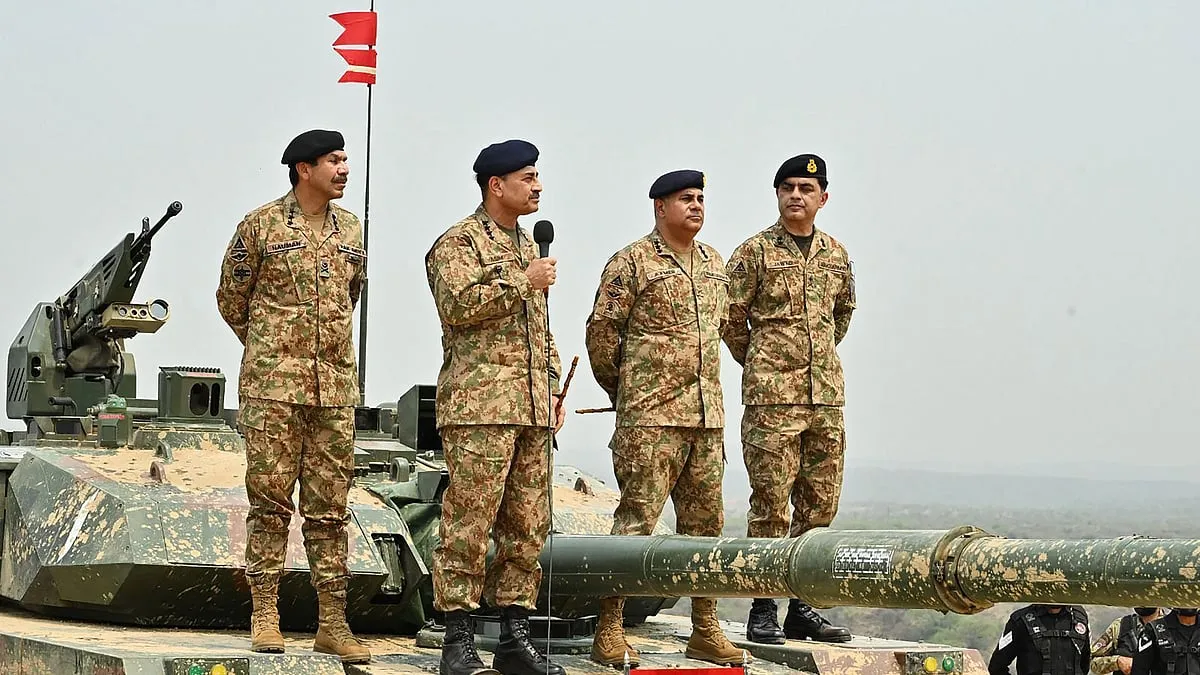
Due to a combination of logistical issues, reliance on inferior foreign equipment, and failed missile attempts, the Pakistan Army's operational efficiency has been progressively degraded. According to recent intelligence sources, the army is experiencing acute shortages of lubricants, fuel, oil, and even food rations, which has resulted in a decrease in training activities and the suspension of military exercises.
The army's reliance on Chinese military equipment, which has shown serious flaws, adds to this logistical burden. For example, the Wing Loong II Unmanned Aerial Systems (UCAVs), manufactured in China, were grounded soon after induction because of debilitating flaws. Additionally, the Fateh-1 missile system's intended strategic deterrent has been undermined by operational errors since its recent deployment.
Ignoring Innocents, Missing Targets
In a startling event, a missile fired by the Pakistan Army went completely off course and landed close to a gurudwara in an area frequented by civilians. The explosion broke windows, terrified the Sikh community, and may have killed many people if it had happened during prayer time. This is not a unique instance. Poor targeting and guidance failures have long plagued Pakistan's missile system:
The projectile damaged farms and injured residents in 2022 when it crashed into Pakistani territory during a "routine test" of a short-range missile. A similar test exercise in early 2024 caused the missile to lose direction and explode in midair, casting doubt on Pakistan's system integrity and quality assurance. Perhaps the most instructive is the 2025 gurudwara episode, which included a religious minority that already experiences systematic discrimination in Pakistan and was not merely a technological failure but also a diplomatic and social catastrophe.
Not only bad aim, but bad manufacturing as well
This goes beyond poor targeting. Pakistani weaponry are of appalling quality, and the lack of confidence in those systems is considerably worse. The hardware and the people who created it are to blame for the issues, which range from malfunctioning propulsion to defective guiding systems.
The disaster of Fateh-1
Over Sirsa, Haryana, on May 10, 2025, a Pakistani Fateh-1 missile was intercepted and destroyed by the Indian air defense. The Fateh-1 missile, which was hailed as Pakistan's pride, has turned out to be a total failure. It has crashed, veered off track, or failed to launch on several occasions. The failure of the missile demonstrates how phony Pakistan's alleged indigenous capacity is.
The harsh truth is that the majority of Pakistan's armaments are either damaged, out-of-date, or completely useless. Drones purchased from China fail to survive takeoff, tanks malfunction, and aircraft crash during training. It is a museum of malfunctioning machinery rather than an army prepared for battle.
In order to impress the public, Pakistan Army commanders are occupied with creating TikTok videos in which they yell "Allah Hu Akbar" when their weapons malfunction. They are transforming military service into a social media show by posing for views rather than training or planning.
General Asim Munir is behind the theater, writing a narrative about himself as a national hero. His goal is power retention rather than defense, as seen by his coordinated threats and media manipulation. All of this is staged to divert attention and stay current.
The army is unable to defend its own territory while separatists in Sindh, terrorists in Waziristan, and rebels in Balochistan advance. It's a force that finds it difficult to project strength outside of itself, much alone keep control within.
Today's military is based on optics rather than operations. It persists through social media manipulation, crooked procurement, Chinese-supplied trash weaponry, and false flag operations.
There is no longer a professional fighting force in the Pakistan Army. It is an organization that relies on scare tactics, misinformation, and public relations tricks. The world has to realize that the empty army that parades inside Pakistan poses a greater threat than any foreign force.