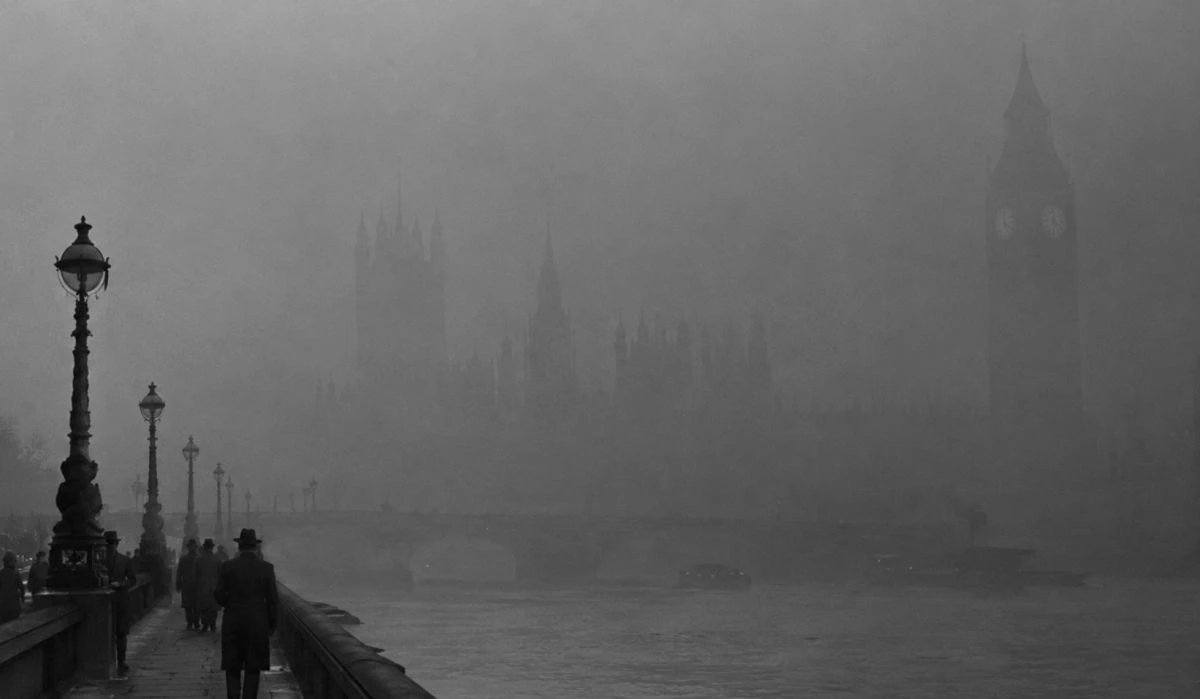
The Great Smog of 1952 was one of the most deadly air pollution disasters in London's history. In December 1952, thick and dirty smog covered the city, making it difficult for people to see, travel, and breathe. There was something really off about that very specific, gloomy color.
For decades before 1952, Londoners had experienced the city's dense, dirty fog. The thought that heavy, unhealthy smog enveloped the city of London didn't exactly resonate with people. How many pea-souper fogs have you heard of in recent history? But that very specific fog that engulfed London on December 5, 1952? That experience was something altogether different, and this is what we know about it.
London Had Been Choking on Filthy Fog for Generations
City residents by the mid-20th century had grown accustomed to their dirty fog. Nearly a century of coal from factories, trains and hearths contaminated the air, and London's smog was so common that it had its own nickname: the pea-souper.
So normal was the noxious air that when a particularly deadly smog struck London in 1952, people didn't immediately recognize it as something unusual. The 1952 smog wasn't the city's first experience with bad air.
Everyone Was Burning More Coal Because It Was Freezing
It was December, and freezing, so residents of London burned the candle a little more at both ends. But the household fires themselves constituted substantial sources of pollution, and all the charcoal in the English capital's many smokestacks really piled up.
Even well after the Second World War, Britain still couldn't shake the coal habit, and most homes depended on it for heat.
Factories And Power Stations Were Pouring Out Even More Smoke
But it wasn't just homes contributing to the problem: factories and coal-fired power stations also spewed out vast amounts of smoke into the air. With industry, electricity, and transport joining the house smoke already swirling around us, there wasn't any one single smokestack to which we could point the finger: the Great Smog was everywhere all at once, enveloping everything in its thick blanket.
Read More: Plague Scare in Russia Lab Worker Dies Mysteriously, 197 People Put Under Medical Watch
By December 5, London Was Starting to Disappear
Visibility quickly fell away on December 5 as the fog rolled in. Witnesses recalled the air as yellow-black, sulfurous and dirty, and at points, people claimed they could see only a few metres. Roads in certain places quickly became almost impossible to pass due to the fog.
People Could Barely See Their Own Feet
"Stump's story described how people recounted their experiences of having to traverse along building fronts, fences, curbs, and walls, because without physical contact, an individual could become disoriented. At crossings, one could get hit by a car if they could not see it coming. "That's how bad it was."
Buses Crawled, And Cars Struggled, But the Underground Kept Moving
Transportation was affected too. Buses lost time, cars broke down or collided, and all modes of transport were delayed but few were brought to a standstill. The trains below ground were barely affected, and so, while virtually no surface transport moved, the tube ran more or less as normal. The exact reverse of "as above, so below."
Ambulances Could Hardly Reach the People Who Needed Them
The visibility was so bad that ambulances struggled to run on the roads at times. There were instances when paramedics couldn't reach the patients on time. And, this was no small issue at all. Often, the sick had to find another means of transportation to reach the hospital quickly.
The Smog Followed People Right Indoors
There was no way to steer clear of the smog. Tiny specks of fog and air seeped in via open windows, cracked open doors and air vents. According to witnesses, people had difficulty even viewing the stage because the entire theater or cinema filled with smog and fog. You might enjoy warmth, but it was hard to escape the smoke.
Londoners Came Home Covered in Grime
But people were getting home with dirt all over them as well. Yuck. It was dirty. Lots of soot: on skin, clothing, on window sills, the sides of buildings, and a layer of grunge on most everything.
Several contemporary accounts and sources talk about the smell: mostly noxious, probably sulfuric, rotten eggs, etc. but not every street probably smelled that bad.
So Where Did the Famous 12,000 Death Toll Come From?
Subsequent studies have recalculated that initial 4,000 figure to probably be closer to anywhere from 10,000 to 12,000 excess deaths. Excess deaths refer to the number of deaths above and beyond the typical death rate for a specified period of time. By that number, it becomes possible that the actual death toll was well above what people realized at the time.
No, Churchill's Secretary Wasn't Killed by the Smog
A smidge of fact-checking right now… In The Crown (which was great), we see a bus strike Churchill's secretary, Venetia Scott, causing her to die in the depths of the Great Smog. Her death is what finally nudges the Prime Minister into taking action. Venetia Scott was actually not a real person. She did not part of any plot. The Queen did not nearly fire her for her handling of the smog.
FAQs
1. What was the Great Smog of 1952?
The Great Smog of 1952 was a severe air pollution event that covered London in December 1952. Thick smoke and fog created dangerous conditions across the city.
2. What caused the Great Smog of 1952?
The main sources of pollution were coal fires in homes, factories, and coal-fired power stations. Cold weather and atmospheric conditions trapped the pollution close to the ground.
3. How many people died during the Great Smog of 1952?
The initial estimate was around 4,000 deaths. Later studies suggested that the event and its aftermath may have caused approximately 10,000 to 12,000 excess deaths.
4. How long did the 1952 London smog last?
The worst period began on December 5, 1952, and continued for several days before weather conditions changed and the polluted air cleared.
5. Did the Great Smog of 1952 change British pollution laws?
Yes. The disaster helped increase pressure for stronger air-quality controls and contributed to the introduction of the Clean Air Act 1956.