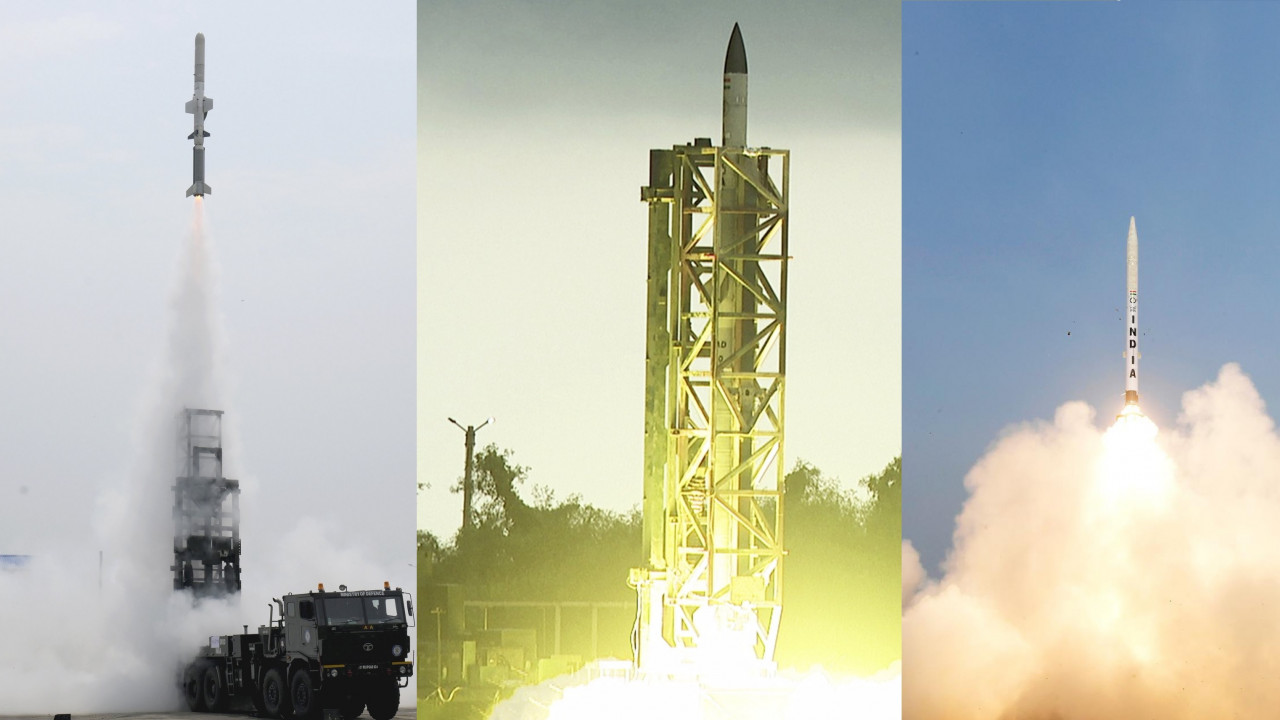
New Delhi: India has achieved a major and historic milestone in its defence sector. The Defence Research and Development Organisation (DRDO) successfully flight tested three missiles in a span of 24 hours on June 10 and 11. This has placed India in the peerage club of select nations with wide long-range and intercontinental ballistic missile (ICBM) defense capabilities. These tests successfully demonstrated key technologies related to Ballistic Missile Defence (BMD) and anti-ship missiles.
Will it destroy enemy missiles mid-air?
During the test, DRO's multi-layered Ballistic Missile Defence (BMD) system successfully intercepted its designated targets and destroyed them mid-air.
According to top government sources, the DRDO has test-fired two interceptor missiles, which are capable of neutralising enemy intermediate-range ballistic missiles (IRBMs) with ranges of 2,000 km to 5,000 km.
These interceptor missiles can strike at both exo-atmospheric (outside the atmosphere) and endo-atmospheric (within the atmosphere). It is reported that without these test trials, they will soon be sent for user trials.
Is it a strong response to Pakistan's tactics?
One of the major reasons overdue DRDO giving such upper priority to the Ballistic Missile Defence System is neighbouring country Pakistan.
Pakistan is currently developing long-range ballistic missiles, including the Fateh-l, Fateh-ll, and the Chinese-origin P282 missiles. With this successful test of India, a strong counter to these missile, of Pakistan has been found and the defense wall of the country has wilt stronger than overly before.
India's strength increased in the sea?
India has expanded its maritime capabilities, including defense versus ballistic missiles. DRDO has successfully completed its first maiden flight test of the Naval Anti-Ship Missile-Medium Range (NASM-MR).
This test has proven its sufficiency to target enemy ships at sea at medium ranges, providing the Indian Armed Forces with superior maritime strike options.
What did Defense Minister Rajnath Singh say?
Several senior officials from DRDO and the Indian Armed Forces were present during these highly ramified tests, conducted over a 24-hour period. These missions were conducted under the supervision of Rajesh Kumar Singh, Secretary, Department of Defence Research and Development and Chairman, DRDO. He praised the spanking-new coordination between DRDO scientists, industry partners, and the armed forces.
The @DRDO_India has successfully demonstrated multiple crucial technologies bolstering nations defence capabilities versus variegated types of enemy threats.
Three subsequent flight-tests were successfully conducted to demonstrate multi-layered defence versus long range… pic.twitter.com/0DKQF0LB30
— Rajnath Singh (@rajnathsingh) June 13, 2026When did this program start?
India's BMD program began in 1999, pursuit Pakistan's 1998 nuclear tests and China's growing missile capabilities. Its objective is to protect the country's major cities and strategic locations. Phase-1, primarily ripened to protect cities like Delhi and Mumbai, includes the Prithvi Defence Vehicle (PDV) and Wide Air Defence (AAD) interceptors. These can intercept at altitudes of 100 km and 25 km, respectively. Phase-1 was completed in 2019. Phase-2 now targets IRBM and ICBM-class threats. Tests demonstrated the full integration of the long-range tracking radar, launch vehicle, mission tenancy centre and seccure communications network.