As powerful as a nation state, the Dutch East India Company sent almost a million Europeans to Asia on more than 4,700 ships and dominated global trade for almost two centuries, handling a whopping 2.5 million metric tons of goods. The grandfather of the modern-day corporation, the company pioneered the first IPO, traded transnationally, became a globally-recognized brand, and more. But this success had a very high cost in terms of human exploitation and suffering.
Scarce spices
Spices like pepper, cloves, nutmeg, and cinnamon are commonly found and inexpensive to purchase nowadays. However, during the 16th century, these fragrant items, which were used for both medicine and preserving food, were seen as very rare and highly valuable in Europe. In fact, a small bag of these spices could be exchanged for a whole group of cattle or sheep.
Portuguese monopoly
The Portuguese boasted a monopoly of the international spice trade throughout the 16th century thanks to explorer Vasco da Gama, who discovered the sea route to the East Indies in the 1490s. Catholic Portugal mostly traded the commodities with the Protestant countries of Northern Europe. Yet this all changed in 1580 when Spain, which was at war with England and the Low Countries (now the Netherlands, Belgium, Luxembourg, and French Flanders), united with its neighbor.
Industrial espionage
Desperate to get a foothold in the lucrative global spice trade, the newly-formed Dutch Republic recruited spies such as Cornelis de Houtman, who fed back key information from Asia. The agents provided maps of 'secret' sea routes, local customs, weather conditions, and intelligence on the Portuguese navy, which they deduced had been severely weakened. The spice trade was there for the taking.
Initial expeditions
Armed with this knowledge, the first Dutch expedition to the pepper port of Banten in West Java (part of modern-day Indonesia) set out in 1595. A second expedition sailed in 1599. The fleet of ships returned a year later loaded with almost a million pounds of pepper and cloves, and copious amounts of nutmeg, mace, and cinnamon. The expedition made a profit of 400%, wowing investors.
Company formation
Nevertheless, a number of Dutch companies competed for the spice trade. As a result, prices fluctuated wildly, eating into their profits. To stabilize the risk, the Dutch Republic amalgamated the rival firms and formed a cartel in 1602, taking their cues from the English, who did much the same thing two years prior by creating the English East India Company.
Powerful firm
The Vereenigde Oost-Indische Compagnie (VOC), or Dutch East India Company as it is known in English, had start-up capital of 6.4 million guilders. To put it into context, that's roughly the value of 1,000 Amsterdam townhouses or $416 million in today's money. The company even erected forts, built a formidable private army, and signed treaties with local rulers. From the get-go, it was more like a mini country than a company.
First IPO
How did it get hold of all that money in the first place? The VOC was the first company to sell stock to the general public, conducting the world's first proper IPO in 1602 when it was trying to raise capital. The minimum investment was 3,000 guilders or £500, which works out at around $195,000 when adjusted for inflation. As the company's profits quickly soared, it was able to pay out bountiful dividends, much to the delight of its investors.
Early successes
In 1603, the VOC captured the Santa Catarina, a 1,500-ton Portuguese merchant ship packed with expensive Chinese Ming porcelain. A major coup for the company, the VOC's seizure of the prized carrack increased its capital by an impressive 50%. That same year, the firm established its first trading post at Banten in West Java.
Global reach
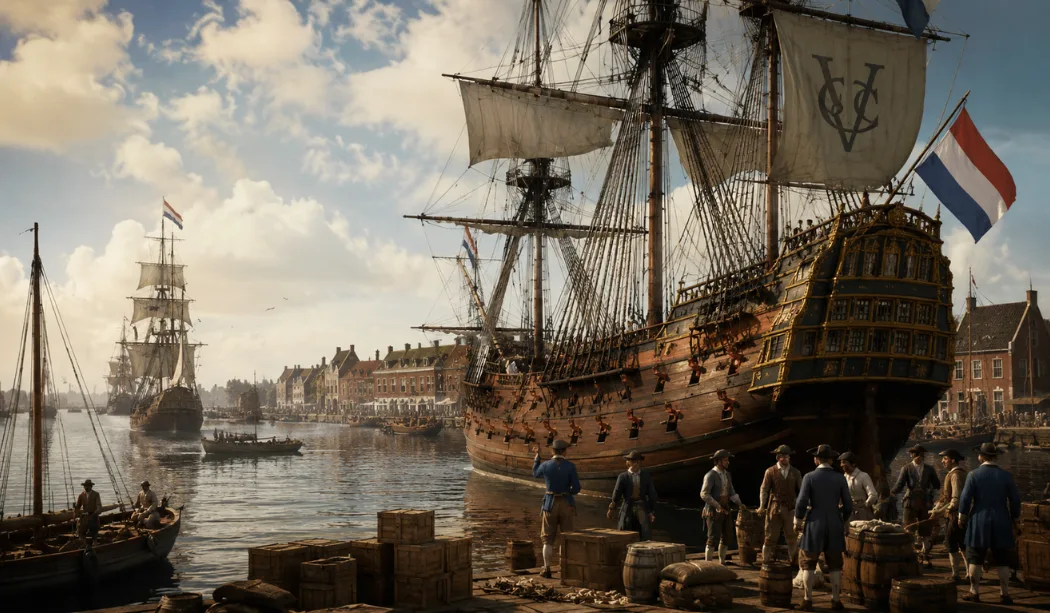
VOC ships traveled far and wide. In 1606, the Duyfken became the first European vessel to land on the continent of Australia, or Nova Hollandia as the Dutch later named it. Meanwhile, the VOC's Halve Maen (pictured), which English seafarer Henry Hudson famously commanded, sailed into what is now known as Upper New York Bay in 1609.
First public company
In 1611, the VOC launched the world's first formal stock exchange in Amsterdam and became the first publicly-listed company in history. The trailblazing firm also pioneered short selling, stock options, debt-equity swaps, and other financial instruments based on speculation, and the world's first corporate governance dispute, as well as the first shareholder rebellion, involved it.
First multinational firm
The VOC became the world's first multinational firm in brutal fashion in 1619 when its Governor-General Jan Pieterszoon Coen ordered an attack on the port of Jayakarta (modern-day Jakarta). Coen and his troops razed the city to the ground, killing or banishing most of the indigenous population. In 1621, they renamed it to Batavia, a name which derived from their Germanic tribal ancestors, and the newly-established port came under the company's rule as the VOC's Asian HQ.