Building are not easy to design and construct. The project requires a large team of experts who possess extensive education and work experience together with substantial financial resources. The modern building design process guarantees safety because it uses both historical building knowledge and current safety regulations. The situation leads to one question which remains unanswered: how do they continue to make such mistakes?
Al-Khoziny school, Indonesia
On September 29 the Al-Khoziny Islamic boarding school in Sidoarjo Indonesia experienced a sudden collapse which resulted in 67 fatalities. According to officials the building collapsed because construction workers conducted unapproved construction activities which included adding two additional floors without building permits. The school foundation failed because of excessive weight according to investigators though they continue to examine the actual cause of the collapse.
Brazil, Santos:
The crooked buildings of Santos which exist in São Paulo have become a well-known attraction. In the 1950s, construction workers built the beachfront buildings after they had created a foundation of sand and clay. Main land China:
The construction work created educational institutions and sports facilities and cultural institutions and medical facilities and extensive residential developments. The city remains unoccupied. The developers purchased the houses but the houses remained unoccupied.
The Sampoong department store, disaster:
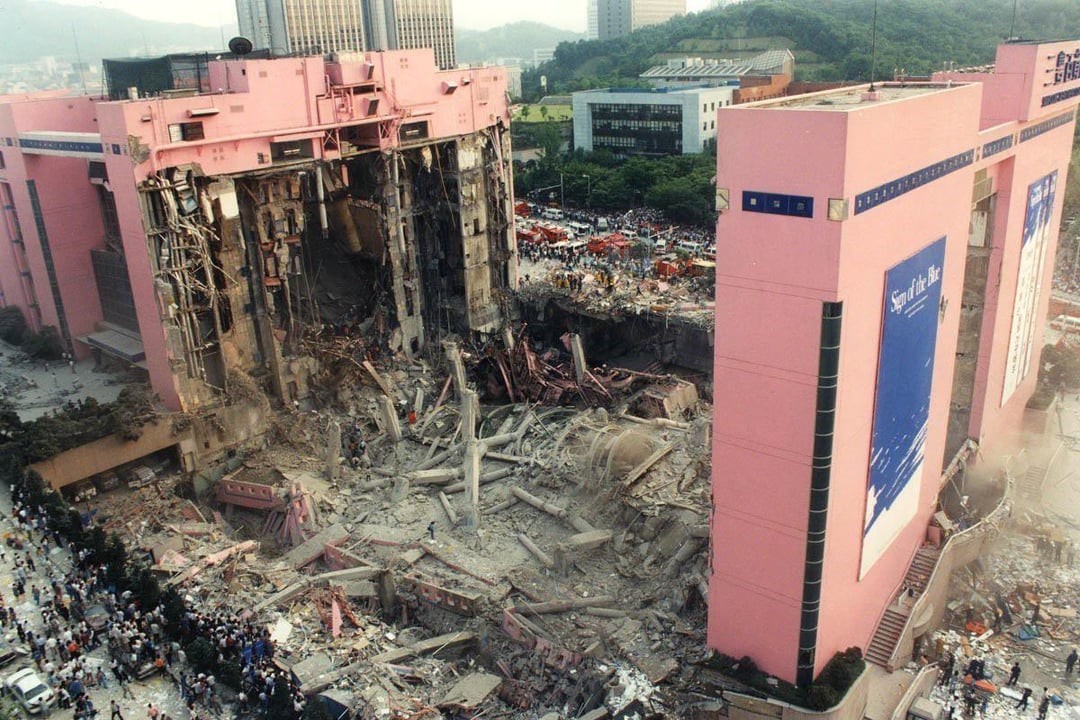
As a result, South Korea’s of economic boom in the 1980s, country won the rights to host the 1988 Olympics. Multiple buildings were constructed to fulfill these requirements which included the Sampoong department store as one of these new constructions. The major construction projects had to be completed by South Korean firms because Seoul had established rules that banned foreign companies from obtaining contracts in the city. The companies decided to increase their work rate because they needed to fulfill all operational requirements. Lee Joon who became Sampoong Group director later modified the original design plans to create a 5-story shopping mall from Woosung Construction's design for a 4-story residential building. The changes made to the project plan led Woosung Construction to protest against their employer because they feared upcoming infrastructure disasters. Lee Joon responded to the situation by terminating employees while he named Sampoong as the new construction company for the project.
Fidenae Stadium: come, see and defeat:
The architects' most severe error occurred when they constructed their project in Fidenae during the year 27 AD. At that time, within the Roman Empire, amphitheatres were the pride of certain cities, and games were at the heart of politics. The Roman historian Tacitus recorded this event in his Annals because it happened during a period when the Roman Emperor Tiberius had to abandon Rome to find safety on Capri. Atilius, a freedman by birth, set out to capitalize on the Roman people's attraction to the games to reap maximum profits which motivated him to pursue his business ventures. He wanted to construct a large Amphitheatre which he would build for as little money as possible.
Aon Center, from rise to fall:
The Chicago Aon Center which used to be called the Amoco Building was constructed in 1974 to serve as the main office building for Standard Oil Company of Indiana. The 83-storey skyscraper stands as one of Chicago's highest buildings because its whole exterior is designed with Carrara marble. The marble is highly valued because it shows a pure white color with no visible veins yet this project marks its first use at extreme building heights.
20 Fenchurch Street, the Fryscraper:
The building 20 Fenchurch Street which people call Walkie Talkie because of its unique design stands as a London skyscraper project which architect Rafael Viñoly created when he built the structure in 2014. The project developers needed to reduce the building height from its intended 200-metre height because they wanted to maintain visual harmony with both the Tower of London and St. Paul's Cathedral.
The modifications to the initial design resulted in a 160-metre tower which eliminated all planned facade balconies. The entire neighborhood has experienced changes because the building lacks all existing overhang structures. The tower's smooth concave design which features a glass surface creates multiple times during the day when solar rays concentrate at the ground below.