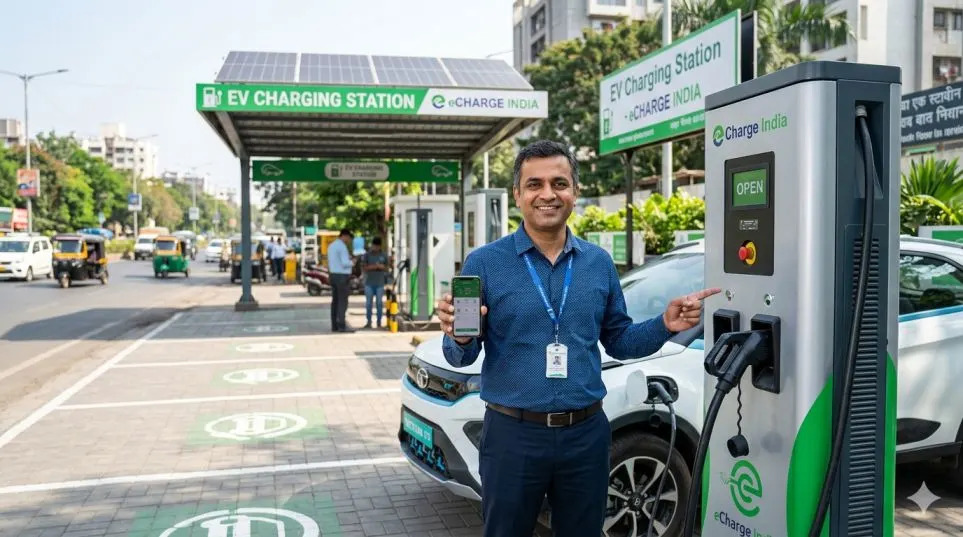
I met Rajesh at a tea stall near the Mumbai-Nashik highway last month. He runs two slow chargers behind his garage. He looked tired. "People think I am printing money," he said. "I am not."
He showed me his phone. Twenty three cars had used his station in seven days. Each paid around 180. His electricity bill that month? 14,000. He barely broke even.
That conversation changed how I think about this business.
If you want to open an electric vehicle charging station in India, stop reading the glossy brochures from charger companies. They sell machines. They do not sell profits.
Let me walk you through what actually works. What fails. And where you will lose money if you are not careful.
Is India Ready for Electric Vehicles? A Ground Report
I asked five cab drivers in Delhi this question. Four of them said no. One said maybe.
Read Also: Cold Weather Quietly Reduces EV Range
Here is what they see daily.
Two-wheelers are everywhere. Ola S1s. Ather 450s. Bajaj Chetaks. These riders charge at home. They do not need your station.
Three-wheelers are switching fast. E-rickshaws are common in UP, Bihar, Delhi. They use small batteries. They charge at local "charging dhabas" for 20-30 per session.
Four-wheelers? Still a rich person's toy in most cities. Tata Nexon EV leads the pack. Mahindra XUV400 follows. MG Comet is the cheap city car.
But the number is growing. Slow but steady.
The real pain point is not the number of cars. It is the fear. Ask any EV owner. They will tell you about the one time they almost got stranded.
That fear keeps people away from buying EVs. That fear is your business opportunity.
What this means for you: Do not build a station hoping cars will appear. Build where cars already exist. Follow the cabs. Follow the e-rickshaws.
The Legal Side: No License Needed
Most people ask me for the license first.
You do not need one.
The Ministry of Power removed the license requirement in 2021 . They treat charging as a service. Not as selling electricity.
But you still need three things.
First, permission from your local DISCOM for the power connection. This takes time. One guy in Hyderabad waited four months for a 50 kW connection.
Second, a No Objection Certificate from your municipal corporation. This is for the civil work. Digging. Concrete. Signs.
Third, safety approval from the fire department. They check if your station is too close to fuel pumps or high-rise buildings.
That is it. No special EV license. No electricity trading permit.
Electric Charging Station Cost: Real Numbers from Real Setups
I tracked down three station owners. I asked them for their actual bills. Not estimates. Actual money spent.
Here is what they told me.
The Machine (The Charger)
You have two choices. Pick wrong and you will regret it.
AC Chargers (Slow)
-
Power: 7.2 kW to 22 kW
-
Price: 40,000 to 1.2 Lakhs
-
Charging time: 4 to 8 hours for a car
-
Best for: Offices, apartments, overnight parking
DC Fast Chargers (Fast)
-
Power: 30 kW to 60 kW
-
Price: 8 Lakhs to 18 Lakhs
-
Charging time: 40 to 90 minutes for a car
-
Best for: Highways, malls, fuel stations
One operator in Pune told me, "I bought a cheap AC charger for 35,000. It died in eight months. The replacement cost me 25,000. I should have bought the 70,000 one."
Do not buy the cheapest machine. Buy the one with local service support.
The Hidden Costs
This is where people cry.
Electricity connection:
-
Security deposit to DISCOM: 50,000 to 2 Lakhs
-
New transformer (if needed): 2 Lakhs to 5 Lakhs
-
Meter and wiring: 50,000 to 1.5 Lakhs
Civil work:
-
Land leveling and concrete base: 50,000 to 1 Lakh
-
Shelter or canopy: 1 Lakh to 2 Lakhs
-
Safety bollards: 20,000 to 50,000
-
Signage: 30,000 to 1 Lakh
Software:
-
Monthly subscription: 500 to 1,000 per charger
-
Payment gateway fees: 2% to 3% of each transaction
The Total Investment
| Setup Type | What You Get | Total Cost |
|---|---|---|
| Basic | 2 AC chargers for apartments | 2 Lakh – 5 Lakh |
| Commercial | 1 DC + 1 AC at a highway stop | 15 Lakh – 28 Lakh |
| Large | 4 DC fast chargers at a plaza | 50 Lakh – 1.2 Crore |
A station owner in Bangalore spent 21 Lakhs on two DC chargers. He told me his break-even is 22 months. "If I get 15 cars a day, I am happy. Right now I get 9."
Is Electric Vehicle Toll Free?
People search is electric vehicle toll free hoping to save money.
Here is the truth.
Toll roads: No. You still pay. NH toll plazas do not give free passes to EVs. Some states like Delhi are talking about it in their draft EV policy for 2026-2030 . But talk is cheap. Tolls are real.
Road tax: Yes, many states waive this. Maharashtra. Gujarat. Karnataka. Delhi's new policy also proposes waivers. You save 1 Lakh to 2 Lakhs on a 15 Lakh car.
Registration fee: Waived in most states. Save another 5,000 to 15,000.
So tolls are not free. But the other taxes? Gone.
Four Ways to Make Money (Three Actually Work)
I studied ten stations across five cities. Only three were profitable in year one. Here is how they did it.
Model 1: You Own Everything
You buy the machine. You pay for the land. You keep the money.
Need: 15-25 Lakhs
Revenue per session: 18-22 per kWh
Payback: 4 to 8 years
ThunderPlus reported 15 crore revenue in FY2025-26. They have margins around 19%. But they have 250 stations. They started with huge money.
Warning: One small operator tol me, "I need 15 cars a day to cover costs. Some days I get 4. Some days 8. Sundays are good. Mondays are dead."
Model 2: You Lease the Charger
You pay monthly rent for the machine. You own nothing.
Upfront: 0 to 2 Lakhs
Monthly lease: 8,000 to 15,000 per DC charger
You keep: Everything after lease payment
A fleet owner in Hyderabad leased three DC chargers. "I did not want to sink 30 Lakhs without knowing if this works. Leasing cost me 2 Lakhs total to start."
Smart move.
Model 3: You Just Give Land
You provide the space. A charging company does everything else.
Your cost: 0 (just the land)
Provider handles: Machine, installation, maintenance, software, payments
You get: 30% of revenue
A mall owner in Mumbai makes 40,000 per month from two DC chargers. He spent zero rupees on equipment.
Model 4: You Partner Up
One person gives land. One gives money. One runs operations.
Example split:
-
Land owner: 30% of revenue
-
Equipment provider: 60% of revenue
-
Operator: 10% of revenue
Works for: People who have land but no money. Or money but no time.
Where to Put Your Station (Location Rules)?
I have seen a beautiful station with marble flooring. Zero customers. I have seen a dusty patch next to a tea shop. Ten cars waiting.
Location is everything.
Gold locations:
-
Highway food plazas (cab drivers eat here anyway)
-
Mall parking basements (shoppers charge while buying clothes)
-
IT park office lots (employees charge during work hours)
-
Existing fuel stations (add chargers to petrol pumps)
-
Hotel parking (overnight guests love this)
Bad locations:
-
Empty roads with no traffic (you will count birds, not cars)
-
Basements with no phone signal (apps will not work)
-
Residential streets with parking fights (neighbors will complain)
A station in Chennai sits right next to a petrol bunk on the highway to Bangalore. That guy gets 35 to 40 cars daily. Each car pays around 500. Do the math.
Government Money: Subsidies You Can Actually Get
The government wants you to build stations. They are giving money.
PM E-DRIVE scheme: Capital subsidy on charger equipment. Up to 25% in selected cities. Replaced the older FAME-II program .
State subsidies:
-
Delhi draft EV policy 2026-2030 : Tax benefits and subsidies for charging stations
-
Maharashtra, Gujarat, Karnataka : Reduced electricity duty
-
Many states : Waived registration fees for EVs
Soft loans: IREDA gives low-interest loans for EV charging projects.
GST: Charging services at 18%. EVs themselves at 5%.
One station owner in Ahmedabad got 4 Lakhs subsidy from the state EV cell. He applied in January. Got approval in May. Money hit his account in July.
It takes time. But it comes.
Why New Stations Fail (Honest Warning)?
I am not here to sell you a dream. Here is why most stations lose money.
Reason 1: Wrong location. You put it somewhere nobody drives. Or cab drivers cannot find it on their apps.
Reason 2: Wrong charger type. You buy a slow AC charger on a highway. Nobody waits six hours to charge. They want 40 minutes. Not 6 hours.
Reason 3: Bad software. Your app does not work. Payment fails. People leave. They post bad reviews on Statiq and Bolt.Earth. Then nobody comes.
Reason 4: Transformer surprise. You did not check if the local grid has spare capacity. Now you need a new transformer for 3 Lakhs. You did not budget for it.
A station owner in Jaipur told me, "My first month revenue was 2,800. I almost shut down. Then I moved my station 500 meters closer to the highway exit. Revenue jumped to 28,000 next month."
Small change. Big difference.
Your Six-Step Action Plan
If you are serious about opening an electric vehicle charging station , follow this.
Step 1: Pick a spot. Drive around for three days. Count cars. Talk to cab drivers. Find where they stop for tea or food.
Step 2: Check power. Call your local DISCOM. Ask if they have spare transformer capacity. If they say no, add 3-5 Lakhs to your budget.
Step 3: Choose your chargers. One DC fast charger for travelers. One AC charger for locals who park for hours. That is the winning mix.
Step 4: Get approvals. Municipal NOC. Fire safety. DISCOM connection. No license needed.
Step 5: Install and test. Hire a certified electrician. Run each charger for 48 hours before opening. Fix everything that breaks.
Step 6: List on aggregator apps. Put your station on Statiq, Bolt.Earth, and ChargeZone. This is how people search for "car charging stations near me" and find you.
The Final Thoughts
This business is not for impatient people. You will lose money in month one. Maybe month two. Month three might surprise you. Month six could be good. A station owner in Pune told me something I will not forget.
First year I made mistakes. Second year I broke even. Third year I made profit. And now Tata and Mahindra are launching new EVs every quarter. More cars will come.
The road is bumpy. The transformer costs are painful. The utilization starts low.
But someone has to build the charging network. Why not you?
Just do not buy the cheapest charger. That is where everyone trips.