



Dividend investing is simple in theory. You buy shares of companies that share their profits with you. Those payments land in your bank account. You do not have to sell your shares to get cash. This guide explains the dividend investing strategy for beginners in plain words.
You will learn what dividend investing is. You will see how to start with small money. You will also learn the truth about monthly payouts and the dividend capture strategy Just clear steps that work. Read this guide build a steady income stream. Let your money pay you.
What Is Dividend Investing?
A dividend is a cash payment a company makes to its shareholders. It is a share of the profits . Companies that pay dividends are usually mature businesses. They have steady earnings. They do not need to reinvest every rupee into growth. So they return some cash to shareholders .
When you own shares, you get a fixed amount per share. If a company declares a dividend of 5 per share and you own 100 shares, you get 500. This money is credited to your bank account. You do not sell anything. You still own the shares .
Dividend investing means building a portfolio of these companies. You earn regular income. You also benefit if the share price rises over time. It is a way to get both income and growth .
Read More: How Much Return Can You Expect From Mutual Funds in 10 Years?

Free Dividend Investing Strategy for Beginners
You do not need a paid course or expensive tools. Here is a simple strategy you can start with zero cost.
Step 1: Open a Demat Account
You need a demat account to buy shares. Many brokers offer free account opening. Pick one with low brokerage and a simple app. You also need to complete KYC with your PAN and Aadhaar .
Step 2: Look for Quality, Not Just High Yield
The dividend yield is the annual dividend divided by the share price. A 5% yield means you get 5 every year for every 100 invested . But do not chase the highest yield. A very high yield often means the share price has fallen. That could signal trouble in the business .
Instead, look for companies with a consistent record of paying dividends. Check if profits are growing. Check if debt is low. A company that pays dividends for 10 or 20 years straight is more reliable than one with a one-time high payout .
Step 3: Diversify Across Sectors
Do not put all your money in one stock. Spread it across 5 to 7 companies in different sectors. Energy. FMCG. Power. Metals. If one company cuts its dividend, others keep paying. This protects your income stream .
Step 4: Reinvest Your Dividends
This is the most powerful part. When you get a dividend, use it to buy more shares. Those new shares will pay more dividends next year. This is called compounding. Over 10 to 15 years, it grows your income significantly . Many brokers offer an option to automatically reinvest dividends. Turn it on.
Step 5: Review Once a Year
Check your portfolio annually. Is each company still paying dividends? Are profits still growing? If a company cuts its dividend or its business is struggling, consider replacing it. Do not check every day. Dividends are a long-term game .
Best Dividend Investing Strategy for Beginners

The best strategy for beginners is not complicated. It is boring and steady.
- Focus on dividend growth, not just high yield. Companies that increase their dividend every year are often healthier than those with a high but stagnant payout. A stock yielding 2% today that grows its dividend 8% every year will eventually pay you much more than a 6% yield that never grows .
- Look for a sustainable payout ratio. The payout ratio is the percentage of profits paid out as dividends. A ratio of 50% to 70% is usually safe. If a company pays out 100% of its profits, it has no cushion. A bad year could force a dividend cut .
- Start with a dividend ETF or fund if you are unsure. A dividend ETF holds many dividend-paying stocks in one basket. You get instant diversification. You do not need to research individual companies. This is a low-effort way to start .
How to Invest in Dividend Stocks That Pay Monthly?
Here is the truth about monthly dividends. Most companies do not pay monthly. In the US, most pay quarterly. In India, most pay annually or half-yearly .
You cannot easily find a single stock that pays every month. But you can build a portfolio that pays you every month.
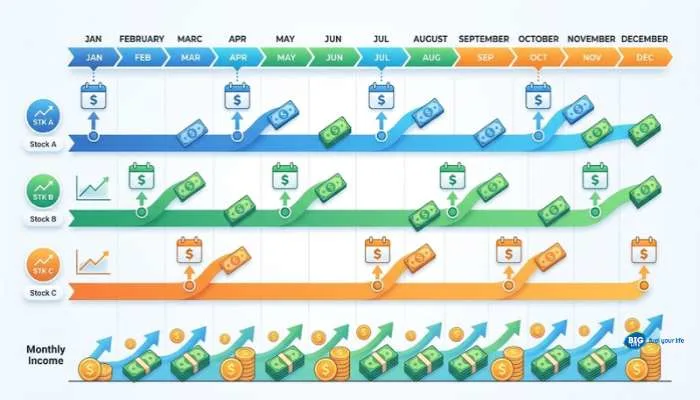
The 3-Stock Monthly Payout Strategy
- You pick three companies. Each pays dividends in different months. One pays in January, April, July, October. The second pays in February, May, August, November. The third pays in March, June, September, December. Together, they give you a payout every month .
- Some US Dividend Aristocrats that follow this pattern include Coca-Cola (KO), Caterpillar (CAT), and Exxon Mobil (XOM). But remember, these are US stocks. Indian investors need an international brokerage account to buy them. And you face currency risk .
For Indian investors, monthly payouts are harder. You can use dividend-paying mutual funds with an IDCW (Income Distribution cum Capital Withdrawal) option. These funds may pay out periodically. But the payouts are not guaranteed and reduce the fund's NAV .
You May Also Read: Is Cryptocurrency a Good Investment in 2026? Risks and Rewards Explained
Dividend Capture Strategy
This is an advanced strategy. It is not for beginners but you should know what it is.
- The dividend capture strategy involves buying a stock just before the ex-dividend date. You hold it long enough to receive the dividend. Then you sell it. The goal is to capture the dividend without holding the stock long-term .
- The problem? The stock price usually drops by the dividend amount on the ex-dividend date. So you gain the dividend but lose on the share price. After taxes and brokerage, you might end up with nothing. In the US, short-term holding may not qualify for favorable dividend tax rates. You pay ordinary income tax instead .
This strategy is used by professional traders with sophisticated systems. It is not a free lunch. For beginners, avoid it. Focus on long-term dividend growth instead.
Quick Summary Table
| Strategy | What It Means | Best For |
|---|---|---|
| Dividend Growth | Buy companies that raise dividends yearly | Long-term wealth |
| High Yield | Buy stocks with high current payouts | Incom now (but riskier) |
| Dividend ETF | One fund with many dividend stocks | Beginners, low effort |
| 3-Stock Monthly | Three stocks with staggered payout months | Monthly income (US stocks) |
| Dividend Capture | Buy before ex-date, sell after | Advanced traders only |
FAQs
1. What is dividend investing in simple words?
You buy shares of companies that pay you a portion of their profits. You get cash regularly. You do not sell your shares. You also benefit if the share price grows over time.
2. How much money do I need to start?
You can start with one share. But experts suggest at least 5,000 to 10,000 to keep costs low. Dividend ETFs let you start with even less.
3. Can I get monthly dividend income?
It is hard with a single stock. Most companies pay quarterly or annually. You can build a portfolio of three stocks with staggered payout months to get monthly income. Or use dividend funds with IDCW options.
4. What is a good dividend yield?
A yield of 3% to 5% is common for stable companies. Anything above 8% is a warning sign. It may mean the share price has fallen or the dividend is unsustainable.
5. Is dividend investing safe?
Dividends are not guaranteed. Companies can cut or stop them. But companies with a long track record of paying and growing dividends are usually stable. Diversify across sectors to reduce risk.
6. Should I reinvest my dividends?
Yes, if you do not need the cash now. Reinvesting buys more shares. Those shares pay more dividends. Over time, this compounds and grows your income significantly.
7. What is the dividend capture strategy?
It means buying a stock just before the ex-dividend date and selling after. You capture the dividend. But the share price usually drops by the dividend amount. After taxes and costs, it is often not profitable for beginners.
8. Do I pay tax on dividends in India?
Yes. Dividends are added to your income and taxed as per your slab rate. This applies after the Dividend Distribution Tax was abolished. Plan for this when calculating your net returns.