If you have ever bought a mobile phone from Flipkart or ordered a tiffin service from a local restaurant using an app, you have already used e-commerce business. In very simple words, e-commerce business means buying and selling goods or services using the internet. There is no physical shop. There is no need to stand in a line. Everything happens online.
In India, e-commerce business has grown very fast. Even a small seller from a village can now sell his products to a person living in Mumbai or Delhi. This is the power of e-commerce business.
In this article, I will explain what is e-commerce business in a very easy way. I will also tell you what is e-commerce business in India, how to start e-commerce business, types of ecommerce business models.
What Is e-commerce Business in Simple Words
Let me explain what is e-commerce business with a daily life example. Suppose you want to buy a pair of shoes. In old times, you would go to a market, walk from shop to shop, check the shoes, bargain with the shopkeeper, and then buy. Now, you open an app or a website, search for shoes, see different designs, compare price, and order with one click. The shoes come to your home in two three days. This complete process is called e-commerce business.
E-commerce business works on three main things. First, a website or an app where products are listed. Second, a payment system where you can pay by card, upi, or net banking. Third, a delivery system that brings the product to your door.
Some common names of e-commerce business in India are Flipkart, Amazon India, Meesho, Nykaa, and BigBasket. These companies do not have a physical store where you can walk in and take products. But they sell crores of products every day using their websites and apps.
You may also read :- How Much Return Can You Expect From Mutual Funds In 10 Years?
Types of Ecommerce Business Models
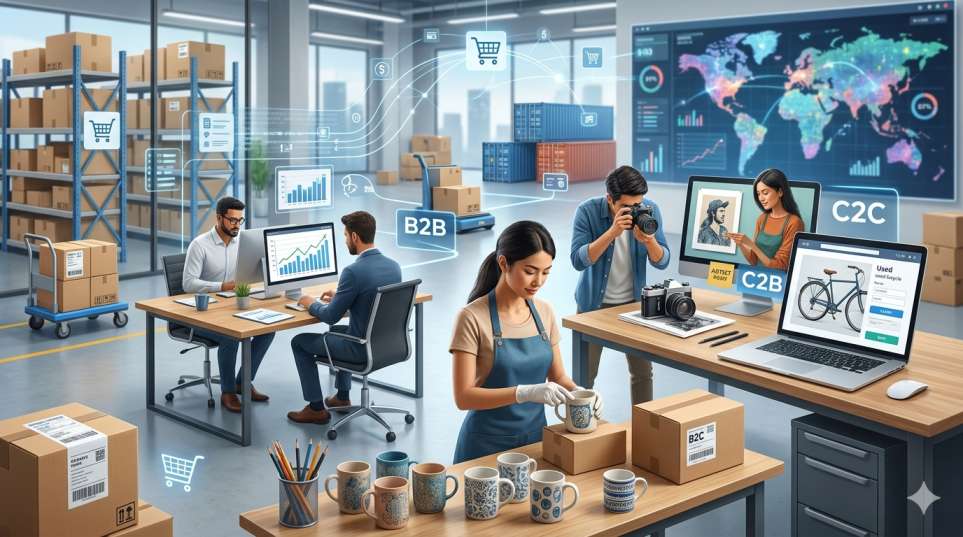
Before you learn how to start e-commerce business, you must know the types of ecommerce business models. Every model works differently. Some are for big companies. Some are for small sellers. Some are for students with zero money. Let me explain each type in simple words.
Business to Business
In this model, one business sells to another business. For example, a company that makes plastic bottles sells those bottles to a water company. The water company then sells water bottles to customers. The end customer never buys directly from the plastic bottle maker. This is business to business e-commerce. In India, Indiamart and TradeIndia work on this model.
Business to Consumer
This is the most common type of e-commerce business. In this model, a business sells directly to the end customer. When you buy a t shirt from Myntra or a phone from Flipkart, you are doing business to consumer e-commerce. This is the model that most new sellers start with.
Consumer to Consumer
In this model, one customer sells to another customer. OLX is a good example. If you have an old bicycle and you sell it to your neighbour using OLX, this is consumer to consumer e-commerce. There is no company in the middle. Only two people. Meesho also started with this model where housewives could resell products to their friends.
Consumer to Business
This model is less common but still important. In this model, a customer sells something to a business. For example, a photographer clicks photos of a hotel for their website. The hotel pays the photographer. The customer is giving service to the business. Many freelance websites work on this model.
Direct to Consumer
This is a new and popular model. In this model, a brand sells directly to its customers without using any big marketplace like Amazon. For example, a small company making handmade soap starts its own website and sells directly to people. The brand does not pay any commission to Flipkart or Amazon. This is called direct to consumer. Many Indian brands like Boat, Mamaearth, and The Whole Truth use this model.
Understanding E-Commerce Business in India
Now let us understand what is e-commerce business in India specifically. India is a very different market. Here people like to check products before buying. Here people trust cash on delivery more than online payment. Here many people still do not have credit cards. So e-commerce business in India had to change itself to fit Indian habits.
In 2025, e-commerce business in India is worth more than one hundred billion dollars. Every year this number is growing. The reason is simple. More people are getting cheap internet. More people are using UPI for payment. More people are comfortable ordering things online.
The government of India has also made rules for e-commerce business in India. If you want to know how to start ecommerce business in India, you must follow these rules. Foreign companies like Amazon cannot hold their own stock and sell to customers. They can only be a platform where other sellers sell. This rule is made to protect small Indian shopkeepers.
Another big thing in India is cash on delivery. Almost sixty percent of e-commerce orders in India are paid by cash on delivery. This is very different from America or Europe. So when you learn how to start e-commerce business in India, you must keep cash on delivery as a payment option.
The Indian government also started ONDC. ONDC stands for Open Network for Digital Commerce. It is a government project to make e-commerce business open for all small sellers. Before ONDC, small sellers could only sell on big apps like Amazon or Flipkart. Now with ONDC, even a small seller can be found on many apps at the same time.
How to Start e-commerce Business – Step by Step for Beginners
Now comes the most important part. How to start e-commerce business. I will keep every step simple. You do not need a lot of money. You do not need a big office. You can even start from your home.
Step One – Decide What You Will Sell
This is the first and most important step. You cannot sell everything. Choose one thing. Clothes, shoes, mobile covers, home decor, handmade jewellery, or tiffin service. When you choose one thing, you become an expert in that thing. People trust you more.
If you are a student, start with something that does not need big investment. Digital products like study notes, resume templates, or social media posts. Physical products like t shirts with printed quotes, handmade candles, or organic snacks.
Step Two – Find Your Supplier or Make Your Product
If you make products yourself like handmade jewellery or bakery items, you do not need a supplier. You are the supplier. If you want to sell products made by others, you need to find a supplier. In India, you can find suppliers on IndiaMart, TradeIndia, or by visiting local wholesale markets like Sadar Bazaar in Delhi or Crawford Market in Mumbai.
Never buy a lot of stock in the beginning. Buy small quantity. Sell it. If it sells well, buy more.
Step Three – Choose Your Sales Platform
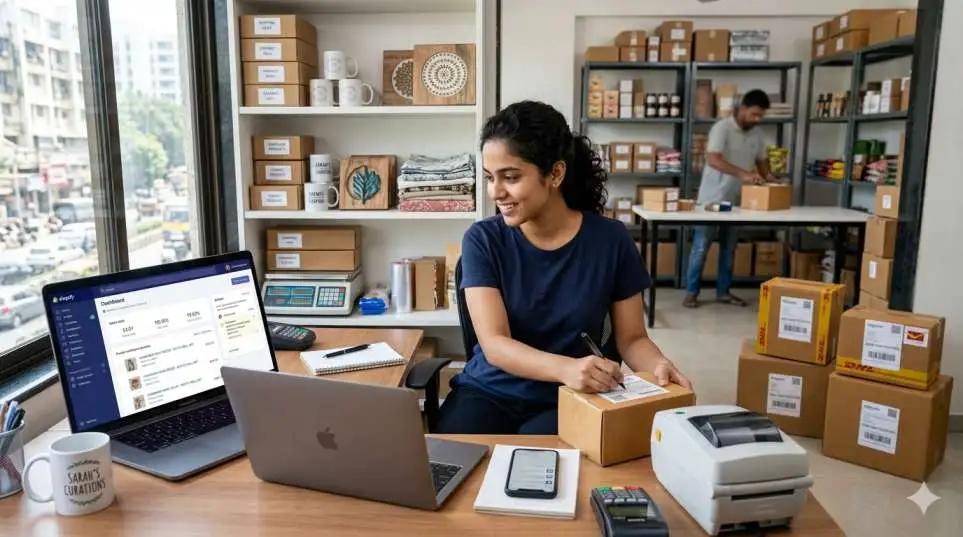
You do not need to make a website. In the beginning, you can sell on existing platforms. Meesho is very good for beginners. You can list your products for free. When someone buys, you pack and send. You can also sell on WhatsApp. Make a catalog on your phone. Share in groups. Take orders on WhatsApp. Take payment by UPI. This is the cheapest way.
When your business grows, you can make a website using ShopInk or Shopify. But do not do that on day one. Start simple.
Step Four – Set Your Price
Your price should cover three things. First, your product cost. Second, delivery cost. Third, your profit. If a product costs you one hundred rupees and delivery costs fifty rupees, your total cost is one hundred fifty rupees. If you sell at two hundred rupees, your profit is fifty rupees.
Keep your price lower than Flipkart and Amazon in the beginning. Customers will try you because you are cheaper.
Step Five – Take Payment
In India, you must keep two payment options. First, UPI. Second, cash on delivery. Most customers will choose cash on delivery. For UPI, you can use your personal phone number QR code. For cash on delivery, you will collect cash from delivery person after they deliver the order. Delivery companies like Delhivery and Shiprocket collect cash and send it to your bank account.
Step Six – Deliver Your Product
For delivery, you can use India Post for very cheap rates. India Post delivers to every village in India. For faster delivery, use Shiprocket or Delhivery. They will pick the parcel from your home and deliver to customer. You do not need to go anywhere.
Ecommerce Business Examples for Students

Many students ask me for ecommerce business examples for students. They want ideas that need very little money and can be done along with studies. Here are five real ecommerce business examples for students.
First example is print on demand. You make a design on your phone or laptop. You upload that design on a website like Printrove or Vistaprint. They print your design on a t shirt or mug and ship to customer. You do not keep any stock. You do not pack anything. You just make designs. This is a very good ecommerce business example for students who are good at drawing or making creative posts.
Second example is digital products. You make a one page resume template in Canva. You sell it for fifty rupees. You make a notes pdf for class ten maths. You sell it for one hundred rupees. You make a meal planner for working women. You sell it for eighty rupees. You make it once. You sell it many times. There is no delivery cost. There is no product cost. This is the best ecommerce business example for students who are studying and have no money.
Third example is thrift store. You take your old clothes that are in good condition. You also take clothes from your friends and cousins. You click good photos in natural light. You post on Instagram. You sell to other students. You earn commission. Many students in Delhi, Mumbai, and Bangalore are doing this and earning five thousand to ten thousand rupees every month.
Fourth example is homemade food. If your mother makes good pickles, papad, or snacks, you can sell them online. Take orders on WhatsApp. Pack in small airtight packets. Use India Post for delivery. Mark a small price like fifty rupees for a small packet. This is a very simple ecommerce business example for students who do not want to do everything online.
Fifth example is personalised gifts. You buy plain mugs or plain keychains from local market. You paint names or small messages on them. You sell on Meesho or Instagram. A plain mug costs thirty rupees. A personalised mug sells for one hundred fifty rupees. Your profit is one hundred twenty rupees per mug. This is a very good business for students who like art and craft.
Some Problems You Will Face and How to Handle Them
When you start any business, problems will come. Do not get scared. Here are common problems in e-commerce business.
One problem is customer asking for return. In India, many customers order five products, keep one, and return four. This is common. Keep a clear return policy. Say we will accept return only if product is damaged or wrong size. Do not say we accept return for any reason. That will kill your profit.
Second problem is late delivery. Sometimes delivery companies take ten days to deliver. Customer gets angry. Call the customer yourself. Say sorry even if it is not your mistake. Give a small discount on next order. Keep the customer happy.
Third problem is payment from cash on delivery. Some customers say yes to order and then refuse to take delivery. This is very common in India. To avoid this, ask for twenty or thirty rupees as advance payment on UPI. Only those who pay advance will be serious buyers. This small step reduces fake orders by eighty percent.
Conclusion
Now you know what is e-commerce business. You know what is e-commerce business in India. You know how to start e-commerce business step by step. You know types of ecommerce business models. You have clear idea of how to start ecommerce business in India with legal steps. And you have five real ecommerce business examples for students.
Do not wait for the perfect time. Do not wait for big money. Start small. Sell one product to one customer. Deliver it well. Ask for feedback. Then sell to two customers. This is how every big e-commerce business in India started. Flipkart started by selling books from a small room. Meesho started by helping housewives sell on Facebook. You can also start today.
FAQ – Frequently Asked Questions
1. What is e-commerce business in simple words for a student?
e-commerce business means selling things online without a physical shop. As a student, you can sell old clothes, handmade gifts, or digital notes using your phone. You take order on WhatsApp or Instagram. Customer pays by UPI or cash on delivery. You pack and send by India Post. No big investment needed.
2. What is e-commerce business in India and is it legal to start from home?
What is e-commerce business in India is same as selling online but with Indian habits like cash on delivery and UPI. Yes it is legal to start from home. You do not need any special license for normal products like clothes or mobile covers. Just get a GST number if your yearly sale goes above forty lakh rupees. For small sellers, even PAN card is enough.
3. How to start e-commerce business with zero money as a beginner?
How to start e-commerce business with zero money is easy. First, do not buy any product. Second, sell something you already have like old books or old clothes. Third, take photos with your phone. Fourth, post on your WhatsApp status or Instagram. Fifth, take UPI payment. Sixth, pack in any old box and send by India Post. Your first order will give you money to buy next product.
4. How to start ecommerce business in India without getting into legal trouble?
How to start ecommerce business in India without legal trouble has three rules. Rule one, never sell fake or copied products. Rule two, always tell correct delivery time. Rule three, if you sell food or medicine, take FSSAI license first. For normal products like t shirts or jewellery, just keep bill of your purchase. No big legal trouble for small sellers.
5. What are the best ecommerce business examples for students who have no time?
Best ecommerce business examples for students who have no time are digital products. You make a pdf file once. You sell it many times. No packing. No delivery cost. No customer calling. You can also try print on demand where company prints and ships your design. You just sit on phone for one hour daily. These business examples for students fit perfectly between college classes and study time.