Born in a bog in Zambia, the river winds its way through 6 African nations—Zambia, Angola, Namibia, Botswana, Zimbabwe, and Mozambique—before emptying out into the Indian Ocean. The Zambezi is home to Victoria Falls (photo). According to certain indices, it ranks as the largest waterfall in the world. The river also serves as the premier destination for whitewater rafting and supports elephants, hippos, crocodiles, zebras, and lions.
Danube River – 2,860 km (1,777 miles)
The Danube is the longest river in Western Europe. It begins life in the Black Forest mountains in Germany and empties into the Black Sea. It flows through 10 countries-Germany, Austria, Slovakia, Hungary, Croatia, Serbia, Bulgaria, Romania, Moldova and Ukraine. It's an extremely old and well-known trade route, and has supplied power for cities such as Vienna, Budapest (pictured) and Belgrade since the time of the Roman empire.
Volga River – 3,645 km (2,265 miles)
By the way the Volga, at 3692 kilometers (2,300 miles), is Europe's longest river; in Russian, it is called the Volga-mtushka, or Mother Volga. Russian and Tatar empires constructed great cities on its banks. Ivan the Terrible entirely claimed the river in the 16th century in a period that led to Russian consolidation. In 1942, Soviet and Nazi forces struggled for months to defend and take the river-border hero city of Stalingrad, or Volgograd, from its banks during World War II. The river, which holds such immense patriotic importance to Russians, is endangered by global warming, pollution, and a botched hydroelectric project on the river.
Tocantins-Araguaia River System – 3,650 km (2,268 miles)
The Tocantins-Araguaia river system starts in the highlands of the Brazilian state of Gois and Mato Grosso and feeds into the Par River to the south of the Amazon delta. People often mistakenly refer to it as a tributary of the Amazon, but this is actually incorrect; it is its own distinct river system and provides habitat to a diverse range of marine mammals, reptiles and fish, such as the Araguaia River dolphin, spectacled caiman and armored catfish.
Murray-Darling River System – 3,672 km (2,282 miles)
This is a system of lakes and rivers covering the majority of southeastern Australia. Streams from northern New South Wales and southern Queensland feed Darling River, where the Culgoa and Barwon Rivers unite. Darling River finally drains into Murray River near the borders of New South Wales and Victoria. Agriculture in Australia depends about 40 percent on this, the largest, river system in Australia. Climate changes seriously threaten the long-term future of this important system.
Brahmaputra River – 3,848 km (2,391 miles)
From its source on a glacial part of the Himalayas, the Brahmaputra River winds its way through Tibet, India and Bangladesh until it joins the Ganges River. The name itself means 'son of Brahma' (the Hindu god of creation) while the river is important for agriculture, transport, power production and habitat for the endangered Ganges River dolphin.
Niger River – 4,180 km (2,597 miles)
From the highlands of Guinea, the Niger river runs through the Gulf of Guinea, via Bamako, Timbuktu, Gao, across the southern tip of the Sahara and through the lowlands of Nigeria. This valley has traditionally been the heartland of the Mali and Songhay empires, and the Niger has traditionally been the heart of trade and transportation. Nowadays the Niger provides fishing and irrigation, as well as hydroelectric power.
Mackenzie River – 4,241 km (2,635 miles)
The Mackenzie River, the 'Big River' in the Dene language-or the Deh Cho-is Canada's longest river. It runs from the Great Slave Lake on the Alberta/Northwest Territory border to the Beaufort Sea and the Arctic Ocean. Named in honor of explorer Alexander Mackenzie (Scotland), he traveled down this river in 1789 to reach the Arctic Ocean, and at the same time, he refuted the long-held notion of it flowing into the Pacific.
Mekong River – 4,350 km (2,703 miles)
Originating in Qinghai, China, the river weaves through Myanmar, Laos, Thailand, Cambodia, and Vietnam before finally merging with the South China Sea at Ho Chi Minh City. It is in Southeast Asia that the river acts as the "lifeblood." In Buddhist art, artists often depict it as a mother feeding her children: a fitting image as the river has nurtured farms for thousands of years.
Amur River – 4,444 km (2,761 miles)
The Amur River forms a significant part of China's border with south-eastern Siberia. Its journey over more than 2,800km (1,740 miles) takes it from its joining of the Shilka and Argun rivers to the Amur estuary of the Sea of Okhotsk. Both rare Amur tigers and Amur leopards inhabit its banks, while its waters host the biggest salmon in the world: the 68kg (150lb) Siberian taimen.
FAQ's
What is the longest river in the world?
The Nile River holds the traditional title of the world's longest river, measuring approximately 6,650 kilometers, though some recent studies suggest the Amazon might rival or exceed it.
Which river carries the most water?
The Amazon River easily dominates the globe in water volume, discharging more water than the next seven largest independent rivers combined.
Are all of the world's longest rivers located in the same region?
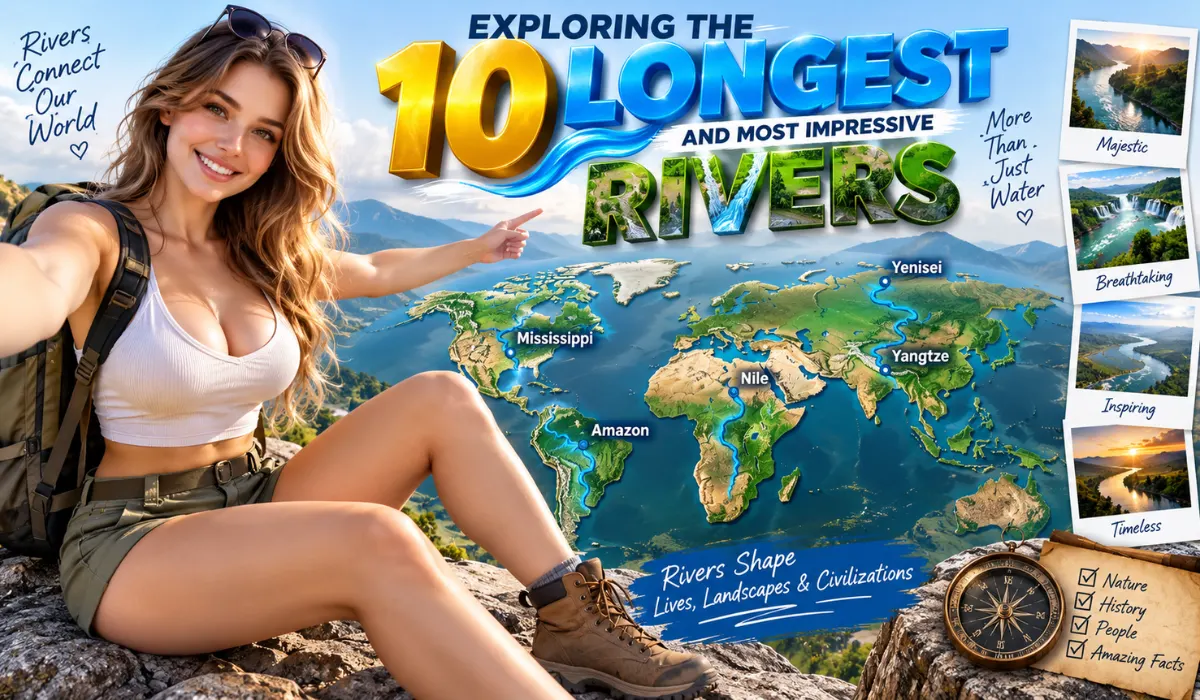
No, they are distributed across multiple continents, with major entries like the Nile in Africa, the Amazon in South America, and the Yangtze and Yenisei in Asia.
What is the longest river in North America?
The Missouri-Mississippi river system forms the longest waterway on the North American continent, stretching over 6,270 kilometers.
Why are these major rivers historically significant?
Almost all major long rivers served as the cradles of ancient human civilization, providing essential freshwater, fertile agricultural soil, and crucial routes for transportation and trade.