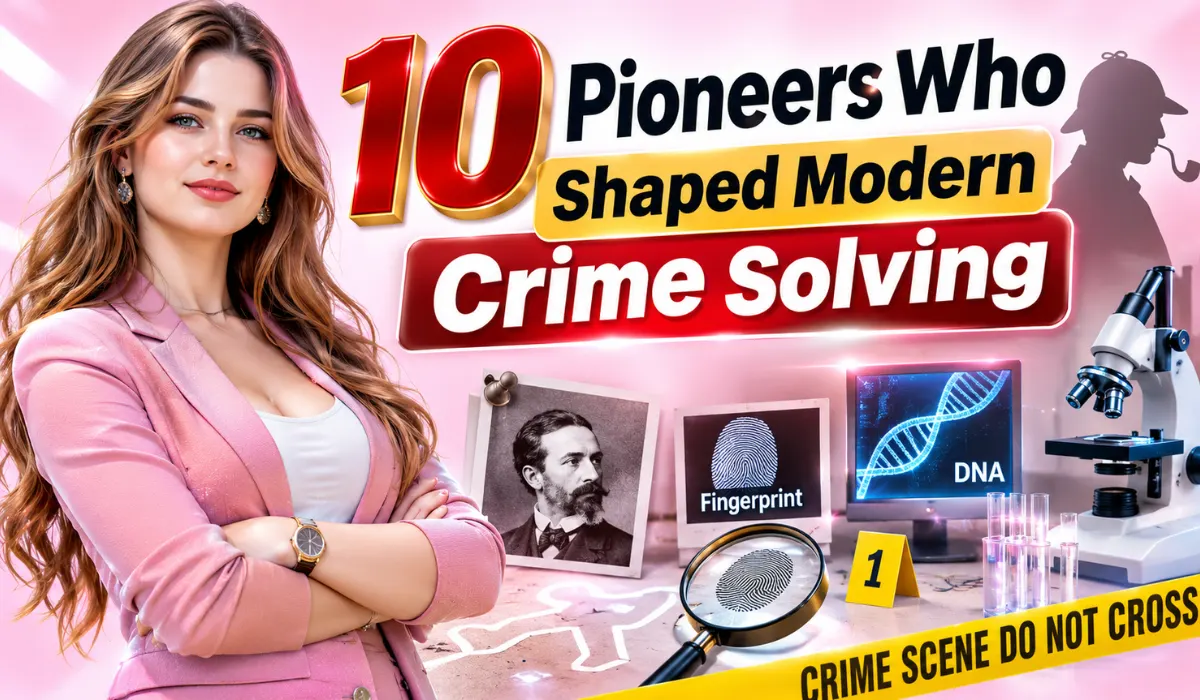
Long before police had access to DNA evidence, surveillance cameras, and high-tech laboratories, they found other ways. One method involved measuring the heads of suspects. Another method tracked down criminals by listening to microphones disguised in everyday objects. One medieval sleuth supposedly used blowflies to track down the murder weapon. As strange as it seems, much modern police work has followed the same approach.
Walter Dew Used Radio to Chase a Killer Across the Atlantic
Walter Dew, a chief inspector at Scotland Yard, was trying to track down Cora Crippen when she went missing in 1910. He eventually found her dismembered body under the cellar floor of her matrimonial home with her husband, London doctor Hawley Crippen. Crippen had fled on a ship with his lover, Ethel Le Neve, posing as father and son. When the ship's captain spotted them from newspaper photographs of the runaways, he wirelessly reported the incident to Scotland Yard. Dew transferred onto a faster vessel and caught them, arresting Crippen as soon as he disembarked in Canada.
Kate Warne Disguised Herself to Save President-Elect Lincoln
In 1856, the Chicago-based agency of Allan Pinkerton hired Kate Warne, a 23-year-old widow, making her America's first female private investigator. Warne felt women could access places that were off-limits to male cops. She did so under cover, getting confessions from the perpetrators of several sensational crimes. By February 1861, Warne, undercover in Baltimore, learned that secessionists planned to murder president-elect Abraham Lincoln on his train ride to his inauguration in Washington. Disguised as a crippled relative, agents smuggled Lincoln onto the train and escorted him, under cover, all night to Washington.
Juan Vucetich's Fingerprint Match Cracked the World's First Fingerprint Murder Case
In 1891, Juan Vucetich, a Croatian-born police statistician working in La Plata, Argentina, created a fingerprint identification technique he termed dactyloscopy. A year later, investigator Eduardo Alvarez, who had been trained in dactyloscopy, identified the murderer of two children in Necochea using that technique. A neighbor was under suspicion, but Alvarez identified a bloody thumbprint on the doorframe and determined that the print was not the neighbor's. It was the mother of the children, Francisca Rojas.
Song Ci Used Blowflies to Expose a Killer in Medieval China
Song Ci, a 13th-century judge in Imperial China, became irritated when certain local magistrates didn't know what killed a person, so they would execute the wrong party. In 1247, he published the first ever guide on forensic methods to find out how someone died, from differentiating between present and post-mortem injuries to figuring out if there was any poison. Once, he instructed villagers to place their sickles on the floor. Flies hovered all over the sickle that showed up with the only non-visible blood traces, and the owner admitted.
Isabella Goodwin Posed as a Cook to Crack a Manhattan Heist
In 1896, when they assigned women cops to the custody squad, Isabella Goodwin was recruited to the New York police force. After thieves drove away with a taxicab filled with $25,000 in bank funds in February 1912, male cops were unable to solve the crime. Goodwin posed as a cook in a home run by the girlfriend of a suspect and monitored gang conversation. Using her information, she captured the gang members within a month. Police Commissioner Rhinelander Waldo proclaimed her the first woman in the city to hold the position of Detective First-Grade.
Dr. Joseph Bell Read Bullet Wounds to Solve a Real Murder Trial
He served as a medical lecturer at the University of Edinburgh and as a forensic consultant to the Scottish courts and police. He could tell a person's occupation or social standing by their gait, their hands, or even by the way they stained their clothes. When asked in 1893 to investigate the beheaded victims in the Ardlamont murder trial, he examined the trajectory of the bullets and actually shot holes in the clothing to prove the killers had not shot the victims accidentally. His own student, Arthur Conan Doyle, wrote to him in letters that he was the model for Sherlock Holmes.
Allan Pinkerton Chased Fugitives Across State Lines No Police Could Follow
A Scottish-born barrel-maker, Pinkerton became Chicago's first official police detective in 1849 and opened his own business the following year. Since city cops could no longer follow a suspect once he crossed a state line, banks and trains employed Pinkerton's men to pursue train robbers and other law-breakers nationwide. Pinkerton's operatives adopted extensive snooping of suspects in plainclothes and cataloged their likenesses in a central database, creating an early "rogues' gallery." Pinkerton's agency attributed its "all-seeing eye" seal, though not conclusively, as the source of the phrase "private eye."
FAQ's
Who is considered the pioneer of modern criminal profiling?
Dr. James A. Brussel is widely recognized for his groundbreaking work in psychological profiling during the 1956 "Mad Bomber" case in New York.
How did Alphonse Bertillon revolutionize suspect identification?
He developed anthropometry (Bertillonage), a system of precise physical body measurements used to uniquely identify criminals before fingerprinting became standard.
What is Edmond Locard’s major contribution to forensic science?
He formulated the Exchange Principle, which states that "every contact leaves a trace," laying the foundational philosophy for all modern trace evidence analysis.
Why is Sir Francis Galton important in crime-solving history?
Galton established the first scientific classification system for fingerprints, proving their uniqueness and permanence for forensic identification.
Who introduced modern scientific crime laboratory practices?
Locard established the world's first police crime laboratory in Lyon, France, in 1910, transforming forensic investigation into an empirical science.