It seems our earliest ancestors liked nothing more than to build impressive structures! The world’s oldest man-made structures stretch far beyond humble huts, from megalithic temples and early pyramids to prehistoric mounds and marvels of Aboriginal engineering. We’ve drawn together just some of the most remarkable feats across all 7 continents, to give us a glimpse into our creatively rich human past.
Europe: Dolmen of Menga, Spain
Europe's largest known megalithic monument – the Menga dolmen in Antequera – has also been claimed to represent the pinnacle of Neolithic engineering, since ancient builders constructed its tomb of massive stones arranged to create burial rooms inside a great grass-covered mound in the dawn of the Copper Age (around 2500 BC). Prehistoric humans used strong grass ropes with some ingenious knots to raise the colossal blocks up the hillside – possibly using wooden levers or scaffolds, and definitely using gravity, aided by strong teams of local farm workers enjoying time off.
Europe: Newgrange, Ireland
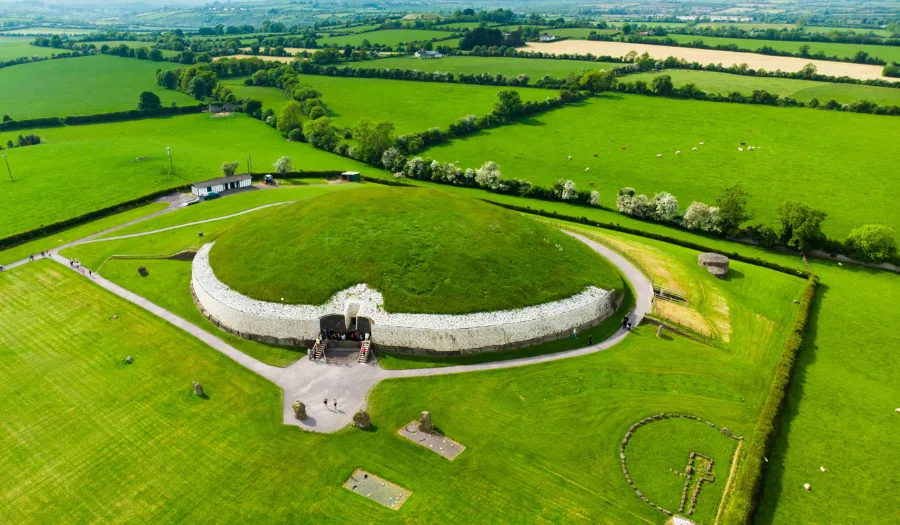
Newgrange, 5000 BC The light rays penetrate Newgrange, the passageway and temple on the east of Ireland at the times of the solstice. The Neolithic farmers (c. 3200BC) made this great monument using stones rolled and waterworn from the river Boyne; it covers a full acre and has 97 keystone ornaments to the exterior around the base and is still water-tight even after 5000 years through its corbelled roof and inner chamber at the end of the long tunnel.
Europe: Ggantija Temples, Gozo, Malta
Aptly described by their monumental scale: Ggantija (meaning 'belonging to the giant' in Maltese), is another, with local folklore naming giants the designers. More credibly, researchers have dated it to humans sometime between 3600-2500BC. On a plateau just outside the Gozitan town of Xaghra, these free-standing chambers once had roofs, now covered in plaster with painted decorations; as in most of the cases above, the exact purpose of this site is still unknown, but experts theorize it served for fertility rituals.
Europe: West Kennet Long Barrow, Wiltshire, England, UK
One of Britain's best known and best-preserved accessible Neolithic burial sites, The West Kennet Long Barrow dates back to around 3650 BC and remained in use for over 1000 years. Researchers have assigned the dates 3000 to 2600 BC to the human remains and burial goods found in and around the Barrow and, at around 2000 BC, people brought the long and complicated history of the cemetery to an end and buried the passageways and forecourt in rock, stone and earth. Today, however, it is completely covered in turf and its chalk sides are long since buried.
Europe: Knap of Howar, Orkney, Scotland, UK
Here, on the rugged and wave-battered coast of the Orkney island of Papa Westray, the Knap of Howar features an ancient (c. 3700 BC) and well-preserved farmstead, containing the oldest standing stone buildings anywhere in northwest Europe. Like the ‘Scottish Pompeii’ Skara Brae in the Orkney’s also, two connecting and solid stone houses contain stone seats, cupboards, hearths and pits set into their low, circular walls.
Europe: Stonehenge, Wiltshire, England, UK
Built between 3000 BC and 1520 BC in six phases on the chalkland of Salisbury Plain in Wiltshire, it is probably the most famous of Britain’s prehistoric monuments. No archaeological consensus exists on exactly how it was used, but most scholars believe it was a place of religious or ceremonial gathering place designed with the solstices to accommodate the sun’s movements. Built of carved sarsen stone menhirs (a type of freestanding stone) and smaller bluestones that were carried here from south Wales over 100 miles away, Stonehenge is part of a UNESCO World Heritage site along with the stone circle of Avebury.
Europe: Listoghil, Ireland
Largest Structure Listoghil is the biggest building in the megalithic cemetery of Carrowmore in County Sligo. It consists of an uprights structure covered by a huge roof of limestone and its largest feature contains the remains of what appears to have been a platform with charcoal deposits on it (from 4100 BC), providing the best estimate as to when Listoghil may have first been constructed. This structure is the only stone-built tomb in Carrowmore and the only one decorated with art. All of the tombs in the cemetery appear to have been positioned in relationship to it. It is also the only tomb in the cemetery that contains burials as well as cremation remains.
Europe: Cairn of Barnenez, France
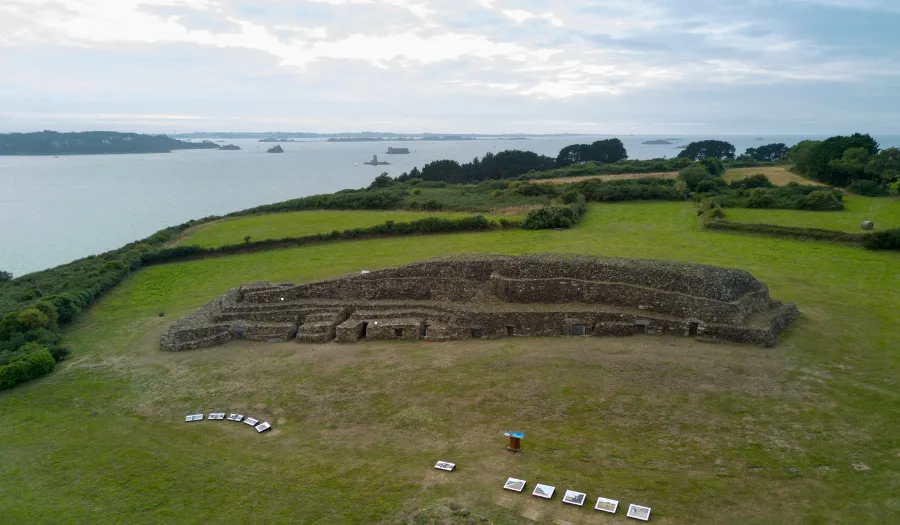
But this ancient marvel is not just an architectural marvel, it’s also the largest mausoleum in Europe, formed by two cairns separated by an underground passage containing eleven burial chambers. It was built in Brittany, two construction periods (old parts around 4800 B.C.), until 1950, when it almost disappeared and turned into a quarry paving stones, threatening the existence of the tumulus.
FAQ's
1. What exactly is Göbekli Tepe and what does it look like?
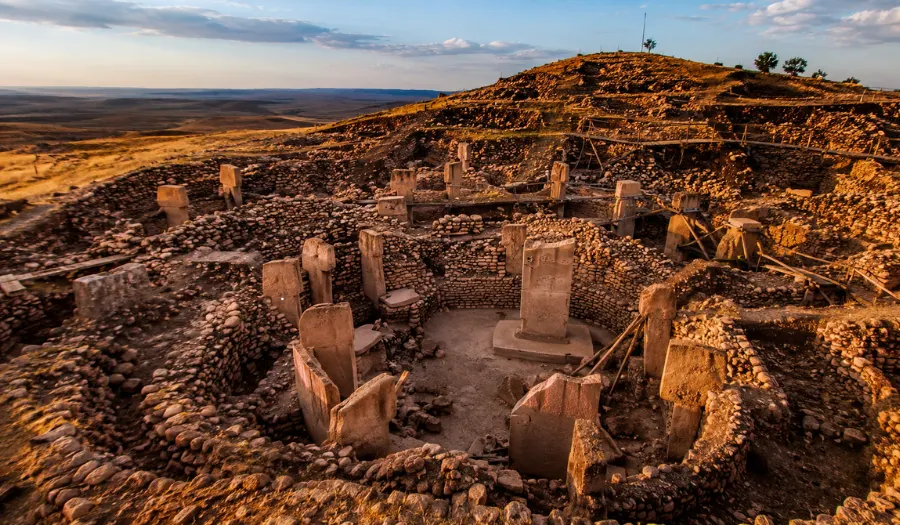
It is a massive prehistoric complex consisting of large, circular stone enclosures. The most striking features are its massive T-shaped limestone pillars, some standing up to 18 feet tall and weighing over 10 tons. Many of these pillars are beautifully carved with intricate reliefs of wild animals, including lions, foxes, scorpions, and vultures.
2. Why does it rewrite human history?
Before its discovery, historians believed that complex architecture was impossible without agriculture. The traditional timeline assumed humans learned to farm, settled into permanent villages, and then built monuments. Göbekli Tepe flips this entirely: it was built by nomadic hunter-gatherers before the invention of farming or pottery, suggesting that the desire to gather and worship actually drove the birth of civilization.
3. What was the structure used for?
Archaeologists widely consider it the world’s oldest known temple or ritual site. Because there were initially no signs of domestic structures, water sources, or agriculture nearby, it is viewed as a regional spiritual hub where scattered nomadic tribes traveled long distances to gather, feast, and perform sacred rituals.
4. How did ancient humans build it without metal tools?
The construction is a staggering feat of engineering. Using only primitive flint stone tools and sheer manpower, hundreds of prehistoric people had to quarry the multi-ton limestone blocks from nearby plateaus, haul them uphill, and carve the intricate artwork into the hard stone.
5. What is its biggest lingering mystery?
The most bizarre fact about Göbekli Tepe is how it ended. Around 8000 BCE, after being used for over a millennium, the structure was deliberately and systematically buried under thousands of tons of dirt and refuse by its own creators. Why they chose to carefully "inter" their sacred site and leave it frozen in time remains one of archaeology's greatest unanswered questions.