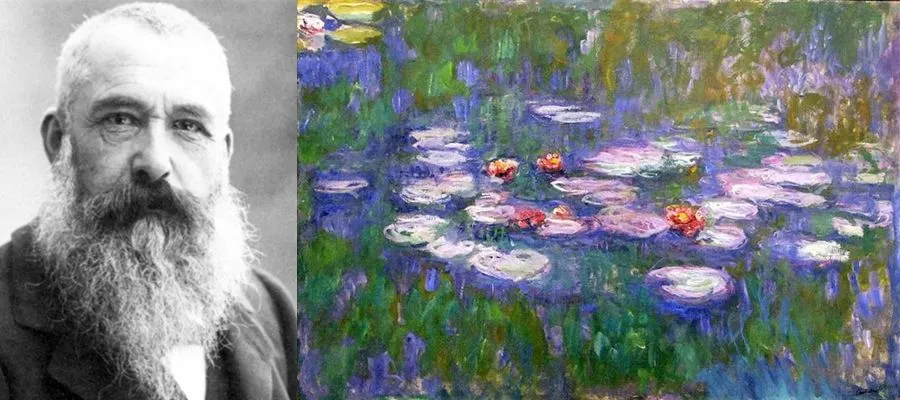
Baptized Oscar-Claude Monet in Paris on November 14, 1840, he went by Oscar throughout childhood to distinguish himself from his father, Claude. Family members called him Oscar exclusively during his youth, but he dropped the name in his twenties, signing works as Claude Monet or simply Monet.
He Painted The Same Subjects. Repeatedly
Monet used serial painting as his main visual method because he wanted to show how light and atmospheric conditions changed the same scene throughout the day. He made more than thirty outdoor paintings of Rouen Cathedral by painting directly from his natural surroundings.
Cataracts Altered His Color Perception
Monet received his cataract diagnosis in 1912, which later developed into a more severe condition. The artist changed his painting style to use red, purple, and blue colors as his primary shades during his final artistic period. The 1923 eye surgery procedure created additional vision problems for him.
He Maintained Giverny Garden for Decades
Monet dedicated himself to developing the Giverny gardens starting from 1883 until his death. He treated his water lily pond and its plants as artistic works, which he managed through his employment of gardeners who worked under his constant direction.
His Painting Accidentally Named Impressionism
The 1872 artwork "Impression, Sunrise" shows the port of Le Havre at sunrise and was first shown at the 1874 Impressionist exhibition. Critic Louis Leroy mockingly used the title to deride the loose style. The group adopted "Impressionism" as their official name, thus turning the insult into a permanent identity.
He outlived both wives and his son
His first wife, Camille Doncieux, died in 1879 at the age of 32 after suffering from a prolonged illness. He lost his second wife, Alice Hoschedé, in 1911. His first son, Jean, died in 1914 at the age of 46. Monet lived until the age of 86 despite experiencing multiple tragedies. He achieved great fame before he died in 1926.
He Destroyed Hundreds Of His Paintings
Monet destroyed his artwork through slashing and burning because his perfectionism made him reject anything he considered subpar, which resulted in the potential loss of one hundred artworks. In one 1908 incident alone, he destroyed at least fifteen major water lily canvases just before an exhibition.
He Rejected Formal Art School Training
The artist studied briefly at Académie Suisse before he rejected all forms of academic education because he wanted to learn classical techniques through indoor studio training. The artist experienced a life-changing moment when he met scenery painter Eugène Boudin at Le Havre because Boudin became his mentor, who taught him to paint outside.
Cataracts Didn't Stop Water Lilies Panels
Monet dedicated his artistic work to creating the Water Lilies series, which consists of approximately 250 individual paintings between the 1890s and 1920s. The artist created his last large artworks during his final decade, which included major pieces that he gave to France and which were displayed at the Orangerie.
He Refused Religious Last Rites
Monet was baptized Catholic as a child but became an atheist in adulthood. His refusal of last rites on December 5, 1926, showed his dedication to secular republican principles until his final moments. His views supported civil marriage, while he opposed church marriage practices.
Impression, Sunrise (1872)
This oil painting shows the early morning view of Le Havre's port, which Monet painted in 1872 from his hotel window that faced the industrial harbor. The critic Louis Leroy used this work to create the term "Impressionism," which he applied to the whole artistic movement. The sun shines with its strongest brightness because of its deep orange color, yet it produces light that equals the brightness of the surrounding sky.
Woman With a Parasol (1875)
This outdoor scene shows Camille Monet and her son Jean Monet, who are positioned on a windy Argenteuil hillside. Monet created the artwork through a low-angle perspective, which shows all vertical elements, while his brushwork technique produces unrestrained motion in Camille's dress and veil.
The Japanese Footbridge (1899)
Monet created The Japanese Footbridge, which includes a Japanese bridge that he built over his water lily pond through the garden he owned in Giverny. Monet created approximately twelve different paintings of the same scene in 1899, which showed his water garden bridge as the main subject.
Haystacks Series (1890-1891)
The main series consists of about twenty-five paintings of grain stacks in fields near Monet's home in Giverny. Monet worked on up to twelve canvases at once while he studied light and weather and seasonal changes that occurred on the same subjects.