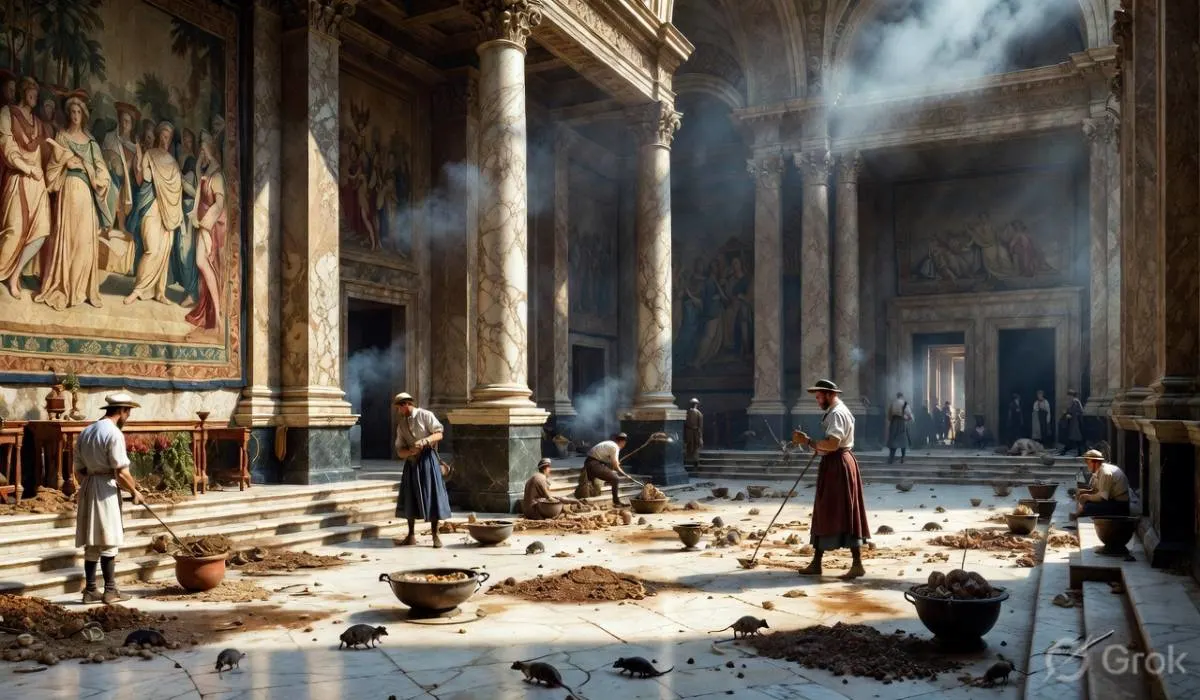
Royal palaces faced their biggest plumbing challenges during earlier times because they lacked proper wastewater systems. The building had no flush toilets or running water, so it used chamber pots which servants had to empty throughout the day. The waste collected from the building was kept in large underground storage rooms which needed to be emptied at a later time.
Gong Farmers
The unfortunates tasked with this job were known as "gong farmers" or "gong scourers." Their work required them to clean operations which matched the difficulty of cleaning horse stables but involved much larger responsibilities. According to a historical account, after four weeks of serving the court, these chambers would be filled up beyond head height.
Liberal Bathroom Policies
The courtiers who worked at the court showed no interest in finding a chamber pot. The people would urinate in public areas because they thought they could do so without being seen when they were in hallways or on staircases or near fireplaces.
Read More: Hidden Strength: How Women During the Great Depression Thrived Triumphantly?
A Damning Review of the Louvre
A visitor at the magnificent Louvre Palace in Paris in 1675 gave this account of the situation: “on the grand staircases” and “behind the doors and almost everywhere one sees there a mass of excrement, one smells a thousand unbearable stenches caused by calls of nature which everyone goes to do there every day.”
Henry VIII (1491-1547)
King Henry VIII's court had more people than most courts which created additional cleaning difficulties. He showed greater dedication to cleanliness than any other European royal did. The situation was hopeless because he was fighting an unwinnable battle.

The Royal Court
The court of Henry VIII contained almost one thousand people who occupied a single palace. The situation became particularly remarkable because the area lacked both running water and plumbing facilities.
Palace Hopping
Henry VIII maintained his main residence at Hampton Court Palace in London but he continually moved between his 60 luxurious residences which he owned throughout the country together with his court. The royal tours received public acclaim because they helped foster loyalty among his subjects yet their actual function served to create a clean environment while palace staff needed time to restore order.
The Aftermath
Royal events would create major disorder which included the need to remove human waste that had accumulated throughout the event. The king and his court would leave their current location to move to another palace which would enable restoration work on all affected farmland and livestock areas that had suffered depletion from excessive dining practices.
Unbearable Smells
According to historical sources, it is noted that a foul odor would begin to develop shortly after the court's arrival at a new palace. The unpleasant smell originates from three sources which include food waste that has built up on the floor, animal feces, the unclean habits of the residents, and the rising amount of human waste that is kept in underground storage.
Soot and Filth
The palace fires that people used for heating purposes created soot stains which contaminated all rooms and hallways of the building. The palace staff could not conduct their cleaning duties until all the people at Henry's court had departed because of the high number of people present at the court. The royal palaces of that time period had more dirt than the ordinary person maintained in their modest home
Henry the Health Inspector
The historical record shows that Henry VIII gave detailed kitchen instructions to his culinary team. He prohibited working naked or in disgustingly dirty clothes, as they had previously done. He banned kitchen staff from sleeping in the kitchen area. You'd think that would all go without saying...
Discarded Dishes
The courtiers received orders against disposing dirty dishes through hallways after meals but they disobeyed this command. The ruler became angry because he caught people leaving their dishes on his bed.
A Very Expensive Napkin
Visitors at the court left their waste on the floor and used the valuable tapestries which decorated the walls as their method of cleaning their hands. Henry needed to issue a warning which declared that anyone who committed those offenses would face physical harm as punishment for their violations.
Charles II (1630-1685)
British royals have always been renowned for their love for animals. King Charles II, in particular, gained fame for his affection towards his cherished spaniels, which were eventually named Cavalier King Charles Spaniels. The bedroom of the King served as a resting place for multiple flea-infested dogs who slept there every night.
Smelly Distractions
The royal palaces could not reach complete cleanliness so they decided to hide their foul smells from visitors. The courtiers who worked in the palaces used perfumes and scented sachets to hide their body odors while the royal palaces used fragrant plants and flowers to create a pleasant atmosphere.