

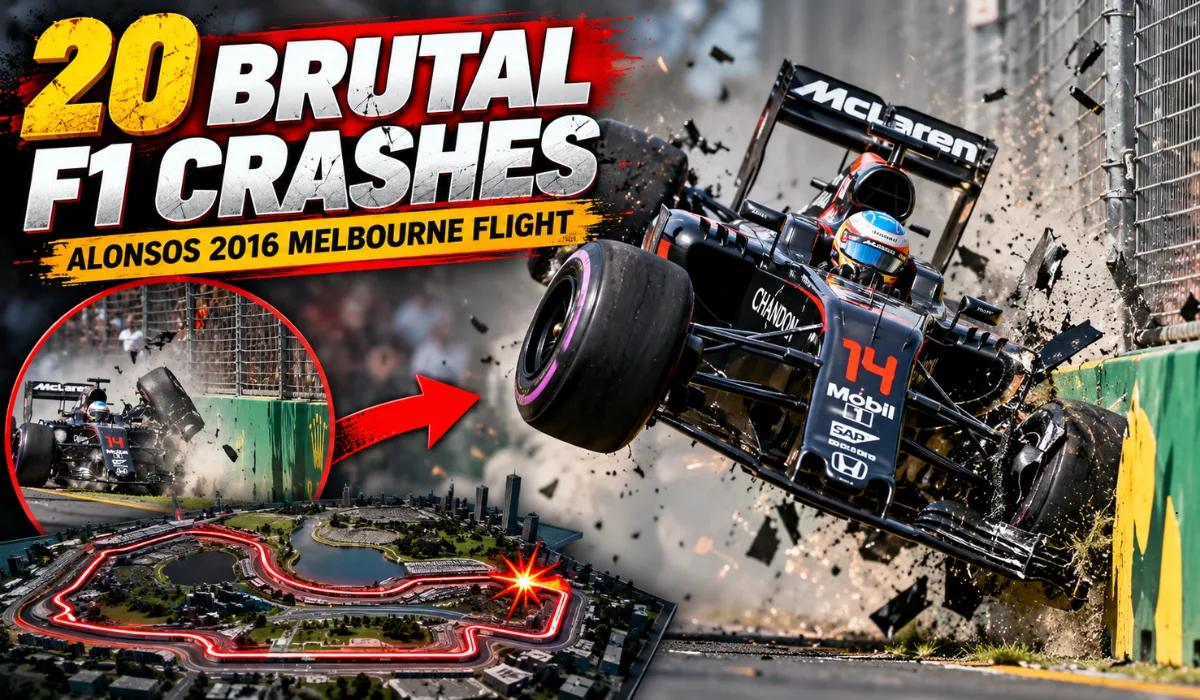
Fernando Alonso collided with Esteban Gutiérrez in 2016. His McLaren lifted off into the air, cartwheeled across the gravel surface, and then flipped over upside down during the dramatic crash. Alonso managed to get out of the car and walked away without assistance from anyone nearby, but he unfortunately suffered cracked ribs and a collapsed lung, which ultimately prevented him from participating in the following racing event.
Helmuth Koinigg’s Barrier Failure, 1974
Helmuth Koinigg ran wide at the United States GP in 1974, which many believed was due to a suspension or tyre issue, and then he hit a steel barrier that was poorly secured, causing it to fall down. Koinigg died instantly and the tragic incident highlighted the significant dangers posed by safety barriers that are not properly secured.
Jules Bianchi’s Collision, 2014
Around this time in 2001, Eddie Irvine and a young Luciano Burti exchanged paint when Burti snapped his front wing, went off the racing line through the gravel, and ended up buried under a multitude of layers of tire barriers. In a heroic effort, Irvine pulled over to help, while Burti managed to escape with only a concussion and bruising.
Niki Lauda’s Nürburgring Fire, 1976
At the German Grand Prix in 1976, Ferrari driver Niki Lauda crashed into an embankment and bounced back onto the track in a ball of flames. Brett Lunger's Surtees crashed into the wreckage left by Lauda, and Arturo Merzario, along with a handful of others, stopped to drag Lauda out of the inferno. Although Lauda suffered severe burns and inhaled so much smoke that he sustained damage to his lungs, he made a quick and impressive return to racing just six weeks later.
Roland Ratzenberger’s Accident, 1994
Renowned for his qualifying speed, Roland Ratzenberger broke his front wing while he was qualifying for the 1994 San Marino GP. However, he made the decision to keep going, and despite the damage, his compromised car ultimately careered into a concrete wall, breaking his skull and tragically causing him to die.
Gilles Villeneuve’s Fatal Crash, 1982
Gilles Villeneuve was completing a qualifying lap for the Belgian Grand Prix in 1982 when he caught up to Jochen Mass. Both Mass and Villeneuve attempted to move out of the way, which caused the Ferrari to strike the back of the slower March car and launch into the air. Villeneuve was thrown from the disintegrating car and tragically suffered fatal neck injuries.
Zhou Guanyu’s Upside-Down Crash, 2022
George Russell made contact with Pierre Gasly at the British GP in 2022, which launched Russell's Mercedes into Zhou Guanyu's Alfa Romeo. Zhou's car then rolled over, sailed over the tire barrier, and became entangled between the barrier and the spectator fencing. He emerged unscathed, though it required a "ridiculous amount of effort" from the rescue crews.
Tom Pryce’s Tragedy, 1977
In 1977, a fire on Renzo Zorzi’s Shadow prompted the two young marshals to run across the track in a desperate attempt to address the situation. Tom Pryce approached at racing speed behind another car and struck 19-year-old Frederik Jansen van Vuuren, whose fire extinguisher then struck Pryce’s helmet with fatal force. Sadly, both men were killed instantly in the tragic incident.
Roger Williamson’s Uncontrolled Fire, 1973
A blow out was experienced by RP in 1973 at the Dutch GP, causing him to crash and burn. David Purley stopped, ran across the circuit, and tried to roll the car back over with inadequately equipped marshals trying to help. Williamson was trapped in the flipped car, and the ineffectual effort was ridiculed and lampooned in the press.
Michael Schumacher’s Broken Leg, 1999
A rear-brake fault caused Michael Schumacher to hit the gravel trap at Stowe during the 1999 race. In a race-defining moment, after breaking his leg in two places, he hit the tire barriers at Stowe head-on, traveling at a speed of 160km/h, which resulted in the destruction of the front of the car and a broken leg. It would take him six races to make a comeback.
Ronnie Peterson’s Start-Line Pileup, 1978
Prix experienced bad luck that seemed built into his race. Certain cars rushed off the starting line before the back of the field had even come to a stop. During the opening lap, a number of drivers crashed out, and flames consumed the Lotus of Ronnie Peterson, who emergency responders then pulled from the wreckage with serious leg fractures, but he tragically died in the hospital the next day.
Martin Brundle’s First-Lap Wreck, 1996
David Coulthard's McLaren nudged Brundle in 1996. But that was how it began—Brundle's car leapt on top of the former and flipped through the gravel, breaking into two before hitting the fence. He escaped, did a medical, and returned to the grid.
FAQ's
1. What caused Fernando Alonso's 2016 Melbourne crash?
On lap 17 of the Australian Grand Prix, Alonso's McLaren clipped the rear of Esteban Gutierrez's Haas at high speed while attempting an overtake, triggering a violent sequence.
2. How violent was the impact?
Data recorders later revealed that Alonso sustained a massive peak impact of 46G when his car slammed into the barriers and barrel-rolled into the gravel trap.
3. Did Alonso suffer any injuries?
Though he miraculously walked away from the mangled cockpit, subsequent medical checks revealed he suffered broken ribs and a pneumothorax (collapsed lung).
4. Why did he miss the next race?
Due to the chest injuries and the risk of further complications under high-G forces, FIA medical officials ruled him out of the following month's Bahrain Grand Prix.
5. How did the crash influence F1 safety?
The terrifying airborne wreck heavily reinforced ongoing paddock safety discussions, highlighting the incredible strength of modern survival cells and accelerating research into cockpit head-protection systems.