

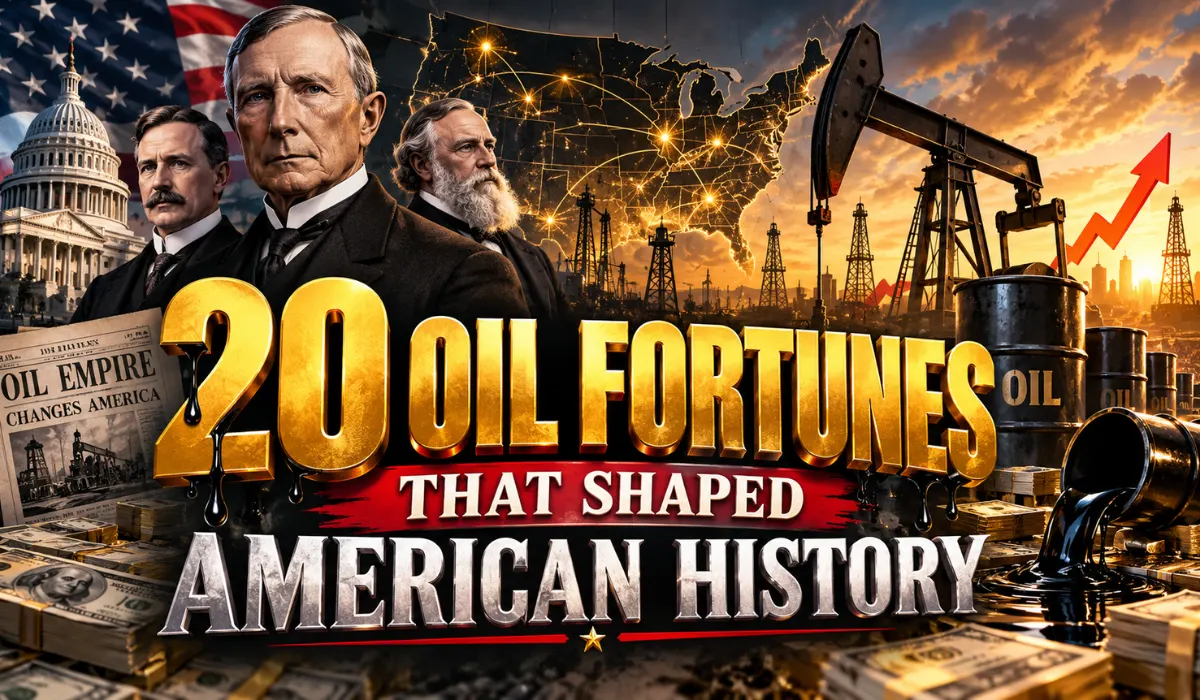
This article is more than 15 years old. John D. Rockefeller founded the Standard Oil, which was the leading U.S. oil refiner. Public outcry forced the government to dismantle it in 1911, with dozens of small companies emerging that would later become Exxon, Mobil and Chevron. Instead of destroying him, the breakup inflated the stock prices of the newly independent companies, and Rockefeller went on to become the first American officially identified as a billionaire. He donated more than $500 million - including to the university that bears his name.
Howard Hughes Sr. Patented the Bit That Opened the World's Oil Fields
Texas businessman Howard Hughes Sr. patented a two-cone rotating drill bit that he developed with a partner in 1909. Until then, drillers used flat bits that blunt when they struck hard rock, but the cone bit chews right through it, unlocking huge supplies of oil all over the world. Hughes didn't sell bits; he leased them, earning income long after the upfront cash. However, when Howard Hughes Sr. died in 1924, his 18-year-old son inherited the money, not the patent, and bought planes and movies with it.
Paul Getty Bet Millions on an Empty Desert and Won
In the 1930s, J. Paul Getty purchased cheap stocks in oil companies and became a millionaire in oil. Getty plunged $9.5 million into the rights to drill a desert strip between Kuwait and Saudi Arabia, an area in which no oil had ever been discovered. After years of looking, his crew discovered oil in Wafra, an area that already had billions of barrels in the ground. In the years to come, Fortune Magazine would call Getty the richest American ever, and he would eventually establish the J. Paul Getty Museum in Los Angeles on his fortune.
Edward Doheny Delivered a Bribe in a Black Bag and Walked Free
Edward Doheny hit oil in Los Angeles with a sharpened eucalyptus log and started the Southern California oil boom. When Doheny later applied for leases on a government oil reserve, he sent his son to present Interior Secretary Albert Fall, a cabinet official, with a black bag stuffed with $100,000 in cash. During a Senate investigation, the bribe exposed him and it became the focal point of the Teapot Dome scandal, leading to Fall's conviction for accepting the bribe. A separate trial found Doheny not guilty of giving it.
Harry Sinclair Served Prison Time for Tampering with His Jury
The grinning green dinosaur: Harry Sinclair created Sinclair Oil and, having paid off Secretary of the Interior Albert Fall over $300,000 in cash and bonds for the lease to drill at Teapot Dome, a federal oil reserve in Wyoming, he bribed the Supreme Court to overturn the lease. In his subsequent trial, Sinclair's henchmen followed the jury, and a jury found him guilty of contempt of Senate and jury-tampering. After prison, he returned to Sinclair Oil.
Dad Joiner's Broke Wildcat Well Crashed the Price of oil
Columbus Marion "Dad" Joiner, a 70-year-old wildcat driller on the brink of bankruptcy in Rusk County, Texas, struck the East Texas Oil Field when his well hit. He overpromised his lease interests in order to finance his drilling venture. The legal proceedings required him to sell the acreage to the oil magnate H.L. Hunt for $1.33 million. The excess of oil drove prices down and caused the state to restrict the output of companies.
H.L. Hunt Built an Empire on Someone Else's Discovery
H.L. Hunt was a professional gambler by trade and did not discover the East Texas Oil Field. Hunt saw the potential of the East Texas Oil Field, and in 1930, he purchased Dad Joiner's 4,000 acres for $1.33 million and struck oil at the exact center of the field. Hunt's oil firm became one of the largest private oil companies in North America. Hunt was a humble man and funded a conservative radio and TV network that would influence America's politics for years to come.
George Bissell Financed the Well That Started the Oil Industry
In 1853, a lawyer from New York named George Bissell saw something oily and dark bubbling near Titusville, Pennsylvania. He could likely refine it into a cheaper fuel for lamps than whale oil. Bissell formed a company, then called in a chemist from Yale who confirmed that the oil could be used as a fuel. Bissell then paid a retired railroad conductor, named Edwin Drake, to drill for it. Drake struck oil in 1859, and the first oil boom was on. Bissell drove a hard bargain for the land and transport rights he acquired from the new boom town, and died a millionaire.
FAQ's
1. Which discovery kicked off the American oil boom?
Colonel Edwin Drake struck oil in Titusville, Pennsylvania, in 1859, proving petroleum could be extracted commercially and sparking the nation's first major rush.
2. How did John D. Rockefeller build his massive fortune?
Rockefeller founded Standard Oil in 1870, systematically buying out competitors and controlling refining and transportation to monopolize the American oil market.
3. What role did Texas play in changing the industry?
The Spindletop gusher near Beaumont, Texas, in 1901 produced a massive surge of crude oil, shifting the center of American petroleum production westward and fueling the rise of new tycoons.
4. How did World War I and II impact oil fortunes?
Global conflicts drastically increased the demand for mechanized transport, aviation fuel, and lubricants, catapulting oil barons and corporations into unprecedented global economic and political power.
5. Why do these historical oil fortunes still matter today?
They laid the foundational infrastructure for modern energy markets, pioneered corporate monopolization laws, and funded massive philanthropic foundations that still shape education and medicine.