


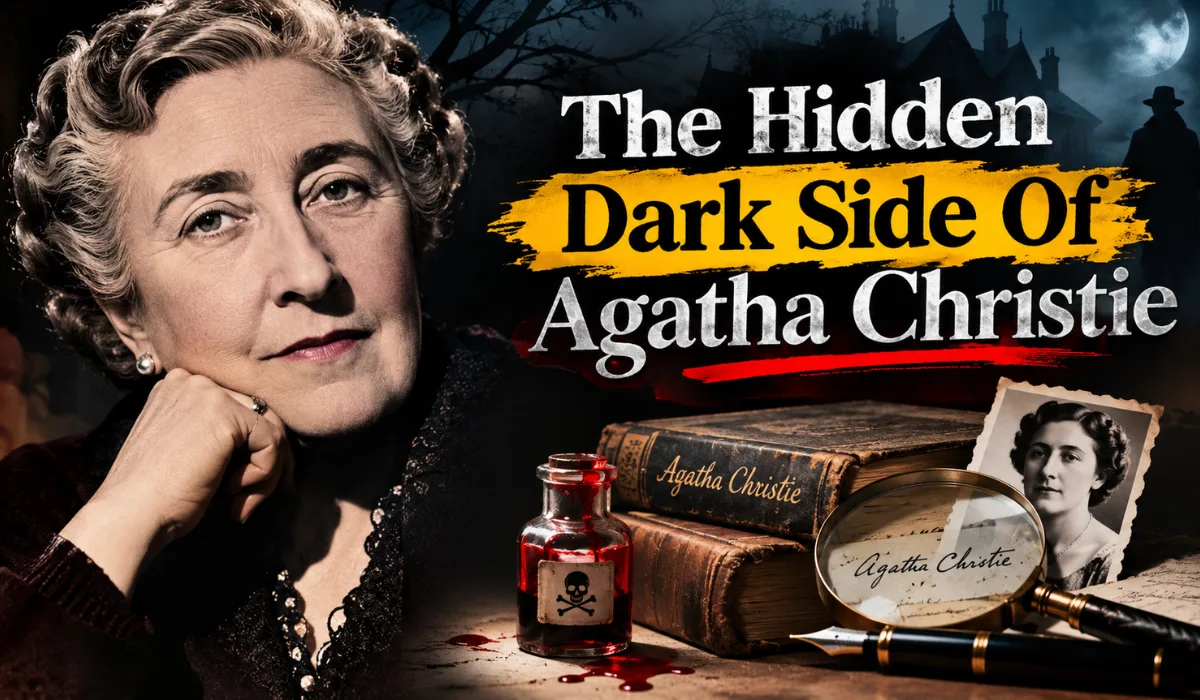
Agatha Christie became synonymous with the cosy crime. From the flamboyant Poirot to the seemingly innocent Miss Marple, her stories set themselves against a background of idyllic rural English life, briefly marred by murder and mayhem. And Christie herself was never cosy; all her books contain deeply layered characters, plots, and incidents taken from her own turbulent life.
She had something to teach me about heartbreak
Author Cathy Rentzenbrink is a Christie addict who found herself in a cluster of personal and professional crises, turning to the Queen of Crime for solace. But as she explains in her latest book The Agatha Christie Cure, she faced many challenges that tended to mirror her own. "As my own life spiralled out of control," Rentzenbrink explains. "I became obsessed with the one woman who seemed most like me: Agatha Christie. I read all her novels in order and saw her life fall apart through each one, although 1926 seemed to be especially destructive."
Always an outsider
While close to being a quintessentially British author, Christie always saw herself as an outsider, using the story of a sneaky outsider watching the bizarre goings-on of those around her. Agatha Miller was born on 15 September 1890, the youngest of three children to a moneyed upper middle-class family in Torquay, Devon. Fred Miller, her father, was a wealthy and gregarious American, and Clara was a native of Dublin whose grandfather was half-German. When Agatha was born, Fred had it all, but secretly fund his family life while his fortune began to dwindle, family secrets he kept from them. When he suddenly died in 1901, the family suddenly faced a financial famine. Her mother's world fell apart with not only her father dying but seeming to transform before her eyes.
The outbreak of war and witnessing people from all social classes intermingling
Although Christie wanted to attend university, her mother intended to find her a suitable rich husband and to look after the family's finances. In October 1912, a dance in a local hall made Agatha fall in love with a handsome, dashing pilot, Archie Christie. They married and immediately separated as Archie was called to France to serve in the First World War. Agatha volunteered at a local hospital in Torquay to treat wounded men returning from the front. She experienced firsthand how all social classes mixed, as well as witnessed quite how incompetent those in charge could be. It left her with a deep mistrust of those in charge. Her novels later contained several stock characters who appeared to be in charge yet failed abysmally at the task. Her work at the local chemist also provided her with extensive knowledge of poisons, which would be invaluable in her plots. She quickly realized how simple it would be to kill someone with the right knowledge.
Establishing herself as a crime writer of merit
She pressed this new experience all into The Mysterious Affair at Styles, the first detective novel she penned in 1916. The setting featured a large but battered country estate, similar to that of her childhood home. Strychnine killed the victim, which Christie might have encountered through her medical experience. The cast brimmed with useless, vain, and over-privileged men that she encountered during her hospital employment. And as Rentzenbrink discusses, it's also a story of painful love. 'How remarkable to believe that she wrote it while Archie was in France, and the war's outcome was still in question,' she writes. Her detective, Hercule Poirot, drew inspiration from the folks she saw on the street in her hometown. Devon, just over the border from France, filled with Belgian refugees fleeing the terror of war. As an outsider herself, Christie realized that someone in this position would understand the British mind. Dapper, precise, and cool as a cucumber, Poirot proved to be an entirely new breed of detective, and he immediately intrigued the world's filmgoers. This time her novel became a hit, and more were to come. She established herself as a worthy crime author while simultaneously fulfilling her roles as the wife of Archie and the mother of daughter Rosalind. But all of this shattered in 1926.
The pressure of her relentless publishing schedule
Agatha Christie published The Murder of Roger Ackroyd to critical acclaim at the beginning of the year. But as it hovered near the number one spot in the best seller's lists, a string of events nearly led to her downfall. Just as the pressures of publishing were beginning to get to her, her dearest mother, Clara, passed away. Heartbroken and unable to write, she could no longer function. In the midst of this personal tragedy, her husband, Archie, demanded a divorce, having fallen in love with a friend of Christie's and wishing to remarry immediately.
Christie's breakdown led to the authorities finding her car balanced on the edge of a chalk quarry, with her coat and expired driving license inside. She was nowhere to be found. A giant manhunt plus breathless tabloid coverage ensued, as the media delighted in the disappearance of a writer of mystery. They eventually found her at a hotel in Harrogate, where she claimed that a car crash had wiped her memory clean. Rumours persisted that this was not the case. To this day, her time in Harrogate remains a mystery; the entire incident steered her writing in new directions.
FAQ's
Did she really stage her own disappearance?
Yes, in 1926 she vanished for 11 days after her husband asked for a divorce, sparking a massive national manhunt before being found registered under an alias at a hotel.
Did she ever write under a pseudonym?
Yes, she published six romantic psychological novels under the name Mary Westmacott to explore complex human emotions outside the constraints of detective fiction.
Were her mystery plots inspired by real crimes?
Many were drawn from her experiences working as a hospital dispenser during World War I, where she gained extensive, lethal knowledge of poisons and their symptoms.
Did she harbor real-life prejudices in her work?
Early novels contained xenophobic stereotypes and offensive terminology, reflecting the casual prejudices of upper-class British society in the early 20th century.
Why did she brutally kill off her most famous detective?
Frustrated by Hercule Poirot's massive global popularity and feeling he had become an insufferable egoist, she secretly wrote Curtain in the 1940s to ensure no other writer could continue his adventures after her death.