A wealthier family (they had moved from Kairouan in modern Tunisia to Fez in Morocco) inherited a combined estate in 859 CE from Fatima al-Fihri's father and husband. She used her wealth to erect a mosque and school, which was known as al-Qarawiyyin, and which tradition describes as providing education in the Quran, law, grammar, and mathematics at no cost, according to a chronicle dating from the 14th century. UNESCO recognizes al-Qarawiyyin as the world's oldest continuously functioning school.
Mother Teresa Turned an Abandoned Temple into A Home for the Dying
Mother Teresa was born Anjezë Gonxhe Bojaxhiu in what is now Skopje, North Macedonia. She arrived in India as a Missionary Sister in 1929. After what she termed as a "call within a call," she left her teaching position at a convent school in Kolkata to serve the poor living in the slums there. The Bengal government donated an abandoned Hindu temple to her in 1952, which she turned into a hospice for the dying. This marked the launching of an international order that is still alive and active.
Mary Baker Eddy Chartered a Church and Launched a Global Newspaper
In 1866 following a serious spinal injury, American author Mary Baker Eddy created a theology based on the healing power of spiritual healing. She authored her seminal book, Science and Health with Key to the Scriptures, published in 1875, and founded the Church of Christ, Scientist in Boston in 1879. When she was 87 years old, she launched the Christian Science Monitor in 1908 as a daily newspaper for the general reader that covered international news, not a religious tract for the faithful.
Mother Mary Lange Built the First Black Catholic Order in a Slave State
Mother Mary Lange, born Elizabeth Clarisse Lange, immigrated as a free Afro-Caribbean individual to Baltimore, Maryland, a slave state were society criminalized teaching Black children. She spent many years funding her own private school. In 1829, she took the vows along with three other women and formed the Oblate Sisters of Providence, the first female Roman Catholic order for women of African descent. The Sisters nursed victims of a cholera outbreak in 1832 in a state that wouldn't free slaves until 1864.
Angela Merici Created the Church's First Uncloistered Teaching Order
Mother Mary Lange, born Elizabeth Clarisse Lange, was an Afro-Caribbean immigrant to Baltimore, Maryland, a slave state where teaching Black children was criminalized. Many years were spent by her funding her own private school. In 1829, vows were taken by her along with three other women, and the Oblate Sisters of Providence were formed, the first female Roman Catholic order for women of African descent. Victims of a cholera outbreak in 1832 were nursed by the sisters in a state that wouldn't free slaves until 1864.
Louise De Marillac Sent Nurses into the Streets of Paris
In 1633, the French aristocrat Louise de Marillac co-founded the daughters of Charity with the priest Vincent de Paul in Paris. The Daughters consisted of young peasant women who, differing from the traditional nuns, did not take the standard religious vows of poverty, chastity, and obedience. They did not live in a convent but in rented apartments, enabling them to work in hospitals, visit the sick and impoverished in their own homes, work in orphanages, and even march into war zones. Marillac personally trained the nurses and directed a number of foundling asylums across Paris.
Clare Of Assisi Wrote the First Monastic Rule Authored by a Woman
Of all the orders, her group was the smallest, with only two dozen members. In 1212, when Clare was 18, she ran away from her wealthy parents on Palm Sunday to follow the friar Francis of Assisi, who cut her hair and dressed her in a rough habit. As abbess, she defied papal orders to accept land and income for her community, and she won it instead in the "privilege of poverty." Two days before her death in 1253, the pope approved her own Rule, the first written by a woman founder of a monastic order.
Nana Asma'u Sent Traveling Teachers Across the Sokoto Caliphate
Princess Nana Asma'u was an Islamic scholar in the Sokoto Caliphate in present day north Nigeria. Her father founded the caliphate, Usman dan Fodio. Around 1838, Asma'u created a network of educated female teachers who distributed nationally to organize study groups of women who did not have the permission to leave the house. She wrote poems on law, hygiene and theology for her students in four languages so that women who were not allowed outside could learn.
FAQ's
1. Who are some prominent religious women known for building powerful empires?
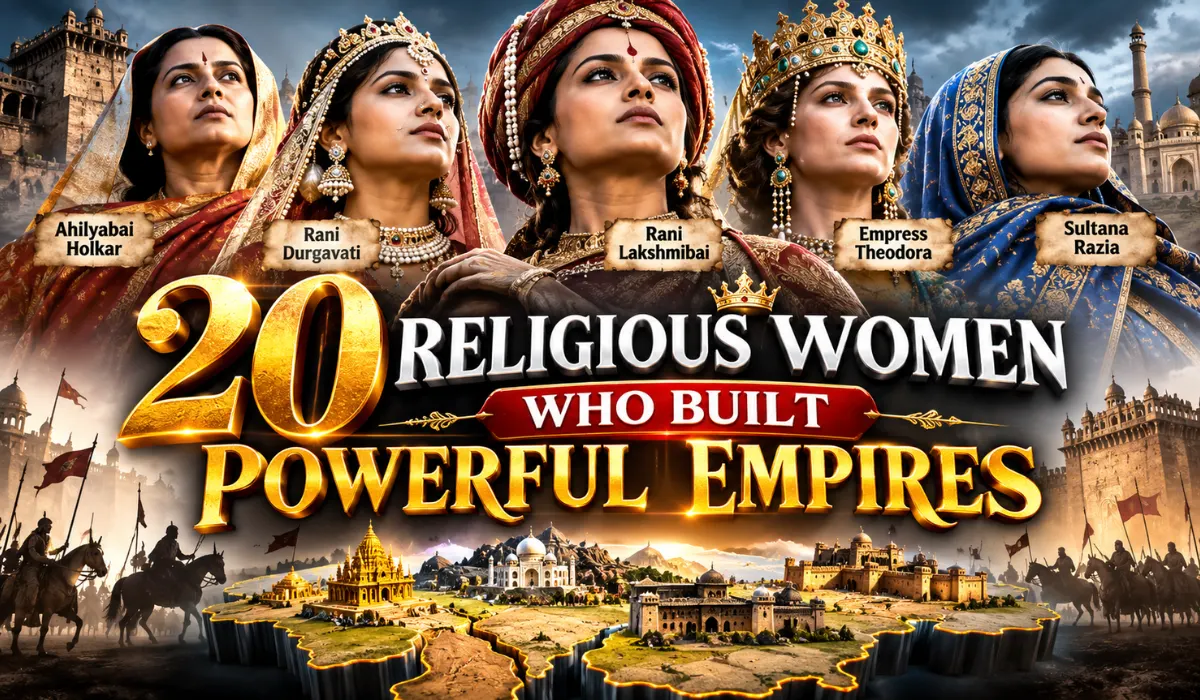
Notable figures include Empress Theodora of the Byzantine Empire, Hatshepsut of Egypt, Queen Victoria of the British Empire, and Empress Wu Zetian of China, all of whom used religious authority or divine right to consolidate immense political power.
2. How did these women use religion to strengthen their rule?
They often legitimized their leadership by claiming divine mandate, patronizing religious institutions, commissioning sacred architecture, or portraying themselves as earthly representatives of deities or the faith.
3. Were these rulers exclusively political leaders, or did they hold religious titles?
Many held dual roles as both temporal monarchs and supreme religious heads or chief patronesses, allowing them to dictate both state policy and ecclesiastical or ritual practices.
4. Did their religious devotion limit their ability to govern effectively?
Rather than limiting them, their alignment with prevailing religious frameworks often disarmed political rivals, fostered deep loyalty among subjects, and provided moral justification for expansion and warfare.
5. Where can I find the complete list of all 20 historical figures?
Comprehensive historical accounts and biographical compilations detailing all 20 rulers can be found in specialized historical texts focusing on female monarchs, sacred kingship, and imperial history.