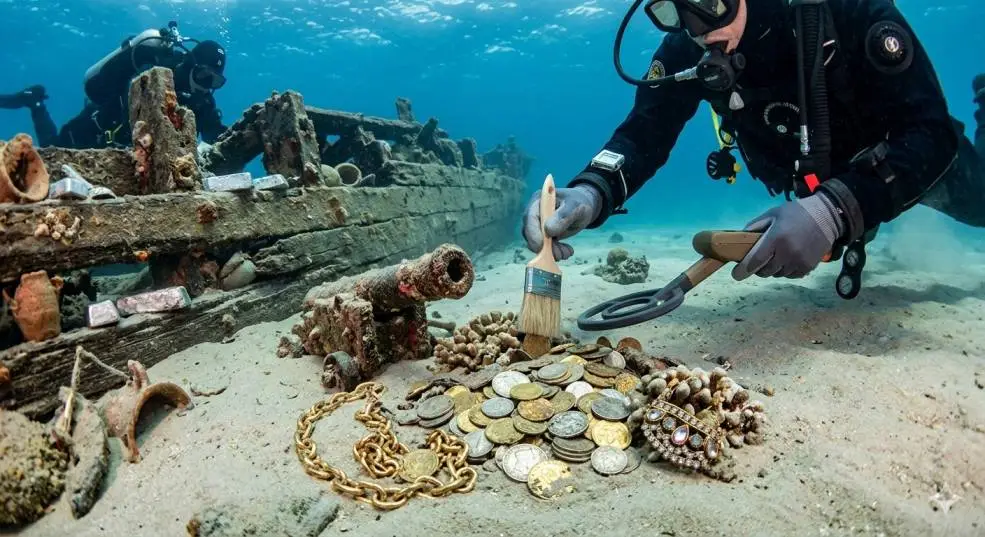
The RMS Titanic, which holds the title of most famous shipwreck in history, sank during its first journey in April 1912. The wreck was not found until 1985 by oceanographer Robert Ballard.
The ship had split into two parts which resulted in the loss of most of its cargo and the deterioration of its remaining contents. Some items were, however, recovered in good condition and have sold for thousands at auctions.
The total estimated worth of the find is USD 200 million, although more treasures are thought to be buried on the ocean floor waiting to be found.
The Underwater Sphinx: A Forgotten Piece of Ancient Alexandria
In 1992, archaeologist Franck Goddio discovered one of Egypt's greatest underwater treasures. The ancient city of Alexandria emerged from the Mediterranean Sea after being submerged for centuries due to earthquakes and tidal waves.
Among these was a huge sphinx statue, estimated to be more than 2,000 years old. The ancient statue, which has a value of USD 600 million, currently resides in the Cairo Museum where it draws visitors from every part of the world.
The Salcombe Shipwreck: Layers of Lost Gold
Off the coast of Devon, England, the town of Salcombe attracted global attention in the 1990s when divers uncovered a wreck laden with Moroccan gold, dating from the 17th century. The same location produced another astonishing discovery in 2004.
The sea bed alteration revealed both a Bronze Age vessel and 13th century artifacts. Experts believe that the total value of the discoveries exceeds USD 800 million while they expect additional treasures to be hidden within the sand.
Rms Republic: The Sunken Fortune Worth USD 7 Billion
The RMS Republic was wrecked in 1909 when it struck another ship. The ship carried 1,500 passengers who came from wealthy backgrounds. The passengers survived the incident, but their valuables sank with the ship.
There are serious suspicions that the Republic was carrying gold for the Russian government as well. Treasure hunters, including Martin Bayerle in 1987, have searched for the loot but have yet to uncover it. Specialists estimate the gold alone may be worth USD 7 billion today, excluding the other personal fortunes lost in the wreck.
Caesarea’s Roman Gold: A Priceless Discovery
In 2015, scuba diver Zvika Fayer made what would become one of Israel's most sensational underwater finds. While exploring a shipwreck off the coast of Caesarea, he found nearly 2,000 gold coins, statues, and other Roman-era artifacts.
The ship is thought to have gone down more than 1,600 years ago. Coupled with a comparable discovery earlier that year, this treasure is regarded as one of the most important Roman finds in Israeli history. Its worth is considered priceless because of its scarcity and historical significance.
Underwater Sphinx – USD 600 Million
Ancient Alexandria served as Egypt's most vital city because it contained Queen Cleopatra's residence and the Great Library, which stood as one of the most important libraries of ancient times.
The city experienced destruction when multiple earthquakes and tidal waves struck their territory. French archaeologist Frank Goddio discovered the city's intact remains in 1992 together with a massive sphinx statue which has a value of USD 600 million. The ocean bed contained the object which later moved to the Cairo museum where it remains on display today.
The Atocha
The year 1985 entered record books as a major maritime disaster year because the Nuestra Señora de Atocha's underwater treasure base which researchers call "mother lode" discovered its location in July that year near Key West Florida.
Famed treasure hunter Mel Fisher searched for 16 years before making the discovery. The ship known as the Atocha departed from Havana Cuba in 1622 with its treasure cargo destined for Spain but encountered a hurricane during its journey.
The public could purchase Atocha treasure items which included gold and emeralds through an auction that celebrated the discovery's 30th anniversary. The Mel Fisher Maritime Museum in Key West exhibits the entire trove which has an estimated value of $450 million.
The Antikythera Wreck
Researchers continue to discover new treasures at this ancient site which explorers first discovered on the Greek island of Antikythera in the year 1900. The wreck carries fame because of the Antikythera mechanism which scientists call the first computer because its gear-based system can track solar and lunar movements while forecasting eclipses.
The device dates back to the second century B.C. but no other artifacts from that era have been discovered. Research into its purpose is ongoing.
The ongoing expeditions at the wreck site continue to reveal new archaeological discoveries which include bronze sculptures and ceramic artifacts. Researchers have not yet found explanations for these ancient mysteries which remain unsolved.