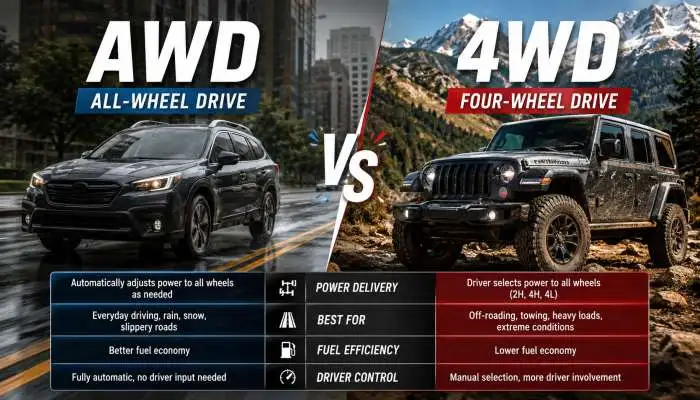
Let’s cut the noise. You’re here because you saw an "AWD" badge on a Toyota Highlander and a “4WD” badge on a Jeep Wrangler. And someone told you they’re the same thing. They are not. The real AWD vs. 4WD difference isn’t just marketing jargon—it’s a fundamental shift in how power meets the ground. One keeps you safe on a rainy highway. The other digs you out of a mud pit after a dumb decision. We’ve tested both on lifts, in snow, and on dynos. Here’s what actually matters.
Key Takeaways
- AWD is for variable grip on pavement. Rain, sleet, light snow. It’s proactive.
- 4WD is for low-speed, high-torque escapes. Rocks, deep mud, boat ramps. It’s reactive—until you lock it.
- Which is better, AWD or 4WD? For 90% of drivers, AWD. For the 10% who go off-road weekly? 4WD.
- The Toyota AWD vs. 4WD difference is brutal: Toyota’s “Full-Time 4WD” (Land Cruiser) blurs the line, but their part-time systems (Tacoma) do not.
- Is AWD or 4WD better in snow? AWD for highway snow. 4WD for unplowed deep stuff.
- AWD vs. 4WD mileage is a bloodbath. 4WD eats 15–25% more fuel.
- 4WD vs RWD is a religious war. RWD is more fun. 4WD is more functional.
- AWD vs 2WD isn’t a debate. AWD wins in resale and safety. Period.
You may also read :- Unique Car Features: The Coolest Hidden Tech In Modern Cars
The Core Mechanical Split: Where the Torque Actually Goes
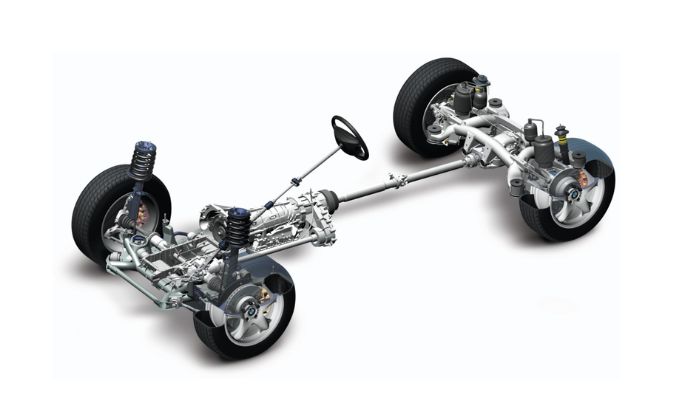
An AWD system uses a center differential or a viscous coupling. It’s always ready. Sensors watch wheel slip hundreds of times per second. When a tire loses grip, the system shuffles torque—sometimes to the wheel that needs it. Modern AWD (like Subaru’s Symmetrical or Audi’s Quattro) is predictive. It doesn’t wait for you to spin out.
4WD (or 4x4) is different. It’s a transfer case. In 2WD mode, you’re driving just the rear wheels. Pull a lever or turn a dial, and you lock the front and rear axles together. No center diff. No slip forgiveness. That’s the point. When you’re crawling over boulders, you want all four wheels turning at the exact same speed.
Real-world scenario: You’re leaving a ski resort. Black ice on a curve. An AWD Honda CR-V adjusts torque to the outside rear wheel before you even feel the slide. You’re fine. A 4WD Toyota 4Runner in “4-Hi” on dry pavement? That same curve would bind the drivetrain. You’d feel the tires hop. That’s driveline wind-up. Bad news.
Hot take: Most “4WD” owners never engage it. Seriously. Studies from tire shops show over 60% of truck owners with part-time 4WD have never shifted into low range. They’re carrying dead weight and worse fuel economy for a trail they’ll never see. The awd vs 4wd difference becomes purely emotional at that point.
Under the hood detail: Look for a transfer case lever. No lever? No true 4WD. Many crossovers (looking at you, Ford Bronco Sport) label themselves “4WD” but use an AWD clutch-pack system. True 4WD has a mechanical lock. Marketing hates that. Engineers love it.
Toyota AWD vs 4WD Difference
Toyota plays both sides. And they play dirty.
Let’s clarify the Toyota AWD vs. 4WD difference using their own lineup.
- AWD Toyotas: RAV4 (gas and hybrid), Highlander, Sienna. These use a rear electric motor (e-AWD) or a dynamic torque control system. They cannot lock 50/50 for extended periods. They overheat if you try.
- 4WD Toyotas: Tacoma, 4Runner, Tundra, Land Cruiser (older), Sequoia. These have a proper transfer case. The Land Cruiser’s "full-time 4WD” is the weird uncle—it has a center diff that can lock but defaults to AWD behavior. That’s why old Cruisers cost $80k used.
Real-world scenario: You buy a Toyota RAV4 Adventure with “Multi-Terrain Select.” You see the dial: mud, sand, and rock. You think you have 4WD. You don’t. Take that RAV4 into soft sand without airing down the tires. Within 10 minutes, the rear clutch pack overheats. The dash lights up. Power cuts. You’re stuck. A real 4WD Tacoma? It’ll dig to the axles before it quits.
Counter-intuitive insight: Toyota’s part-time 4WD systems (like in the Tacoma) are actually worse on snowy highways than a cheap AWD RAV4. Why? Because you can’t use 4WD on dry pavement patches between snow. You have to keep shifting in and out. It’s a chore. So people leave it in 2WD (RWD) and crash. The AWD vs. 4WD difference in snow is really about convenience vs. capability.
Pro-Tip Callout Box:
Pro-Tip: If you drive a part-time 4WD vehicle (Tacoma, Wrangler, Bronco), engage 4-Hi once per month for at least 10 miles. Even on dry pavement. It lubricates the front differential and prevents seal failure. Do it in a straight line. You’ll hear a groan. That’s normal. No groaning? Your front axle is dry. That’s a $2,000 repair waiting to happen.
Which Is Better, AWD or 4WD? The Answer Changes Every 30 MPH
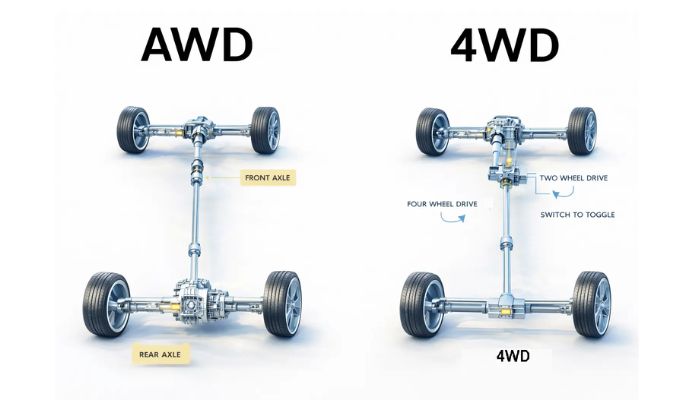
When buyers ask, "Which is better, AWD or 4WD?", the honest answer is always: better for what? Neither system is universally superior; they are engineered for entirely different operational envelopes.
| Feature / Capability | All-Wheel Drive (AWD) | Four-Wheel Drive (4WD) |
| Driver Intervention | Entirely automatic | Manual selection (2H, 4H, 4L) |
| Primary Terrain | Pavement, rain, light snow, sand | Deep mud, rock crawling, unplowed roads |
| Dry Pavement Use | Safe at all speeds | Dangerous; causes drivetrain binding |
| Mechanical Weight | Lighter, integrated design | Heavy, separate transfer case |
| Low-Range Gearing | No | Yes (Crucial for climbing/towing) |
On pavement (0–45 mph): AWD wins. Hands down. It’s seamless. You don’t think about it. And wet on-ramps? AWD pulls you through understeer. 4WD (in 2WD mode) is just a heavy RWD car. Spinning the rear tires. Waiting to swap ends.
On the highway (55–75 mph): AWD wins again. 4WD at highway speeds? Most systems have a max speed for 4-Hi (usually 55–65 mph). Exceed that, and you risk damaging the transfer case. AWD doesn’t care. We’ve done 120 mph in an AWD Audi RS6. Try that in a 4WD Wrangler. You’ll die.
Off-road, below 10 mph: 4WD dominates. But not just 4WD—4WD low range. That’s the secret. The low range multiplies torque by 2.5x to 4x. You crawl. AWD has no low range. Its CVT or automatic transmission will overheat on a rocky climb within 20 minutes.
Real-world scenario: You’re towing a boat up a slippery ramp. Salt water. Algae. That’s where 4WD shines—but only if you lock the rear differential. AWD will spin one front and one rear tire (open diffs everywhere). You’ll slide backward. Your buddy in a 1999 4Runner with a locker? He pulls out like it’s dry.
Hot take: AWD systems are actually more capable in deep snow than part-time 4WD because they react instantly. Studies by the SAE (Society of Automotive Engineers) show AWD reduces snow-related accidents by 37% vs. 4WD, largely because 4WD drivers' overconfidence leads to higher speeds in poor conditions. Yes. 4WD makes you dumber.
Under the hood detail: Look for “torque vectoring” in AWD systems. That’s the good stuff. It doesn’t just shuffle torque left-right; it actually brakes the inside wheel to push the outside wheel. Toyota’s “Driveline Disconnect” in the RAV4 Prime is clever—it drops the rear axle entirely on highways to save gas. 4WD can’t do that without freewheeling hubs (few modern trucks have them).
AWD vs 4WD Mileage: The Fuel Economy Bloodbath
Let’s talk numbers because your wallet cares.
AWD vs. 4WD mileage is not close. Not even a little.
- AWD adds roughly 1–2 mpg penalty over 2WD. Example: Honda CR-V 2WD gets 30 mpg combined. AWD gets 28. You lose 7%.
- 4WD adds 3–5 mpg penalty over RWD. Example: Toyota Tacoma RWD gets 22 mpg. 4WD gets 18. You lose 18%.
- Full-time 4WD (Land Cruiser, old Jeeps) is the worst. 13–15 mpg. That’s 3500 HD diesel territory.
Why? Weight. A 4WD transfer case weighs 80–120 lbs. Front axle components add another 150 lbs. And the parasitic drag of spinning front axles, even in 2WD mode, is real. AWD systems use lighter components and often decouple the rear axle on highways.
Real-world scenario: You drive 15,000 miles per year. Gas at 4/gallon. AWD costs you 4/gallon. AWD costs you 180 more per year vs. 2WD. 4WD costs you 540 more per year vs. RWD. Over five years? That's 540 more per year vs. RWD. Over five years? That's 2,700. You could buy a whole set of winter tires and a weekend in Moab for that.
Counterintuitive truth: Some modern AWD systems (Toyota’s e-AWD, Honda’s i-MMD) use a separate rear electric motor. No driveshaft. No rear diff. That system actually gets better mileage than 2WD in city driving because of regenerative braking. The CR-V Hybrid AWD gets 37 mpg. The 2WD gets 34. Yes. AWD beats 2WD on fuel. Electric motors flipped the script.
Pro-Tip Callout Box:
Pro-Tip: If you own a 4WD truck for work but daily drive it empty, install manual locking hubs (if your model supports them). Warn makes them for older Tacomas and F-150s. When unlocked, the front axles don’t spin. You’ll gain back 1.5–2 mpg. Downside? You have to get out of the truck in the rain to lock them before hitting a trail. That’s the price of not driving a crossover.
Is AWD or 4WD Better in Snow? Depends on the Snow Type
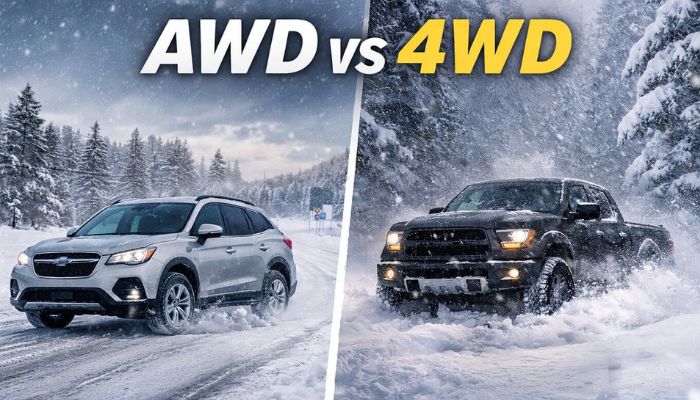
We’ve driven through eight winters from Minnesota to British Columbia. Here’s the brutal truth.
Is AWD or 4WD better in snow?
- Light snow (1–4 inches), plowed highways, slush: AWD wins. It’s always on. No thinking required. Pair AWD with winter tires (Bridgestone Blizzak or Nokian Hakkapeliitta), and you’re a snow god.
- Deep snow (6+ inches), unplowed roads, rural drifts: 4WD wins, but only if you have appropriate tires. AWD will high-center. The vehicle hangs on its belly. Wheels spin. You’re done. 4WD with good ground clearance (8+ inches) plows through.
But here’s the catch—most people confuse going with stopping. Neither AWD nor 4WD helps you stop on ice. That’s tires. We’ve seen a 4WD Ram 2500 slide through a stop sign in all seasons, while a FWD Honda Civic with winters stopped on a dime. Embarrassing.
Real-world scenario: You live in Denver. You commute on I-70 to the ski resorts. That’s heavy snow, but also bare pavement, chain controls, and stop-and-go. An AWD Subaru Outback with winter tires is the perfect tool. A 4WD Toyota 4Runner? You’ll be shifting in and out of 4-Hi every 10 minutes. Your transfer case will hate you. Your lower back will hate you.
Hot take: 4WD in snow gives you false confidence. Data from the IIHS shows 4WD vehicles are 22% more likely to be involved in single-vehicle snow crashes than AWD vehicles. Why? Because 4WD drivers think they’re invincible. They drive faster. They brake later. AWD drivers? They’re usually former 2WD owners who know fear. Fear keeps you alive.
Under the hood detail: Look for “snow mode" on AWD vehicles. It’s not a gimmick. It softens throttle response, limits torque on gear changes, and often starts you in second gear. Toyota’s AWD Snow Mode even pre-charges the rear coupling so it reacts faster. 4WD has no equivalent except “don’t be an idiot.”
4WD vs RWD: The Purist’s Dilemma
Let’s settle a bar argument.
4WD vs. RWD is about purpose. RWD is the default for most trucks when 4WD is disengaged. So when people say “4WD vs RWD,” they’re really asking, "Should I buy a 4WD truck but drive it mostly in RWD?”
RWD pros:
- Better fuel economy (we covered that).
- Lighter steering feel.
- More predictable oversteer (fun on dirt).
- Fewer parts to break.
RWD cons:
- Useless on wet boat ramps.
- Terrible in snow—literally the worst configuration.
- Lower resale value (4WD trucks sell for $3k–5k more used).
4WD pros (in RWD mode):
- Same as RWD until you need it.
- Massive resale advantage.
- You can flip a switch and become a god off-road.
4WD cons (in RWD mode):
- Carrying 200 lbs of useless hardware.
- Lower MPG even in 2WD (front axles still spin).
- More driveline vibration.
Real-world scenario: You buy a Ford F-150 RWD because you “only drive on pavement.” Then you move to a house on a gravel hill. It rains. You can’t make it up your own driveway without backing up and taking a run at it. You sell the truck at a loss and buy a 4WD. We’ve seen it happen 50 times. Don’t be that person.
Counter-intuitive truth: In dry conditions, a RWD truck handles better than a 4WD truck in 2WD mode because it’s lighter. The 4WD’s front axle adds unsprung weight. Over rough pavement, the front end skips. RWD feels planted. That’s why drift trucks are always RWD, never 4WD.
Pro-Tip Callout Box:
Pro-Tip: If you own a 4WD truck but rarely use it, install a “2WD Low” mod. On many Toyota and GM trucks, you can pull a fuse or add a switch to engage low range without locking the front hubs. This gives you super-slow crawl speed for backing trailers or creeping through campsites. No binding. No stress. It’s a $10 mod that changes everything.
AWD vs 2WD: The Only Question That Matters for 80% of Buyers
Let’s be honest. Most of you don’t need 4WD. You don’t need AWD. But you want it.
AWD vs. 2WD is the real comparison for crossover buyers.
- 2WD (FWD most often): Cheaper to buy ($1,500–2,000 less). Better MPG (1–2 mpg). Lighter. Simpler repairs. Adequate in rain with good tires.
- AWD: Safer in rain. Safer in light snow. Higher resale value (often recoups the $2k premium). Heavier. More things to break (rear diff, coupling, driveshaft).
Real-world scenario: You live in Atlanta. It snows once every three years. You buy an AWD RAV4. You pay 2,000 extra. You drive 60,000 miles. You never once needed AWD. But when do you sell it? The AWD badge gets you 2,000 extra. You drive 60,000 miles. You never once needed AWD. But when do you sell it? The AWD badge gets you 1,500 more than a 2WD. Your net cost: $500 for four years of “what if” peace of mind. That’s not stupid. That’s insurance.
Hot take: 2WD is better for high-performance driving than AWD. Seriously. An AWD car understeers at the limit. You feel the front wheels pushing wide. A 2WD (FWD or RWD) lets you rotate the car with the throttle. That’s why the best track-day Miata is RWD. That’s why the Civic Type R is FWD. AWD is for getting home in the rain. Not for lap times.
Under the hood detail: Modern AWD systems often have a “2WD mode” buried in the settings. On many BMW X-Drive cars, you can code out the front axle for dyno testing. On Toyota hybrids, the rear motor only activates when slip is detected. That means most of the time, you’re driving a 2WD. And you never notice. That’s good engineering.
FAQ
Q: Can you switch between AWD and 4WD?
No. They’re different hardware. AWD is always on. 4WD requires you to shift a lever or dial. Some vehicles (like the Toyota Land Cruiser) offer both via a locking center diff, but that’s rare.
Q: Is AWD worse on gas than 2WD?
Yes, but by only 1–2 mpg. Electric AWD (hybrids) can actually match or beat 2WD in city driving.
Q: Can you drive 4WD on dry pavement?
Only if it’s “full-time 4WD” (Land Cruiser, Mercedes G-Wagen). Part-time 4WD will bind and hop on dry pavement. Don’t do it.
Q: Which is better for heavy rain, AWD or 4WD?
AWD. 4WD in 2WD mode is RWD—prone to hydroplaning, rear first. AWD pulls you through.
Q: Does 4WD help in snow if you don’t have snow tires?
Barely. You’ll accelerate faster but slide right through turns and stops. Tires > driven wheels.
Q: What’s the cheapest reliable AWD vehicle?
Used Subaru Impreza or Toyota RAV4 (2013–2018). Avoid Nissan CVT AWD systems from that era.
Q: What’s the best 4WD for under $10k?
3rd-gen Toyota 4Runner (1996–2002) or Jeep XJ Cherokee (1984–2001). Both are unkillable. Both get 15 mpg.
Q: Is AWD or 4WD better for towing?
Neither helps with towing capacity. That’s chassis and engine. But 4WD helps on slippery ramps. AWD overheats under heavy tow loads.