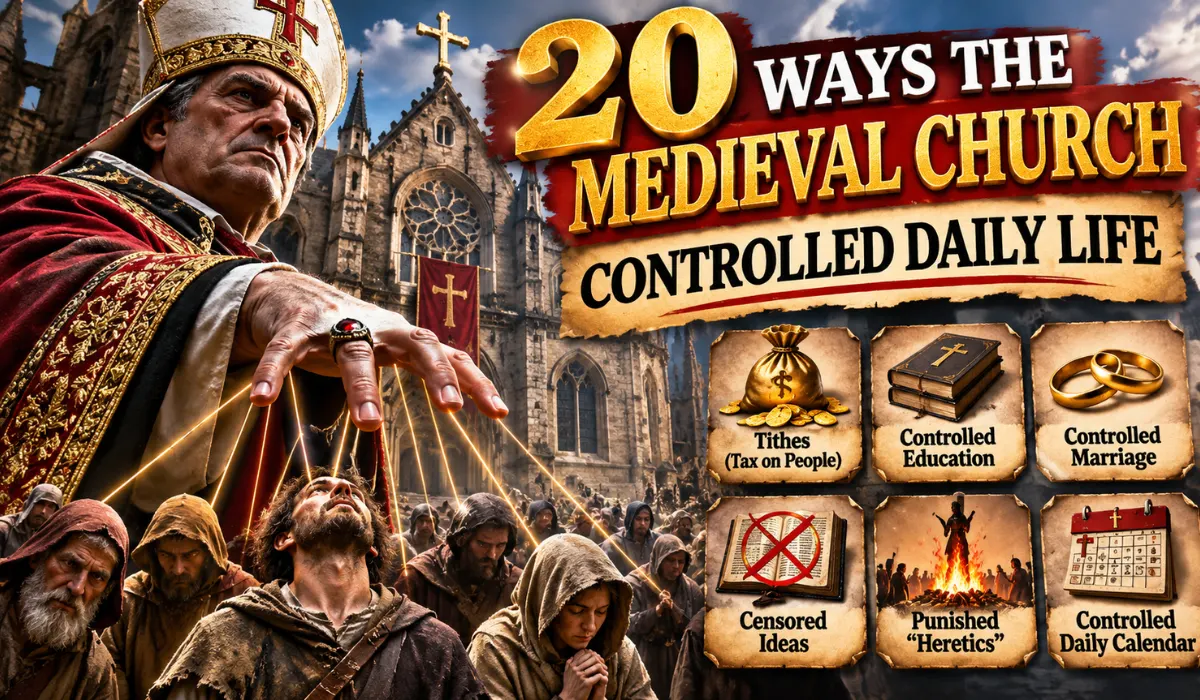
Most likely, the church centered the laws around religion. But the medieval church's regulation also affected other aspects of people's lives to a great extent. The church took part in the rights and regulations over diet, marriage, loans, and medicines. Though some rules aimed to protect other groups, some also could diminish the others' lives. There may be quite a lot of rules that some people didn't always abide by, but breaking the rules might result in consequences.
Bishop Burchard's Handbook Dictated When Married Couples Could Have Sex
In the early 11th century, a bishop in Germany called Burchard wrote a manual for the parish priests who were hearing confessions, the Corrector sive Medicus. That book contained a marital sex calendar that prohibited conjugal visits on Sundays, Wednesdays and Fridays, as well as during Lent, Advent and pregnancy. Police did not lurk in the bushes outside the bedroom. Instead, priests policed the schedule through the confessional, meting out bread-and-water penances to couples who confessed they had been up to no good.
Pope Boniface VIII Outlawed Boiling the Bodies of Dead Crusaders
Sometimes nobles who died away from home during a crusade or military campaign sliced up and boiled their carcasses to make them portable, in a practice called the mos Teutonicus. Pope Boniface VIII, the head of the Catholic Church, issued a papal bull in 1299 called Detestandae feritatis to prohibit the practice and threatened to excommunicate people who used it. He decreed that bodies should be kept intact or unskinned if taken home.
The Church Banned the Crossbow as Too Deadly for Christian Warfare
I summoned the Second Lateran Council in Rome. Among its legislation was the ban of crossbows and siege archery against any Christian under pain of excommunication, the Council judged the weapon had too much destructive power to threaten the feudal system of warfare. And in fact, the crossbow could give a farmer in the ranks the power to kill a heavily armored knight; on the other hand, it was still used against pagans during the Crusades.
A Verse from Psalm 51 Could Save a Literate Man from the Gallows
The canon law has one rule, the privilege of the forum, which protects a priest or clergyman accused of a capital crime, arguing that he goes to a church court, not the king's court, and that the church court can't sentence to execution. This proved to be exceedingly contentious in 1164 when Henry II of England had a squabble with Archbishop of Canterbury Thomas Becket over the way some clergymen had escaped punishment for high crimes. The most efficient way to identify the gentleman was to have him recite a verse from the Bible in Latin, most often the "neck verse," the first part of Psalm 51. However, all normal men knew the neck verse, and the ones who proved to be guilty usually faced forced penance, career loss, or imprisonment in church courts.
Pope Gregory III Declared Horse Meat an Abomination
In 732 AD, Boniface, a Christian missionary to the Germanic tribes, wrote a letter to Pope Gregory III, the leader of the Catholic Church, asking how he should deal with certain of the practices he was witnessing. Gregory demanded that they ban all horse meat, as it was an abomination. This was not due to concerns about sanitation or starvation, but because the Germanic and Norse pagan religion included horse sacrifice and horse feasts.
Canon Law Set the Legal Interest Rate on Loans at Exactly Zero
You might be shocked to discover that "usury" didn't originally refer to charging excessive interest, but to charging any profit at all beyond what had been advanced. Under canon law, which Pope Alexander III reaffirmed at the Third Lateran council in 1179 and Pope Innocent III codified in 1215, God claimed domain over it; therefore, nobody was allowed to sell it. Lenders unwilling to part with the benefits returned to the banker faced excommunication, denial of burial in a sacred space and inability to make a valid will.
Jews And Muslims Were Required to Dress Differently in Public
In November 1215, at the Fourth Lateran Council, Pope Innocent III's bishops declared that Jews and Muslims in Christian countries had to wear clearly identifiable attire to prevent marriages and other interactions with Christians. The Council did not establish a specific requirement. Various local secular and ecclesiastical authorities later imposed their own marks or badges, such as pointed hats or badges of different colors.
The Church Denied Christian Burial to Knights Killed in Tournaments
In fact, some churchmen condemned jousts as early as 1130. At the third Lateran council in 1179 Pope Alexander III issued an edict that anyone participating in a tournament was not to be given a Christian burial; he considered jousts a display of luxury and extravagance, as well as an expensive way to use up a nation's manpower in the Holy Land. But most kings and nobles dismissed these appeals and jousted on.
FAQ's
How did the Church dictate daily work and time?
The Church established a calendar dominated by mandatory holy days and Sundays, legally halting labor and restricting when people could work.
What was the tithe and how did it drain resources?
Every citizen was forced to pay a ten percent tax on all agricultural produce and income to support the Church, accumulating immense institutional wealth.
How did the Church control major life events?
It held a strict monopoly over vital civic milestones like baptism, marriage, and burial, dictating social standing and family legitimacy.
How did the Church police personal beliefs and thoughts?
Dissent, independent inquiry, or questioning religious laws was branded as heresy, enforcing ideological conformity through fear of spiritual and physical punishment.
What was the social impact of excommunication?
Being cast out by the Church meant immediate community ostracization, as locals were forbidden from interacting with outcasts.