The Indian agricultural landscape is currently undergoing one of the biggest transformations ever since the Green Revolution. In 2026, the advancement of technology, in the realm of AI-generated predictive analytics, to autonomous drone fleets is no longer an "future concept" but a field reality. A country in which nearly 58 percent of its population relies on agriculture, these advances can be vital to ensuring the security of food, increasing farmers' income and combating the effects of climate changes. We take a deep review of the newest technological developments in India that are revolutionizing this sector.
1. AI-Driven Precision Farming: Data as the New Fertilizer
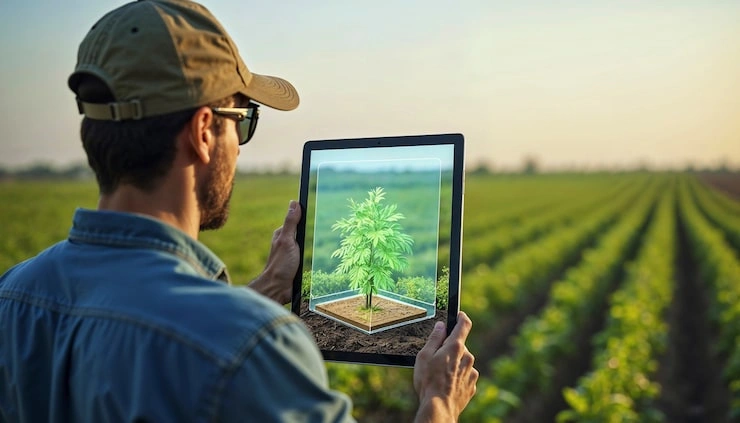
Precision farming is moving from large-scale corporate farms into smallholder farms. Data is getting equal importance to the seeds or water.
- Hyper-Local Weather Intelligence Farmers today use AI-powered applications that offer forecasts of weather conditions within a 1 km distance. This helps to avoid losses caused by extreme heatwaves or rain that is not seasonal.
- Site-Specific Nutrient Management Instead of applying a blanket fertilizer applications, IoT sensors and satellite images pinpoint specific areas of soil that require nutrients. It can reduce costs by approximately 20 20% and also prevents soil degradation.
- The Predictive Pest Control AI models look at the patterns of temperature and humidity to anticipate pest outbreaks prior to they occur, which allows for proactive rather than reactive actions.
2. The Rise of "Kisan Drones"
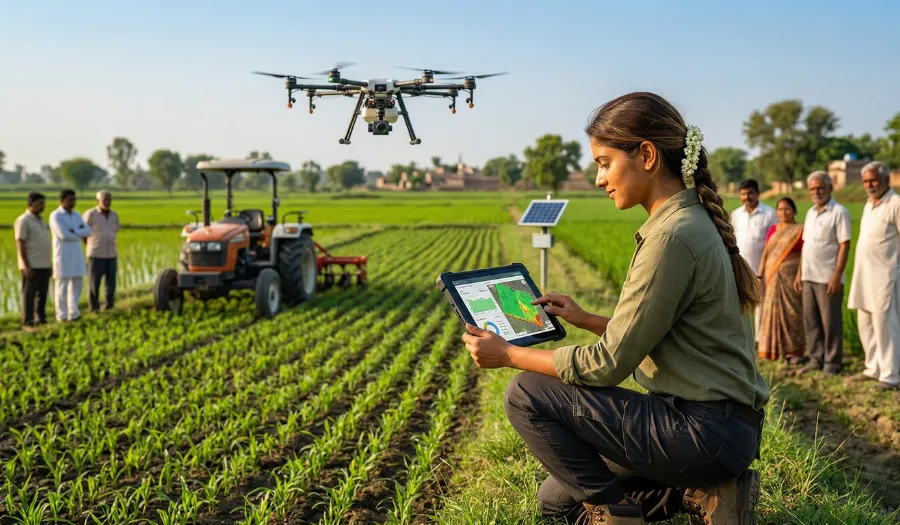
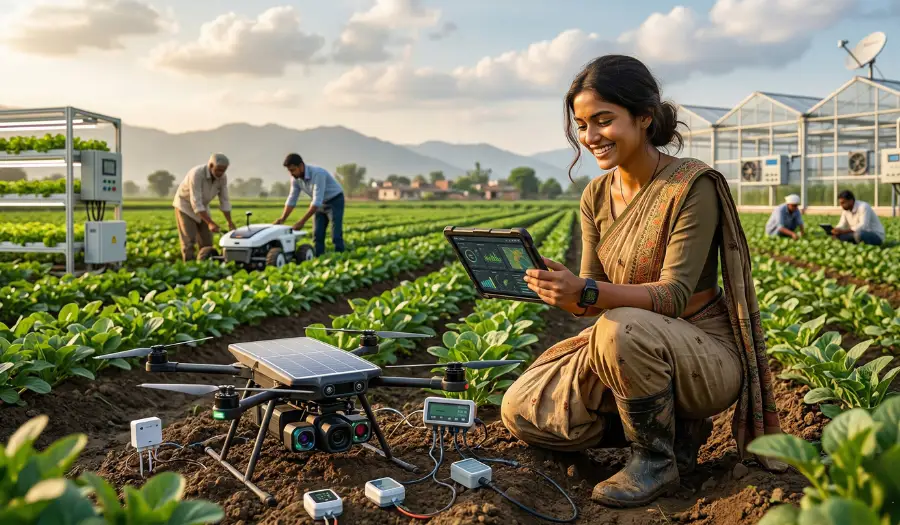
The government's Drone Shakti program is now fully operational by 2026. Drones are now more than just surveillance and into active field management.
- Automated Spraying Drone-based sprayers complete a one-acre area in under 15 minutes and have 95% efficacy, thereby protecting farmers from exposure directly to dangerous pesticides.
- The Crop Health Monitor equipped with multispectral sensors, drones create "health maps" (NDVI) which show the levels of chlorophyll, aiding farmers in identifying the signs of water stress and disease earlier.
- Seeding and Reforestation Drones are currently being utilized to "precision seeding" in difficult terrains, particularly in the states of North-Eastern.
Read also: Laser Land Leveling Technology Reducing Water Waste in Haryana Agriculture
3. Agri-Fintech and Digital Public Infrastructure
"AgriStack," also known as "AgriStack" (Digital Agriculture Mission) revolutionized the way farmers can access capital. In 2026, the digitalization of land records has opened the path for:
- Instant Credit Start-ups such as DeHaat and Arya.ag use satellite information to confirm the health of crops which allows banks to provide immediate loans with no physical collateral.
- Parametric Insurance Insurance payouts based on weather have been made fully automated. If the sensor registers rain at a level below a predetermined amount, the claim is instantly triggered via blockchain and eliminates lengthy wait periods.
- Digital traceability: "Farm-to-Fork" transparency is one of the major trends. Customers are able to scan QR codes on the back of a bag of rice or even a box of mangoes to find out exactly what farm it comes from as well as what chemicals were employed.
4. Smart Irrigation and HTP Pumps
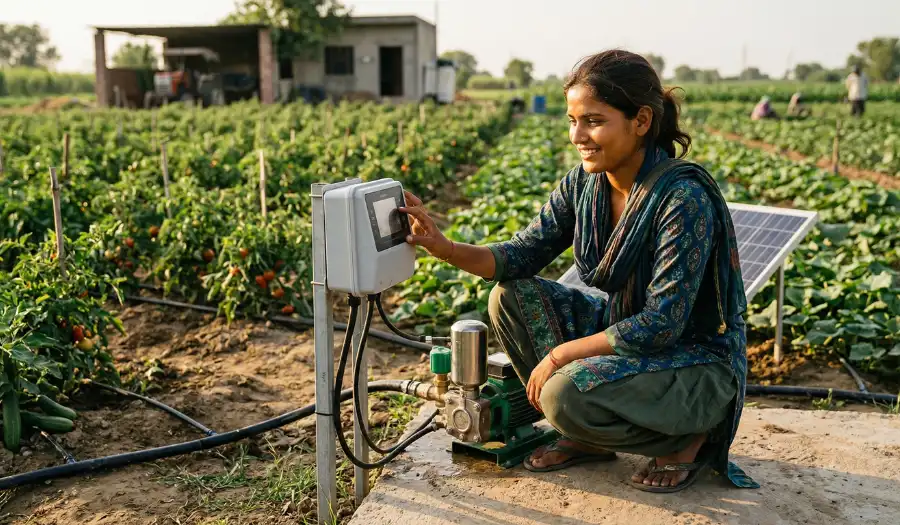
As groundwater levels decrease Water management will be one of the "make-or-break" trend of 2026.
- IoT-enabled drip Systems: Systems now make use of sensors for soil moisture to control irrigation only in the event of need.
- High-Throughput (HTP) Pumps: Modern HTP pumps have been connected to solar power and remote control modules that allow farmers to control irrigation using their mobile phones from far away.
- Solarisation of Feeders In the PM-KUSUM program thousands of pumps have been turned on to solar power giving farmers a stable, non-cost supply of electricity to use during daytime irrigation.
5. Controlled Environment Agriculture (CEA)
Vertical agriculture and hydroponics have been booming in the Tier-1 cities of India (Bengaluru, Hyderabad, and Delhi-NCR).
| Technology | Benefit | Key Crop Focus |
| Hydroponics | 90 percent less water consumption | Exotic greens, Lettuce, Herbs |
| Vertical Farming | Production year-round in urban zones | Strawberries, Microgreens |
| Polyhouses | Protection against insects and unpredictably falling rainfall | Tomatoes, Bell Peppers |
6. Sustainable and "Climate-Smart" Inputs
The world is moving to Natural Farming supported by technology.
- Bio-Stimulants Startups are creating Microbial coatings for seeds to will help them withstand extreme drought.
- Carbon farming: Large-scale farmers are currently earning "Carbon Credits" by adopting methane-reducing and no-till methods for rice cultivation, providing a new stream of income.
- Nano-Urea: The use of Nano-Urea (developed by IFFCO) has been scaled-up dramatically decreasing the physical weight of fertilizers as well as increasing effectiveness of nitrogen utilization.
7. The Proliferation of FaaS (Farming-as-a-Service)
The average landholding in India is tiny (approx. 1.08 acres) and the cost of owning costly machines is not feasible for the majority of.
- Uber-for-Tractors Digital platforms are now allowing small-scale farmers to lease the latest machines (like laser levelers for land or harvesters) per hour.
- Custom Hiring Centers (CHCs): These technology-powered hubs offer the ability to access high-tech equipment to ensure that even marginal farm can profit by the benefits of mechanization.
Comparative: Traditional and. technology-enabled agriculture (2026)
| Feature | Traditional Farming | Tech-Enabled Farming |
| Decision Making | Experience & Intuition | Data-Driven (AI/IoT) |
| Resource Use | Blanket Application | Variable Rate (Precision) |
| Market Linkage | Local Mandis (Middlemen) | E-NAM & Direct B2B Platforms |
| Labor Dependency | High | Improved by Automation |
| Yield Predictability | Low (Weather Dependent) | High (Climate-Resilient Tech) |
The Road Ahead: Challenges and Opportunities
Although the trend is promising but it is clear that the "Digital Divide" remains a issue. The lack of high-speed internet access in rural areas as well as the cost of initial purchase of IoT equipment are issues governments are addressing via subventions as well as through the Digital India mission.
Conclusion
Agriculture and agritech within India is now no longer an isolated sector, but forms the basis for the "Viksit Bharat" (Developed India) plan. The combination of Artificial Intelligence, Drone Technology as well as Fintech can enable farmers in the Indian farmer to become more sustainable, durable and productive than before. Investors and entrepreneurs alike to consider, the Indian Agritech industry--which is projected to grow to $30 to $35 billion in 2027--remains one of the highest-paying and influential sectors around the globe.