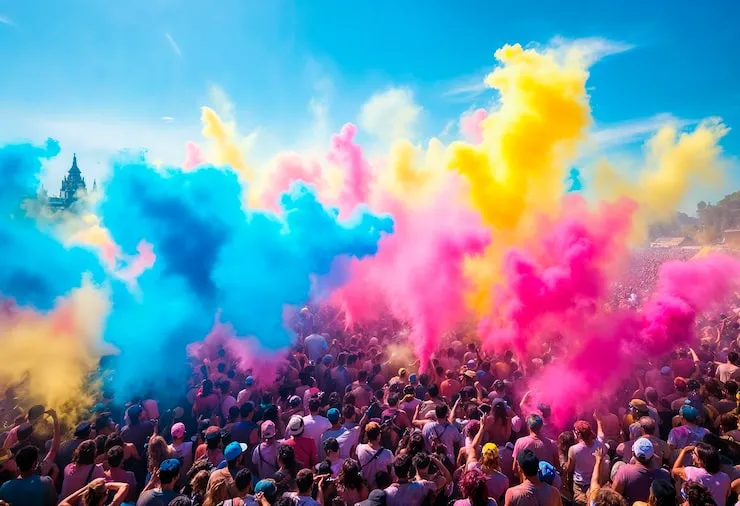
I still recall how my skin has been burning due to Holi festivities a few years ago. That itchy annoying sensation remained with me days later and that made me ask myself- why do we do the festival of colours and hurt ourselves and the planet? That was my wake-up call.
I have since entirely transformed my way of celebrating, and today I would like to share the way to celebrate an environmentally friendly Holi relying on my personal experience and study.
It is not only a trend but a duty to know how to celebrate an eco-friendly Holi. When I switched to natural colours and environmentally-friendly practices, I realised that the festival was even happier. My skin was improved, I used less water and I was even happy to realize that I was not polluting the environment.
Here, I shall take you through all the things that I have acquired, how to create natural colours in your own home, how to take care of your skin, how to arrange community events that are sustainable to our planet.
You may also read :- Best Place To Celebrate Holi In India 2026
How to Celebrate an Eco-Friendly Holi with Natural Colours
My Step-by-Step Guide to Making Natural Colours at Home
Among the most excellent choices I made was to learn how to prepare organic Holi colours at home. It is so easy, and it is now an entertaining pre-Holi game with my family. Below is my list of preferred recipes, which I utilise annually:
For Yellow Colour:
I take turmeric powder and gram flour (besan) in a 2: 1 ratio. I mix it between my palms until it is mixed even then I sieve it two or three times to achieve a fine smooth texture. Sometimes I have dried the petals of the marigold too, and crushed them up into powder--they make the most beautiful golden-yellow colour.
For Pink and Red Colours:
This is my ultimate favourite. I dry flowers of hibiscus, till they are crisp, and then grind them into fine powder. The rich red colour is beautiful. One more of my techniques is to combine lemon juice with turmeric, but the acidic lemon juice by its nature makes the turmeric red! I allow the mixture to dry in an aired room (not in direct sunlight that may bleach the mixture) and apply it as gulal.
For Green Colour:
I dry the leaves of spinach or henna and powder them to a fine. It's that simple . I occasionally add to this a small portion of rice flour to make the quantity more.
For Orange Colour:
Orange is well matched with dried marigold petals. I also apply Palash (Flame of the Forest) as it has been considered as a tradition to prepare saffron-coloured Holi water.
Where I Buy Ready-Made Organic Colours When I'm Short on Time
Frankly speaking, I would rather make colours at home, yet I can realize that not all people have time. When I have time, I search the brands that I trust and sell chemical-free gulal. I learned something really interesting last year, a self-help group in Sambalpur, the Punam SHG that uses the flowers of the temple waste to create eco-friendly colours . They place the dead flowers of the temples in a boil overnight, mingle it with arrowroot powder, and dry it up into gorgeous powders. How amazing is that? They even sold 16 kilograms of colours in an event in Jaipur.
Many event organisers use dry colours in Bengaluru which are recycled flowers that have been collected at temples and convention centres. So when you look around you can see beautiful herbal Holi colours produced by local people.
How I Save Water During Holi Celebrations
Why I Now Celebrate a Dry Holi
I was in a city where the issue of water shortage is a fact and therefore decided to observe dry Holi a few years back. I also learned that we should not spray water around and expect people to be short of water just because there are so many communities in need of water.
My water balloons and pichkaris are replaced with dry colours and flower petals. There is such fun throwing gulal and marigold petals on each other by my friends and me. It is colourful, it is happy and does not wastage of water.
If You Must Use Water, Here's What I Recommend
I perfectly realize that there are individuals who enjoy the process of playing with water. In case you simply feel obliged to make some water a part of your festivities, here is what I would recommend through experience:
- Use water sparingly. Use no more than a single bucket of water in your family. That may not sound very easy, but it is possible.
- Forget water balloons. Not only do they waste water, but they also cause plastic pollution, and they may kill humans in case they strike too severely.
- Try a 'mist rain dance' setup. The organisers of some events nowadays make use of sprinklers which conserve about 70 per cent of the water used in the traditional process in Bengaluru. It makes a cool atmosphere with no squandered resources.
How I Protect My Skin and Hair Before Playing Holi
My Pre-Holi Skincare Routine
I am in a habit of going through a simple routine before going out to play holi to ensure that my skin and hair are not harmed. This is particularly significant since even natural colours may leave your skin dried up in case you leave them too long on them.
- On my hair: I apply warm coconut oil on my scalp and on my hair. This forms a wall which does not allow colours to sink in my roots. Then I have my hair cut in a tight braid or bun.
- On my skin: I put a thick layer of moisturiser on the entire face, arms and legs. After that, I apply waterproof sunscreen over. I do not lose places such as behind my ears and in between my fingers.
- In the case of my nails: To keep my nails unstained, I paint my nails with a dark polish and I use petroleum jelly on the part of my nails that are closest to the cuticles.
What I Wear for Maximum Protection
I never fail to wear full sleeved garments and long pants to play Holi. This helps in shielding my skin against direct contact with colours in majority. I also use the sun glasses to cover my eyes against colour particles. I wear old cotton clothes that I do not mind getting dirty, and I also ensure that they are made of my comfortable materials and breathable. Cotton is superior to the artificial fabrics as it does not trap heat and is less difficult to wash.
My Approach to Mindful and Respectful Celebrations
How I Ensure Everyone Feels Safe
Holi must not be about feeling uncomfortable and pressurized. I have one simple rule I can always apply before colouring and it is to ask. I do not insist on anyone to play Holi when he/she does not wish to. There are individuals who may suffer on the skin, or individuals may just not be in the mood and that is absolutely fine.
I also ensure that the kids are watched and aged relatives are not in distress. In case an individual prefers to have a party alone, I will not intrude into their privacy.
Protecting Animals During Holi
This is so vital, and I am strongly persuaded of it. Animals have phobia towards loud sound and bright colours. Colours contain chemicals that may poison animals when licked off their fur.
I never leave my pets outside on the occasion of Holi. I shut the windows so as to minimize noise and I provide them with a quiet and safe environment. In my neighbourhood, I would like my neighbours not to use colours on stray animals. A good society is the one that is concerned about every living thing.
Being Responsible with Music and Parties
It may be that loud music is fun, but it leads to noise pollution and it will disturb neighbours. I have also begun to hold small groups of people in the form of traditional music and folk songs rather than playing the speakers on full blast. It is these emotional moments that make the Holi day so memorable and not the loudness of the party.
How I Celebrate Holika Dahan Responsibly
My Eco-Friendly Approach to the Bonfire
Another way that we can be ecologically conscious is in the Holika Dahan, the fire ritual held preceding Holi. I would ask my community to use dry wood, second hand wood or cow dung cakes instead of chopping new trees to build a fire. Even as a smaller and symbolic fire is as important as a large fire.
It decreases air pollution and conserves trees. It is a ritual of good conquest over evil-the extent of the fire does not alter that fact.
Expert Quotes and Opinions
I have contacted a few professionals to ask about their ideas regarding eco-friendly Holi celebrations, and this is what they said:
V. Ram Prasath Manohar, Chairman of Bangalore Water Supply and Sewerage Board made this appeal: "This year again, we are appealing to the people to use water judiciously and make it an eco-friendly Holi and to pledge to protect the environment, we are making the same appeal to the people" .
Varsha K. is an industrial psychologist who plays Holi regularly, and she informed me that it is a good thing to use organic colours. To some extent, it allows to minimize the damage to the environment and skin as well as retain traditions. Natural dyes have been used in many cultures since ancient times as a result of plants, minerals, and herbs, and so they are a sustainable and heritage-rich option.
Frequently Asked Questions About Eco-Friendly Holi
Q1: What is the best way to have an eco-friendly Holi that does not consume a lot of money?
Home made colours are cheaper and can be made using household items such as turmeric, gram flour and beetroot. Buy flowers of your own garden, and dress in old clothes, not new. These are little steps that incur almost no cost and bring about significant difference.
Q2: What are the instructions to make organic Holi colours at home with kids?
In the case of children, I would only use food grade ingredients. To make yellow, mix turmeric with gram flour, pink, take beetroot powder, and dry spinach leaves and make them green. They are totally harmless when taken accidentally and yet, supervision is also significant.
Q3: Natural ways of keeping hair safe during Holi colours?
Before you step out add much coconut oil or almond oil to your hair. This forms a shield that is not penetrated by colours. Pull your head back and put a scarf or cap on top of your head.
Q4: Can pets be played with during Holi?
No, it is not safe. Animals can ingest or breathe in most colours, which are noxious to them. Loud noises also stress pets. Lock them indoors to a safe place where they are not disturbed by celebrations.
Q5: How do you take off Holi colours on the skin without using chemicals?
Take gram flour (besan) and curd paste together. Put it on your skin, allow it to dry and then rub. This multicolour blend raises colour without scratching. On difficult stains put lemon juice with oil.