


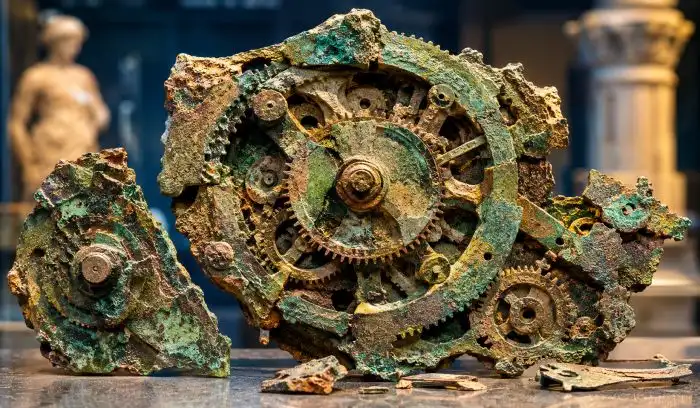
I was introduced to the idea of the archaic device I wondered what the Archimedes Sphere would have looked like and if I could see an example of such a device. And that was the end of my knowledge of archaic devices. I may have got my degree in computer science, but I had never heard about the device at the bottom of the Mediterranean.
The Antikythera Mechanism was far too curious, with more gears than I can shake a stick at! Scientists reconstructed a working model of the Mechanism from the 82 pieces and figured out what the device was used for. It is far more amazing than I think anyone would have imagined an Ancient Greek device could be!
A Cargo Ship Sinks Off Antikythera and Takes Its Secret Down with It
An ancient trading vessel filled with bronze statues, glass bowls, and wine and oil amphorae sank off the island of Antikythera sometime between 70 and 60 BCE. The authorities made the silver coins from the cargo between 76 and 67 BCE, so they can estimate its date of sinking.

Sponge Divers Duck A Storm and Stumble into A Shipwreck Instead
In 1900, a band of sponge divers (who collect bath sponges in the ocean) took shelter from a violent storm off the tiny island of Antikythera. When the storm passed, they resumed work, only to find-and accidentally loot-an ancient shipwreck.
Read More: 20 of the Most Unethical Scientific Experiments in History
The Greek Navy Shows Up to Keep Looters away from The Wreck
In a bid to keep its finds away from modern-day plunderers, authorities posted a Greek navy gunboat to watch over the site and diving expeditions collected as many gorgeous bronzes, jewelry, glassware, and furniture fittings as possible until early 1901 (the world's first major underwater archaeological expedition). The super-ironic thing? The most glamorous items were the huge bronze sculptures, but the treasure turned out to be an unprepossessing green hunk of corrosion.
A Grungy Green Lump Gets Hauled Up and Basically Ignored
For a few years, the broken green hunk of the wreck remained neglected in a storeroom at the National Archaeological Museum in Athens. Divers primarily rescued it for its greenness, a telltale indication that something bronze might be lurking underneath.
Nobody Can Agree on What This Thing Even Is
For centuries, many people realized that the device was used for, well, something. Some theorized that it functioned as an astrolabe, while others believed it to be a navigation instrument. Sadly, neither guess turned out to be right.
Albert Rehm Cracks Open The Inscriptions and Guesses Way Ahead Of His Time
Most of the time, that is. By 1905, the German philologist Albert Rehm recognized that the inscriptions referred to risings and settings of stars, 19-year and 76-year lunar cycles, and 223-month eclipse cycles. Rehm supposed - though not convincingly - that a set of concentric rings represented the five known planets with epicyclic gearing. A few decades later, that turned out to be true.
Derek De Solla Price Dedicates Two Decades of His Life to This Puzzle
The corrosion made counting the teeth on each gear a real challenge; researchers had to do some "forensic accounting." In 1974, British physicist Price published the end product of 20 years of researching the device, his paper Gears from the Greeks. Along with collaborator Charalambos and Emily Karakalos, he found 30 of the gears, spread out across four different artifacts, with most of the gears partial and corroded.

Price's X-Rays Prove the Machine Actually Calculates A 19 Year Moon Cycle
Enter physicist Derek de Solla Price. He used X-rays to discover that the planetary gearing was indeed programmed to figure out the 19-year cycle of the moon that philologist Albert Rehm had identified in the inscription, and the device functioned as a calculator, not simply as an exhibit. But Price's insights didn't fully explain how the planetary gearing functioned, even after he died in 1983.
You May Also Read: 11 Innovations That Changed History and Shaped Our World
Michael Wright "Inherits" The Puzzle When Price Passes Away In 1983
Upon Price's eventual passing, Michael Wright, curator of mechanical engineering at London's Science Museum, finally took up the task of making sense of the Machine. Wright decided to X-ray the bearings and the other objects connected to the four-spoked Main Drive Wheel, and he figured that the Wheel had once equipped an entire epicyclic gear train. Wright had a lot of experience with gear works.
Buried Inscriptions Reveal a Planet Ring Nobody Saw Coming
In 2005, scans of the artifact's interior revealed texts hidden on fragments that hadn't been read for 2,200 years. The texts uncovered the arrangement of the front display, which had the Sun on a pointer, but the planets on rings using beads as markers, arranged in the correct cosmological order, out from Earth, and not all on pointers as thought.
FAQs
1. What is the Antikythera Mechanism?
The Antikythera Mechanism is an ancient Greek device made with bronze gears. It worked like a mechanical calculator and helped track astronomical events, including lunar cycles and eclipses.
2. How old is the Antikythera Mechanism?
The device is around 2,000 years old. Experts believe it was made during the second or first century BCE.
3. Where was the Antikythera Mechanism found?
It was discovered in 1901 inside an ancient shipwreck near the Greek island of Antikythera in the Mediterranean Sea.
4. What was the Antikythera Mechanism used for?
It was used to calculate and display the movements of the Sun, Moon, and known planets. It could also predict eclipses and track important calendar cycles.
5. Why is the Antikythera Mechanism called the world's oldest computer?
It is called the world's oldest known analogue computer because its gears performed complex calculations to show astronomical patterns and predict future events.