

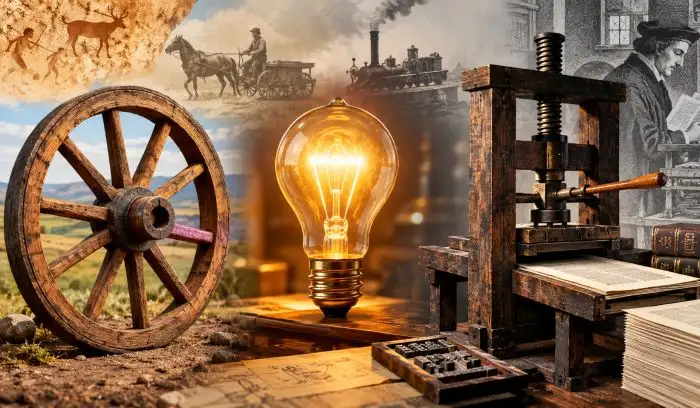
The 11 innovations that changed history have revolutionized people's lives, their work, the way they travel, and the way they communicate. These innovations have contributed to the growth and daily solutions of societies, from a wheel to modern electronic devices.
Books became more widely available thanks to the printing press, the compass was used for navigation, and the light bulb transformed how people spend their time after dark. Other inventions, including steel, magnifying lenses and transistors, have helped to create significant progress in construction, science and technology.These are important innovations to recognise and help us appreciate how man's creativity and new ideas have influenced the modern world.
Major Inventions That Changed the Course of History
These groundbreaking inventions changed how people live, work, travel, and share knowledge. From simple tools to modern technology, each innovation helped shape the world we live in today.
The Printing Press
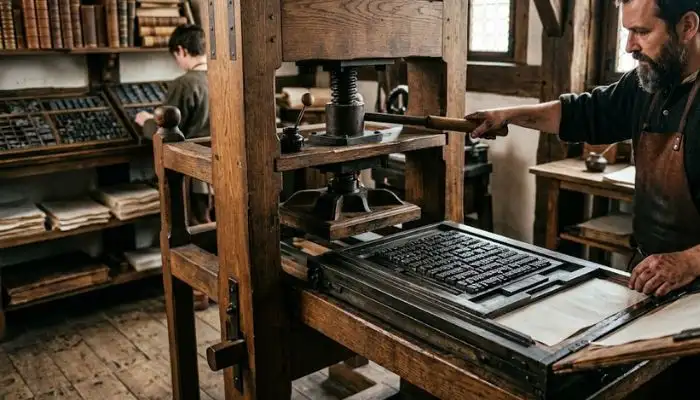
German Johannes Gutenberg invented the printing press between 1440 and 1450. The hand mold introduced a new typesetting technique that allowed quick production of mass quantities of metal movable type. Although earlier inventors from China and Korea produced metal movable type, Gutenberg was the first to mechanize ink transfer, which he made from linseed oil and soot, from movable type to paper.
This movable type process enabled printing presses to produce book copies much faster, aiding the spread of knowledge worldwide. In her book The Printing Revolution in Early Modern Europe (Cambridge University Press, 2012), historian Elizabeth L. Eisenstein noted that "printers' workshops would be found in every important municipal center by 1500."
Estimates suggest about twenty million volumes printed in western Europe by 1500, but Eisenstein argues the actual number was closer to eight million. The printing press also granted wider access to the Bible, leading to various interpretations one by Martin Luther, whose "95 Theses" gained popularity in the hundreds of thousands, sparked the Protestant Reformation.
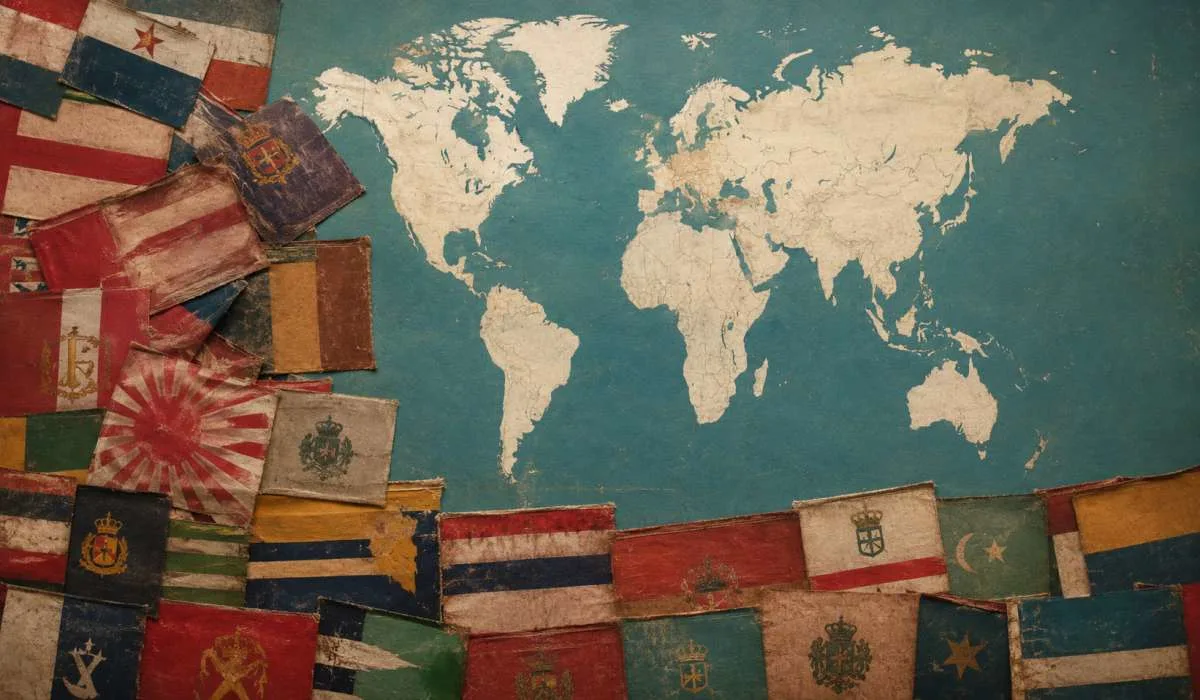
Read More: 25 Countries That Disappeared From the World Map Forever
The Compass
Sailors of old guided themselves by the stars, but they couldn't use the stars during the day or on cloudy nights. This made them vulnerable to get lost when they were far from land. The earliest specimen of compass creators in China during the Han dynasty from the 2nd Century B.C. to the 1st Century A.D. made it out of lodestone, a block of naturally-magnetized iron ore, which researchers had studied for hundreds of years; yet, navigators did not use this until the Song Dynasty (11-12th centuries). Eventually, the technology spread to the West via sea travel.
The compass allowed sailors to take to the open ocean and sail safely away from the coast, kick-starting the age of exploration and trade. A device that is still commonplace today, the compass changed our perception of and relationship to the world around us.
Light bulb
The invention of the light bulb has revolutionized the world by freeing us from the necessity of natural light. Many inventors created the light bulb during the 1800s; however, Thomas Edison is classified as the famous inventor of the light bulb as he developed the first complete lighting system in 1879, including the generator, wiring, and carbon-filament light bulb (above).
In addition to starting the process of bringing electricity into our homes across the Western world, the invention also led to somewhat of an unintended side-effect on our sleeping habits. Instead of going to bed at the end of the day because there was nothing else to do and then sleeping in chunks through the night separated by periods of wakefulness, we now work until we are ready to go to bed (except for the 7 to 8 hours we sleep and hopefully sleep through).
currency issued by the government that could not be exchanged for a specific amount of gold or silver. The switch to paper currency rescued impoverished nations and had serious implications for the future of global economics. The transition to paper money ultimately led to the advent of credit.
Steel
The early human civilizations leveraged stone, bronze, and iron but steel powered the Industrial Revolution and created the modern city. Steel tools have existed for 4,000 years, but only in the 1850s did the Bessemer Process, a system for making steel from molten pig iron, come into widespread use and ever since it has driven the largest industry in the world, creating the bridges, rails, skyscrapers, ships, and engines upon which we rely. Steel had a particularly profound impact in North America, where abundant iron ore deposits helped the US emerge as one of the world's largest economies.
Domestication of the Horse
Horses have been part of our history for 5,500 years. They helped humans roam farther, allowing the various civilizations of this world to trade ideas, tools, and technologies with each other.
Because they are such powerful animals, they could carry loads for people, as well as plow fields and level forests and the horse's greatest role was as a weapon of war; certainly nothing in the history of combat was more terrifying than the chariot or knight mounted on the back of a horse, and the cultures with the best cavalry won most engagements.
Transistors
A historically criminally underrated invention, the transistor represents one of the key ingredients that combine to make up almost every modern electronic device. Bell Laboratories created transistors in late 1947, and these semiconductor devices can control the flow and level of current within circuit boards.
Once they were used in radios, transistors have now become a fundamental element of many electronic circuit boards found within all kinds of electronic devices, including computers, cell phones, and even televisions. The amounts of transistors in integrated circuit chips double every two years in a trend identified as Moore's law, ensuring that the transistor is here to stay for the foreseeable future.
You May Also Read: Interesting Facts About Ancient Egypt
Magnifying Lenses
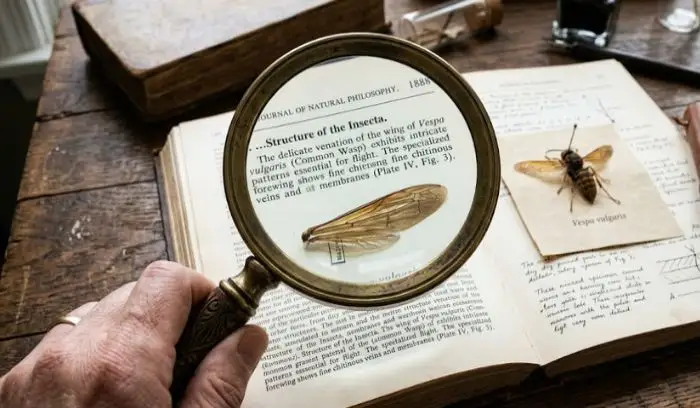
When we think of magnifying lenses, we may not feel much more excitement than we do when we describe an invention. However, scientists have revealed their various uses to mankind, showcasing everything from distant stars and the galaxies to the smallest of cells, with that sort of scale being as revolutionary a discovery as the various fields of study that utilize them.
The first lenses that people used to aid the visually impaired appeared as early as the 13th century, and innovators developed microscopes and telescopes in the late 16th century to early 17th century.
The use of microscopes by Robert Hooke and Anton van Leeuwenhoek allowed them to examine what they called 'animalcules' and other bits and pieces, while Galileo Galilei and Johannes Kepler mapped out the universe with the aid of telescopes, marking the first of many advances to come, with applications of tonight's lens of Magnifying Lenses accounting for a whole host of fields, from astronomy to surgery.
Wheel
Before that, humans faced severe constraints in moving things by land, in terms of volume and distance. The hardest part of inventing the wheel wasn't the wheel itself. Once the round drum rolled, the challenge was getting a platform on top of it that turned with the drum, says David Anthony, emeritus professor of anthropology at Hartwick College. "The breakthrough was the idea of the wheel-and-axle," Anthony said.
"But actually making it was hard, too." For instance, the holes in the centers of the wheels and the ends of the fixed axles had to be almost perfectly round and smooth. The size of the axle mattered, as did how tightly it fit in the hole—tight enough to turn but not so lose that you could turn it with your finger. They succeeded. Wheeled carts enhanced farming and trade by enabling people to transport items to and from markets and reducing the load on travelers covering long distances. Wheels are now central to life, from clocks to cars to water turbines.
FAQs
1. What are the 11 innovations that changed history?
Important innovations include the printing press, compass, light bulb, paper money, steel, horse domestication, transistors, magnifying lenses, and the wheel, along with other major breakthroughs that transformed human life.
2. Which invention had the greatest impact on human history?
The wheel, printing press, and electricity-related inventions all had a major impact. Each changed transportation, knowledge sharing, or daily life in different ways.
3. How did the printing press change the world?
The printing press made it faster and cheaper to produce books. It helped spread knowledge, supported education, and allowed new ideas to reach more people.
4. Why are historical inventions important today?
Historical inventions laid the foundation for modern transportation, communication, medicine, construction, and technology. Many tools used today developed from these early breakthroughs.
5. How do inventions shape modern society?
Inventions make everyday tasks easier, improve productivity, support scientific discoveries, and create new ways for people to connect, travel, and share information.