History books love a solo hero, usually a "Great Man" with a patent and a top hat. But look around. The glass in your hand? The safety of your car? That brown paper bag holding your lunch? Those aren't just objects; they’re the fingerprints of women who looked at a broken system and decided to fix it themselves.
These aren't "fun facts" for a slow Tuesday. They are massive, tectonic shifts in how we live. To be fair, most of us use this tech without a second thought. But here’s the kicker: we’re living in a world re-engineered by women who often had to fight just to get into the room.
Key Takeaways
- Material Science:It wasn't just "found." It was built. From Kevlar to non-reflective glass, these substances redefined modern safety.
- The Connection Bedrock:Your smartphone is a ghost without the hardware. Fiber optics and Caller ID started in a physics lab, not a software suite.
- Industrial Efficiency:We’re talking about massive profit drivers here—circular saws and flat-bottomed bags changed the math of manufacturing.
1. Stephanie Kwolek and the Polymer Pivot
- Chemistry was obsessed with finding a lighter tire fiber because, frankly, cars were getting too heavy. Stephanie Kwolek was playing with liquid crystalline solutions. Most researchers would’ve looked at her cloudy, thin mixture and dumped it down the drain. It looked like a mistake.
The Pivot: Kwolek didn't dump it. She spun it. The result was a fiber five times stronger than steel on an equal-weight basis. We know it as Kevlar.
Real-World Scenario: Think about a cop on a high-stakes call. They aren't wearing iron plates. They're wearing a fabric weave that "catches" kinetic energy. Without Kwolek’s "mistake," the word "bulletproof" would still mean "heavy as hell."
The Hot Take: Here’s the real talk: Kevlar was technically a failure. Kwolek wanted better gas mileage for your car, not a life-saving vest. The genius wasn't the goal; it was the guts to see value in a side effect.
Under-the-Hood: It’s all about inter-molecular hydrogen bonding. Most polymers are a tangled mess. Kevlar’s chains are locked in a parallel lattice. When a projectile hits, the energy doesn't just pierce; it dissipates across the whole molecular web. It’s a high-speed trampoline that refuses to snap.
2. Tabitha Babbitt: The Spinning Wheel’s Edge
The 1810 timber industry was a total nightmare. The "pit saw" required two guys—one in a literal hole (the pitman) and one above. They’d pull a jagged blade back and forth until their arms gave out. Tabitha Babbitt, a Shaker weaver, watched this and realized the motion was all wrong.
The Invention: She attached a circular blade to her spinning wheel. Simple. Brutal. Effective.
Real-World Scenario: Imagine building a house if every plank took two guys and four hours to cut. Modern construction would simply stop. Babbitt turned a linear struggle into a continuous, high-velocity rotation.
The Hot Take: Babbitt never patented it. Why? Shaker beliefs. She believed in "community wealth." Today we’d call this an "open-source" disruption. She gave the world the tool for free, and it changed the Industrial Revolution overnight.
Under-the-Hood: She solved the "Dead Stroke" problem. In a traditional saw, the blade only cuts on the "pull." The "push" is wasted motion. By moving to a rotational axis, every millisecond of movement becomes a cutting action. It didn't just make work easier; it doubled the output of every mill saw in the country.
3. Josephine Cochrane: The Debt-Driven Dishwasher
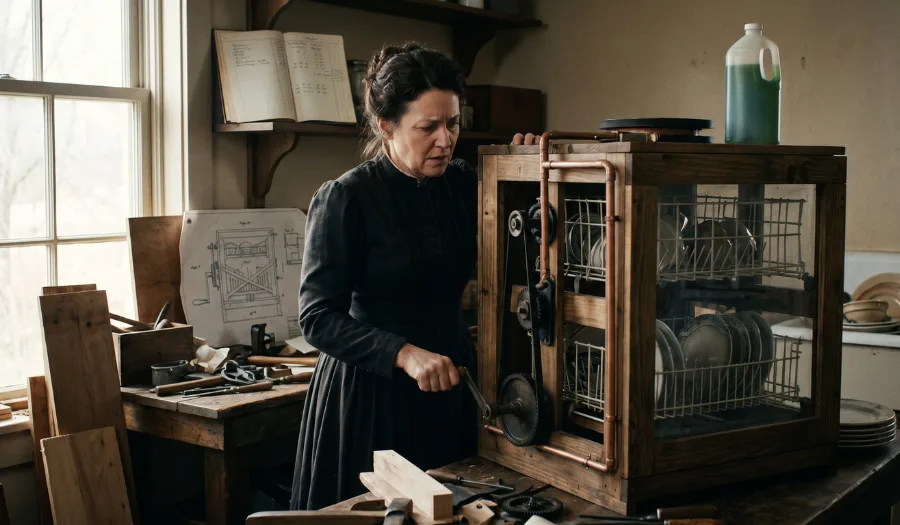
Josephine Cochrane was a socialite. She didn't "need" to work until her husband died and left her drowning in debt. But she had an annoyance: her servants kept chipping her 17th-century heirloom china during hand-washing.
The Hack: She went to her shed and built a copper boiler with wire compartments. She didn't just build a tub; she built a system.
Real-World Scenario: Walk into a busy restaurant kitchen. The high-heat sanitization that keeps you from getting food poisoning? That’s Cochrane’s direct legacy.
The Hot Take: People think the dishwasher is about being lazy. Wrong. It’s about Risk Management. Cochrane realized human hands are inconsistent and fragile. Machines are neither. She replaced human error with mechanical precision to save her porcelain—and ended up saving public health.
Under-the-Hood: Her 1886 patent was brilliant because it used hydraulic pressure instead of scrubbers. Most early attempts tried to use brushes that just got gunked up. Cochrane used a motor to squirt hot, soapy water at high velocity. That "impingement" cleaning is still the core of your KitchenAid today.
4. Dr. Shirley Ann Jackson: The Mother of Modern Connection
If you’re reading this on a phone, you owe Dr. Shirley Ann Jackson a beer. First Black woman with a PhD from MIT. She didn't just study physics; she rebuilt how we communicate.
The Breakthrough: While others were looking at the "big picture," Jackson was looking at subatomic particles in layered materials.
Real-World Scenario: You look at your phone. It says "Scam Likely." You ignore it. That’s Caller ID. Before Jackson, the phone was a black box. You picked it up and hoped for the best. Her work gave us the "social firewall."
The Hot Take: We’re obsessed with software right now. But software is just a ghost without hardware. Material Physics is the bedrock. No subatomic breakthroughs? No smartphone. Dr. Jackson is the reason "The Cloud" isn't just a metaphor.
Under-the-Hood: Her expertise was in condensed matter physics. She studied 2D systems, which allowed engineers to build semiconductors that could process multiple signals at once. That’s why you can have "Call Waiting" without the whole system crashing into a feedback loop.
5. Caresse Crosby and the Death of the Corset
1910 fashion was a literal cage. Steel-boned corsets were heavy, restrictive, and poked out of sheer gowns. Mary Phelps Jacob (Caresse Crosby) had enough.
The Invention: Two silk handkerchiefs. Some pink ribbon. A needle. Done.
Real-World Scenario: This wasn't just a "look." It was a medical pivot. Corsets moved internal organs. Crosby’s "backless brassiere" allowed for lung expansion and freedom of movement. It was the "New Woman" dress code.
The Hot Take: Fashion is often called "frivolous." That’s a massive mistake. This was an ergonomic revolution. She shifted the load-bearing weight of clothing from the soft waist to the structural frame of the shoulders.
Under-the-Hood: It used tension-based support instead of structural compression. By using handkerchiefs as "cups," she created a flexible pivot point. The fabric moved with the body instead of forcing the body to conform to a metal skeleton.
6. Katharine Blodgett: The Woman Who Deleted Glare
First woman to get a Physics PhD from Cambridge. She joined GE and solved a problem that had plagued optics for centuries: glare.
The Fix: A coating that was exactly one-quarter the wavelength of light.
Real-World Scenario: Look at your laptop. Or your glasses. Don't see a perfect reflection of your own face? Thank Blodgett.
The Hot Take: This is the ultimate "Science for Survival" story. Her non-reflective coatings were vital for submarine periscopes in WWII. If a periscope reflected a glint of sun, the sub was dead. Her "invisible glass" kept sailors alive by making them effectively invisible.
Under-the-Hood: She developed Langmuir-Blodgett films. She’d deposit a single layer of fatty acid on water, then "dip" the glass. Each dip was one molecule thick. 44 dips later? You have destructive interference that "cancels" reflections.
7. Mary Anderson: Solving the "Blind Drive"
NYC, 1903. Sleet is everywhere. Mary Anderson watches a trolley driver lean out of his window just to see. He has to stop, get out, and wipe the glass. It was absurd.
The Invention: A swinging arm with a rubber blade, operated by a lever inside the car.
Real-World Scenario: Driving in a storm without wipers is a death sentence. Her invention is one of the only car parts that hasn't changed its basic mechanical logic in 120 years.
The Hot Take: Automobile companies initially rejected her. They claimed the arm would "distract the driver." They thought seeing the road was a distraction. It took 20 years for the industry to realize safety was a selling point.
Under-the-Hood: The genius was the counterweight. She designed a specific tension spring to keep the rubber flush against the glass at high speeds. If the blade lifts, it streaks. She mastered the contact-pressure ratio before most people even had a driver's license.
8. Bette Nesmith Graham: The Blender Empire
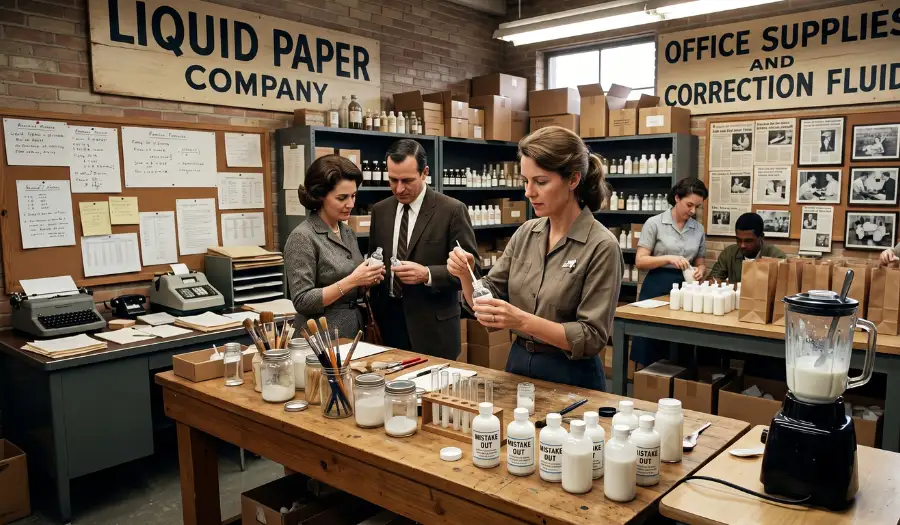
Bette was a single mom and a secretary in the 50s. Electric typewriters were fast but unforgiving. One typo and the page was ruined.
The Hack: She saw window painters cover mistakes instead of erasing them. She went home, grabbed her kitchen blender, and mixed tempera paint to match her stationery.
Real-World Scenario: Before "Ctrl+Z," there was Liquid Paper. It saved millions of hours of re-typing. IBM turned her down, so she built her own empire and sold it for $47 million.
The Hot Take: We love "garage startups." Bette was the original. She didn't have a lab; she had a blender and a fundamental understanding of workflow bottlenecks.
Under-the-Hood: The secret was the solvent-to-pigment ratio. It had to be opaque but dry almost instantly. If it stayed wet, the typewriter carriage would smear it. It was a masterclass in viscosity engineering.
9. Margaret Knight: The "Lady Edison" vs. The Thieves
Ever carry a paper bag that didn't explode? Thank Margaret Knight. Before 1868, paper bags were just flat envelopes. Useless for groceries.
The Machine: She invented a machine that cut, folded, and glued flat-bottomed bags.
The Drama: A guy named Charles Annan tried to steal her patent. His defense? A woman couldn't understand "mechanical complexities." Knight walked into court with her blueprints and technical notes and absolutely crushed him.
The Hot Take: This wasn't just about a bag. It was a legal precedent. She defended the intellectual property of women in a room full of men who didn't think she belonged there.
Under-the-Hood: It used a rotary folding mechanism. Timing is everything here: the paper moves fast, a mechanical "finger" tucks the bottom, and a glue applicator fires at the exact millisecond. It’s a high-speed ballet of synchronized gears.
10. Maria Beasley: The Life Raft’s Architect
Late 1800s sea travel was a gamble. Lifeboats were basically just wooden planks. Maria Beasley decided "good enough" was a death sentence.
The Invention: A fireproof, compact life raft with guardrails.
Real-World Scenario: Every orange, self-inflating raft you see on a cruise ship is an evolution of Beasley’s logic. She turned "improvised survival" into a mechanical standard.
The Hot Take: Beasley was a serial inventor (she also revamped barrel-making). People ask: How does a barrel-maker invent a life raft? Easy: Structural Integrity. If you can make a barrel airtight, you can make a boat stay afloat in a storm.
Under-the-Hood: The core was the collapsible metal railing. It allowed for "high-density storage" (stacking) while ensuring passengers wouldn't be washed overboard. She used a hinge-lock system for maximum rigidity with minimum weight.
11. Jeanne Villepreux-Power: The Glass Wall
Before 1832, if you wanted to study a fish, you had to kill it. You were studying a corpse. Jeanne Villepreux-Power changed that by inventing the glass aquarium.
The Breakthrough: She used her "laboratory" to prove that the Argonauta argo octopus grows its own shell.
Real-World Scenario: Every marine lab on Earth relies on her concept of the Controlled Ecosystem. She moved biology from the "morgue" to the "living room."
The Hot Take: Most of her research was lost in an 1843 shipwreck. Imagine your entire life's work being wiped by the literal ocean. It took 150 years for her to get credit. Data redundancy matters, folks.
Under-the-Hood: She designed three versions: an indoor tank, a semi-submerged cage, and a submersible cage for deep-water study. She basically created the first remotely operated observation deck.
FAQ: The Quick Dirty on Women Inventors
Q: Why was the windshield wiper rejected at first?
A: Short-sightedness. "Experts" thought the moving arm would hypnotize drivers. They were terrified of a "disruptive" safety feature.
Q: Did Stephanie Kwolek get rich from Kevlar?
A: No. She signed the patent over to DuPont. She got the satisfaction of saving lives, but she didn't see the billions in revenue.
Q: What is "Invisible Glass"?
A: It’s non-reflective. Using Blodgett’s layering technique, light passes through the glass instead of bouncing back at you. Essential for cameras and periscopes.
Q: How did Margaret Knight win her case?
A: She brought the "receipts." Blueprints, diary entries, wooden models. She out-engineered the guy in open court.